So, do I need to be watching this show? If so, why?

(And don’t forget to Ask Me Anything!)


The official site of Kelly Sedinger: Reader, writer, photographer, and dreamer
So, do I need to be watching this show? If so, why?
(And don’t forget to Ask Me Anything!)
So, the tough part of getting Princesses In SPACE!!! published continues: I’ve been querying agents, and have yet to hear any responses yet, either yay or nay. So we’ll see. This is long-form nerve-wracking, folks. It’s like fishing, only instead of fish, I’m trying to catch an agent. And instead of a worm, at the end of the hook is my freaking life. Ayup. But all I can do is keep sending out the queries, one by one by one!
As for other projects, I haven’t been doing any writing of late, and it’s time to stop being such a doofus about that. My NaNoWriMo project, Deliverance, eh? (not the actual title), is still unfinished, so that’s what I’ll be getting back to first. After that? Either a return to Lighthouse Boy (not the actual title), or Princesses Still In SPACE!!! (also not the actual title).
What it all boils down to, I suppose, is that I dream of being able to refer to any of these projects by their actual titles. One day, oh yes, one day….

Ask Me Anything!!!
Oddities and Awesome abound! They never stop. Nosiree Bob, never at all.
:: John Scalzi has come up with a creative response to a bizarre nitwit who has developed an even more bizarre fixation upon him. I find the whole thing really funny (and will likely kick a few shekels in myself at some point).
:: Is your cat really a dog? I can relate to a few of these!
:: OK, a little set-up for this. Back in the 1990s and early 2000s, there was a cable teevee channel in Upstate New York called the Empire Sports Network. This channel was devoted to, well, sports stuff pertaining to Upstate teams and interests, such as Buffalo Sabres games, Syracuse University sports, and the like. They also did a lot of locally-produced teevee shows featuring commentary on the Buffalo Bills, often featuring players and coaches themselves (this was when the Bills were actually good). One such figure was head coach Marv Levy, who actually had his own show on the network.
Well, one week, apparently Coach Levy promised his squad that if they beat the Miami Dolphins, he would write — and sing — a fight song for the Bills on his teevee show. They did just that, and…well, if you were a Bills fan in the 90s, you remember this. Maybe fondly. More likely…not so much.
More next week!
Seeing as how I devoted yesterday’s Something for Thursday post to The Sea Hawk, my favorite Errol Flynn movie, I figured, why not use it in this feature too?

The Sea Hawk tells the story of a rogue English sea captain, Geoffrey Thorpe, who is commanding his ship and preying on Spanish vessels right around the time the Spaniards are building their Armada for their final reckoning against England. Thorpe becomes involved in the various politics involved in convincing Queen Elizabeth I that the Spanish threat is very real and that she must arm her nation and prepare for inevitable war, while Spain tries to convince her that they mean no real threat at all. And by “becomes involved”, of course I mean, “has adventures that involve piracy and swordplay and falls in love with a girl”. The girl is Dona Maria, played by the beautiful Brenda Marshall (who seems to get a short shrift, in my view, by virtue of her simply not being Olivia de Havilland). The romance between Thorpe and Dona Maria is pretty typical adventure story romance: charming rogue is at first rebuffed by the woman who finds him disreputable, but gradually wins her over as she discovers that there are depths to him that she hadn’t realized at first.
They meet in the early scenes when Dona Maria is on her way to England, and her ship is attacked by none other than Captain Thorpe. He doesn’t so much take her prisoner as escort her family aboard his ship for safe transit the rest of the way, but he does seem happy to steal her personal jewelry. After the Spanish ship sinks, they’re all en route back to England, and Dona Maria is looking out the balcony on the Captain’s quarters. Meanwhile, Captain Thorpe is on deck, aware of her presence below, and eventually works up the courage to talk to her. But again she rebuffs him, making clear that she does not wish to socialize with a criminal.
Dona Maria: I’m not in the habit of conversing with thieves. I thought I made that quite clear, Captain Thorpe.
Capt. Geoffrey Thorpe: Why, yes, all except your definition. Tell me, is a thief an Englishman who steals?
Dona Maria: It’s anybody who steals… whether it’s piracy or robbing women.
Capt. Geoffrey Thorpe: Oh, I see. I’ve been admiring some of the jewels we found in your chest… particularly the wrought gold. It’s Aztec, isn’t it? I wonder just how those Indians were persuaded to part with it.
Of course, that doesn’t go over well at all, and she turns and disappears inside — to discover, on the table, the chest containing her jewelry, with a note reading — in wonderfully ornate penmanship — “Only a pirate would deprive you of these jewels.”
Later on, after a reception with the Queen (during which it’s clear that Dona Maria’s impression of Thorpe is warming), Thorpe plans a new expedition, a particularly dangerous journey to the New World where he plans to attack the year’s gold shipment to Spain. Before he departs, he visits Dona Maria in an English rose garden, a lovely scene that concludes with Captain Thorpe leaving her with this:
Capt. Geoffrey Thorpe: Dona Maria, in a convent in Peru there is a statue that the sisters there call Nuestra Senora de las floras. That’s how I shall always think of you, as ‘My Lady of the Roses’.
Yeah, he’s smooth. Why wouldn’t he be, though? He’s Errol Flynn, the first of all Shatners.
Oops…a tad late to the party, but hey, it’s still Thursday! So here’s some swashbuckling movie music. I’ve waxed poetic about Erich Wolfgang Korngold in this space before, and specifically about my favorite Errol Flynn movie of all time (and my favorite pirate movie of all time, too), The Sea Hawk. For years, the only version of the music that I was able to find was this fifteen-minute suite, presented on a compilation disc of Korngold music conducted by Charles Gerhardt. During the 1970s and 80s, when movie music tended to be pretty hard to find — especially recordings of older, classic scores — Gerhardt’s re-recordings were often the only thing available, and what a good thing, too, as Gerhardt tended to do wonderful things with these scores. This suite from The Sea Hawk is no exception. It’s in two parts due to length, but the break is in a very logical spot, coming after a triumphant spot where the suite goes silent before playing the film’s magnificent love theme. Keep an ear out for the thrilling “Strike for the Shores of Dover”, which comes during the movie’s most exciting segment, after Captain Geoffrey Thorpe (Flynn) and friends have freed themselves from the chains and oars of a Spanish galleon. Enjoy!
Annotations:
0:00: Main theme, intro at the court of King Philip of Spain
2:06: First sighting of the Albatross, Captain Thorpe’s ship
3:11: Entry of the Sea Hawks (captains of privateer ships) into the court of Queen Elizabeth I of England
4:15: Captain Thorpe bids farewell to Dona Maria before setting sail again
4:49: Captain Thorpe’s enemies plan a trap
5:18: The march of the gold caravan through the jungle of Panama
7:35: Duel with the Spanish captain / Duel with Lord Wolfingham
9:15: The freed English sailors take the Spanish ship
9:52: “Strike for the Shores of Dover!” and conclusion
Roger wrote an interesting post the other day about the process by which he and his wife arrived at their daughter’s name (“Lydia”, which is, by the way, a perfectly lovely name). A taste:
*No naming after any family member, living or dead. I want her to have her own identity. And I didn’t want, “Oh, you named her after Aunt Hortense!” We’ll call her Little Horty!” No, you won’t.
Actually, I would have considered Charlotte, after my great aunt Charlotte, who had died a couple years earlier, truth to tell. And my mother was living in Charlotte, NC; we referred to her, my late father, my baby sister and her daughter as the Charlotte Greens. But The Wife wanted to consider Ann, which is her middle name and her mother’s first name; so I nixed both names.
*No unisex names: Terry, Madison, Lynn, e.g.
This comes directly from the fact that my father AND my sister were both named Leslie. Confusion ensued, and often at my expense. Since my father had a child named Leslie, it was ASSUMED it was his ONLY son, i.e., me. “Hey, little Les,” one guy from church constantly called me. “That’s NOT my name,” I’d mutter under my breath (but never aloud, for that would have been considered rude.)
*It had to have two or more syllables, to balance off the shortness of Green.
That was my other objection to Ann.
This got me to thinking about our own process when The Daughter was born. Basically, we just kind of called out names until we arrived at a first name that we both liked (The Wife liked it more than I did, but I still liked it), and then I basically got to choose the middle name. When it got to be Little Quinn’s turn to be named, we decided to use one of the names we had rejected for The Daughter, plus a middle name that The Wife liked. And later on, we had a lovely name chosen (Fiona) for the girl who was, alas, born too early to live. About the only ‘rule’ we employed, and we didn’t even arrive at this until we were trying for Quinn, that we wanted a five-letter name, since we all have five-letter names. Silly, maybe, but hey — we look for connections, don’t we?
So, folks, what went into your naming processes, whether for kids or cats or goldfish?
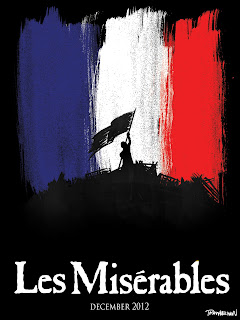

It all comes back to Star Wars, doesn’t it? Even Les Miserables.
What am I talking about? Well, back when The Phantom Menace came out, and initial reaction was somewhat mixed (before ossifying into outright hatred), I remember an article on some site – I think it was AICN – in which the writer said something I found fascinating. Paraphrasing, it went roughly like this:
I’ve made Episode I in my head many, many times since 1983. Now I’ve had to see the real thing twice, once just to get the one I’ve been making in my head for sixteen years out of the way so I can come to grips with the real one that George Lucas made.
I understood the sentiment, but I never made Episode I in my head – or any other Star Wars movie, for that matter. (What I did, in fanfic, was remake the original trilogy entirely, but that’s a tale for another time.) But the movie I have made in my head many, many times over the better part of two decades?
Les Miserables.
And I mean, I’ve made that movie in my head. All the way down to various visuals. Bear with me here a moment. I’ve seen the film tied together around a single location: a bridge over the Seine. We’d first see that bridge when Jean Valjean is conflicted over his release after he stole the silver. We’d see it again when Fantine sings “I Dreamed a Dream”. And again when Javert sings “Stars”, and again when Eponine sings “On My Own”. And at the end of the film, the entire cast would gather on that bridge, after Valjean’s passing. The bridge would be a visual motif tying the entire thing together.
(I know, this would require a bit of license, given that much of the first half of the story doesn’t take place in Paris. Like I said, bear with me.)
I don’t know why I’ve so vividly imagined Les Mis in my head over the years, because I very rarely do that with music. I’m never one to visualize certain scenes or mental images when listening to music, even if the composer intends me to do so, as is often the case with Berlioz. I generally belief, along with Leonard Bernstein, that music is inherently abstract, and that a composer can call his piece “The River” all he wants, but that doesn’t make the piece an actual depiction of a river. This was driven home once in grade school when a music teacher handed everyone a sheet of paper and some crayons and played a piece of music, telling us to draw what we heard in the music. Not one of us drew what the composer said was in the music.
So why did I have such strong visualizations of Les Mis? I have no idea, and I must answer blandly with something along the lines of “I am large; I contain multitudes.” But anyway, now along comes the real movie version of Les Mis. No, it doesn’t match up to my visualizations at all, and there were times when I thought, “No, that’s not the way it’s supposed to look!” But those moments were few and far between, and there were moments when it looked right to me, anyway.
Ultimately, Les Mis the movie seems to be fairly polarizing. I’ve heard basically two categories of responses to this film: “Oh my God thank the Lord that’s over and I never hafta watch it again”, and “Oh my God that movie was a religious experience I can’t wait to watch it again”. And the reactions, at least in my small and not-randomized sample, doesn’t seem to directly correlate in any real way with people who never saw the stage show and people who have.
So what did I think? Well…my reaction isn’t entirely positive, but it’s a lot closer to the latter reaction than the former. I did love the film, but not unreservedly. And my reservations aren’t entirely because the film doesn’t map out exactly with what I made in my head.
Story-wise, the Les Mis film is pretty much exactly the stage show that I saw last year. A few songs have been shortened or altered slightly, but in general, there’s nothing significant missing from the film that happened in the show. Thus, any difficulties in the story are inherent in the show itself, and in its nature: the show distills an immense novel down to a single night’s entertainment, and it does it mostly with music. (I’m reading the novel right now, as it happens. I’m taking my sweet time with it, doling it out to myself at a rate of about 10-15 pages a day. At that rate, I should be able to get through it in about three months. I’ve been at it for a few weeks already.)
From a story standpoint, then, the main problem is the same as the show’s: not enough backstory can be established, particularly in the second half, once our young revolutionaries show up. It’s hard to feel any particularly great emotional involvement in that particular storyline, because the film just can’t go into any great depth about what these students are fighting for and what the source of the revolutionary fervor happens to be. Now, I’m not even close to that point in the book yet, so I can’t be sure if Victor Hugo suffers the same problem, but on the basis of what I’ve read thus far, I rather doubt it. Hugo’s problem seems to be that he never met a chunk of backstory he didn’t love and go on about at length. Not the problem in the movie.
So, that being the case, what are we to make of that whole part of the film and the stage play? The idea seems to be to take Jean Valjean and Javert and put their respective moral centers in the middle of yet another set of moral choices, that of revolution. This can get a bit lost in the shuffle as the melodrama, wonderfully musical as it is, cranks on and on. But again, short of reworking the entire show, I’m not sure how the filmmakers could have really solved the structural problem of the story’s second half. I do think that the film makes two musical choices that don’t help matters, though.
First is a simple one: the wonderful song “Drink With Me” is greatly shortened in the movie. In the show, it’s a gorgeous song of men’s chorus, the young revolutionaries, singing sadly during the night after their first clash with the Paris military. The die is cast, and now they know that it’s for real: at this point real prices have been paid, and the song in its complete version plays as a serene acceptance that no matter what happens now, these young men will never again be simple lads wiling away the time with wine and women. There’s a fatalism to the complete song that’s sadly absent here as the movie only gives us one or two verses.
Second is more problematic. I think I know why Tom Hooper and the producers did it, but it still seems to me a pretty big error. In the film, we don’t hear the show’s singular anthem, “Do You Hear the People Sing”, until after what is the huge show-stopping number in the stage show, “One Day More”. And “One Day More” can be emotionally overwhelming – just listen to it (starting at 1:15) in the famed tenth anniversary concert performance of the show’s score. The problem? For one thing, “Do You Hear…” is what really establishes the revolutionaries in the story, even moreso than “Red and Black” (which immediately precedes “Do You Hear…” in the show). It’s the type of stirring melody that we haven’t heard to that point in the show, and when it comes, it really signifies that something’s coming, that as they say these days, shit’s about to go down. “Do You Hear…” conveys a sense of inevitability to what’s about to transpire, and the tune overhangs everything afterwards.
But in the movie, “Do You Hear…” is moved to after “One Day More”, which I found extremely jarring, because “One Day More” derives much of its astonishing effect from being a literal reprise of just about all the melodies of the entire first half of the show. “Who Am I?”, “I Dreamed a Dream”, “Master of the House”, and “Do You Hear…” – they’re all there, contained within “One Day More”. But in the film, you haven’t heard “Do You Hear…” yet. Instead, you hear it immediately afterwards, when the revolutionaries crash the funeral of the General. What the show does right after “One Day More” is more subtle, because in the show, the next thing we hear is Eponine and “On My Own”. Both acts feature, very early on, a woman singing of heartbreak and unrequited love – Fantine in Act I, and Eponine in Act II. The film messes with the structure a bit, and it doesn’t entirely work.
Neither, it pains me to say, do some of the film’s visual choices. Tom Hooper seems to have set out to make a movie of beautiful squalor, or squalorous beauty, or something like that. There’s a disjointed sense to the film’s visual approach that I found hard to put my finger on, until late in the film, when Valjean carries Marius through the sewers. When they emerge, they are covered literally head to toe with the filth of those sewers, and it was hard for me not to think, “My God, was that really necessary?” And there it was: there are times when it’s clear that Hooper is trying for beautiful effects, because he gets them when he wants to. But then there are other times when he feels the need to dial up the visual ugliness, with washed-out colors, with lingering shots on corpses, with Valjean and Marius completely encased in more shit than Andy Dufresne did, for basically doing the same thing.
I’m of similarly mixed mind on Anne Hathaway’s Fantine. Not because of anything she did, because I think she was basically amazing throughout. But even so, as gut-wrenching as her “I Dreamed a Dream” is, I can’t help wondering how necessary that was – the single take, the broken sobbing, the rest of it. Again, the concert performance of the show is key, because there, they can’t do a lot of stage trickery, so they just let the song speak for itself. For my money, Ruthie Henshall sells Fantine’s soul-crushing heartbreak every bit as well as Hathaway did. But here, I’m quibbling with a stylistic choice, and not so much with the song in question, but with an overall approach of ratcheting up the ugliness at times, which seemed rather unnecessary. Again, I’m not done with the book, but it seems to me that a theme of Les Miserables is the presence of beauty in the world that many can never touch or know.
All this sounds like I’m ripping the movie, but I don’t think I am. There’s much to love in it, because I really did enjoy it immensely, and I’ll be thankful to have it in my DVD collection for when I need a fix. For one thing, aside from the few musical alterations I mention (and the omission of Eponine from Valjean’s death scene, which struck me as quite wrong), the songs are for the most part given room to be the songs they are. That’s important, because in a movie like this, the music is what’s prime – nothing works if the music doesn’t work. And it does.
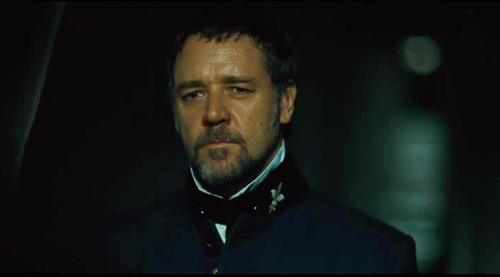
I had zero misgivings about the cast. Like many Les Mis lovers, the casting of Russell Crowe as Javert struck me as potentially problematic, not because of his appearance, but because he simply isn’t blessed with a great musical voice. And when your mental template for Javert is the great Philip Quast, well…yeah, good luck there, Russell. But Crowe did very well, I think, precisely because he doesn’t have a great voice. This makes sense to me because Javert is a man of virtually no happy touches in his life, no vices, no room to enjoy anything whatsoever. I have no trouble at all with the fact that his singing is distinctively unmusical, because Javert’s singing stands at odds with his role in the story, doesn’t it? Plus, Crowe’s singing voice plays in well with the way he plays Javert in the first place: his Javert is a man of weariness, a man who has seized on his obsession with upholding the law as the only way he can make sense of a world in which no matter how righteously he pursues his obsessions, he can never make the world into ‘paradise’. Humans have fallen too far, and Javert knows it – but he can’t ever say it. Crowe captures this internal strife of Javert’s perfectly: there is always a hint of tired confusion lurking in his eyes, and we know, almost immediately upon meeting him, that suicide is likely the only way he’ll ever reconcile the world with his place in it.
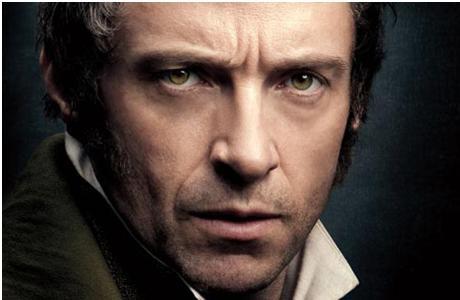
Hugh Jackman’s Valjean is likewise brilliant, and the film would fail utterly without him. I don’t think that the production decision to sing live on stage always served Jackman’s voice to the highest degree, but that is, again, a quibble. Jackman captures Valjean’s internal goodness as perfectly as Crowe captures Javert’s inability to live in the real world, and I loved Jackman’s voice. His Valjean is more of a tenor than usual, but that’s no matter. He completely convinces me of Valjean’s pain, of his moral certitude once he is set on the right course by a compassionate priest, and of the seriousness with which he holds the vow he made to Fantine on the night she died. Best of all, Jackman’s Valjean always seems to be thinking. He’s not just going through the motions of always doing what is moral; Jackman shows us that Valjean has to work at it, even if the music and script don’t always make that internal struggle entirely clear. (Victor Hugo spends entire chapters describing Valjean thinking about his moral choices.)
In all honesty, I can’t think of a wrong note in the cast. Amanda Seyfried’s Cosette is…well, she’s just kind of there, but I don’t think that Seyfried can possibly be blamed for that, as Cosette is just…well, there’s not much there there, with Cosette. She’s easily the weakest link in the stage show, dramatically speaking, and the film can’t really solve that difficulty, either. Cosette is just there to be loved, either protectively (Valjean), or unattainably (Fantine), or romantically (Marius). Eponine is far better drawn as a character in her short time on stage, but she’d better be, because her story is the tragic one.
Sacha Baron Cohen and Helena Bonham Carter as the Thenardiers? That was, for me, utterly perfect casting. Of all the numbers in the film, “Master of the House” is closest to that movie I’ve made in my mind over the years – my “Castle in the Clouds”, so to speak. The Thenardiers are disgusting individuals, the ones who steal the coins from the dead man’s eyes, so to speak. And the way they keep popping up is disconcerting, as if the very world is constantly trying to drag back down those who would rise above it. Which, when you think about it, is really true, isn’t it?
The best person in the cast is very likely Samantha Barks as Eponine, who makes the absolute most of the relatively short time she’s around. Her emotions are raw and we feel them with her, and Barks does something wonderful in the way she allows Eponine’s love for Marius to show only when he’s not looking (until the very end). It’s kind of a shame that Anne Hathaway’s “I Dreamed a Dream” seems to be shaping up as the film’s musical highlight, because Barks’s “On My Own” is amazing. But then, it’s Eponine’s constant fate, isn’t it, to stay in the shadows of someone else?

So no, Les Miserables is not a perfect movie. And it won’t win over anyone who didn’t like the stage show. Nor, I think, will anyone who sees this movie, wonders what the fuss is, and then goes to the stage show find that experience terribly more satisfying. This isn’t my Les Mis, but it is Les Mis. Warts and all, maybe more warts than I would have liked.
Put it this way: After writing this review, all I can think is…I want to go see it again. As soon as humanly possible. “One more day…another day, another destiny….”

The official site of Kelly Sedinger: Reader, writer, photographer, and dreamer


