Screws fall out all the time, the world’s an imperfect place

Thumbing through the new nonfiction books at the Library two weeks ago, I happened upon an interesting looking volume called You Couldn’t Ignore Me if You Tried: The Brat Pack, John Hughes, and Their Impact on a Generation, by Susannah Gora. The cover art features caricatures of characters from the iconic teen movies of the 1980s: John Bender, Lloyd Dobler, Ferris Bueller, and others from Pretty in Pink, St. Elmo’s Fire, Sixteen Candles, and Some Kind of Wonderful.

The “Brat Pack” movies are often said to have “defined a generation”, whatever that means. I’ve never entirely understood that. I wasn’t terribly interested in those kinds of films when I was a teen; I saw The Breakfast Club via a video rental after a teacher, of all people, waxed poetic about it in class one day. (With good reason, I came to see.) Of the films discussed at length in the book, the only one I saw in its first run in a theater was Say Anything, which truly did rock my world — I thought it was a brilliant movie from the first five minutes, and I’ve never stopped loving it. But I didn’t see St. Elmo’s Fire until I watched an edited version on TBS while in college, and I don’t recall ever seeing Pretty in Pink, Sixteen Candles, or Some Kind of Wonderful. I never had a crush on Molly Ringwald. Ally Sheedy, sure. But Molly? Not so much.

(In fact, one of the earliest actual rants I remember posting on this blog came when the American Film Institute did one of their 100 Years, 100 Movies specials, focusing on movie romances…and omitted Say Anything, which I hold to be not just one of the great movie romances, but the greatest teen romance ever. Funny thing about Say Anything, though: when it came out in 1989, I was feeling a bit of teen angst because I was about to graduate high school, my future felt uncertain, and I had just failed in my first real attempt to date a girl. I felt like seeing a movie, so I saw Say Anything. Which is about a guy graduating high school, feels uncertain about his future, and is in love for the first time in his life. Oy!)

Part of this is probably fairly obvious to regular readers; my filmgoing interests back then tended to be a lot more geeky in nature.

The book fills several roles: a chronicle of a certain period and group of people in Hollywood, a behind-the-scenes chronicle of the making of their films, and an examination of their cultural impact. It’s a very entertaining and informative read, especially in its overall profile of writer-director John Hughes, who comes off as a very complex man, often fiercely loyal but also extremely difficult to please. One thing I always look for in a book about movies is that it makes me want to see the movies discussed, especially the ones I’ve never seen before.

I found the inside stories of the movies the most interesting, as I usually do with things like this. I kind of skimmed through the chapter about the New York Magazine article that coined the term “Brat Pack” and, in many ways, doomed the careers of the actors within it; what interested me was the making of the films themselves. The way the set decorators had to literally paint trees green because Ferris Bueller’s Day Off takes place in spring and yet was filmed in fall; the fact that Cameron Crowe came this close to not getting to use “In Your Eyes” in Say Anything; the way the entire ending of Pretty in Pink was reshot, to Jon Cryer’s chagrin, after the original ending tested horribly.

My favorite of these stories involves what is actually my least favorite scene in The Breakfast Club, the bit toward the end when Claire decides that Allison needs a new look:

When it came time for the cast to film a now infamous scene in which Claire gives Allison a makeover, Sheedy wasn’t too thrilled. In the first version of the scene, Claire puts a lot of makeup on Allison, “like putting a lot of stuff on her is making it all better,” says Sheedy. Uncomfortable with this hypocrisy, Sheedy took the matter in hand. She suggested a small change that made a big difference, at least to her, and to any viewers paying close attention. “I asked John [Hughes], ‘Can we make it more that they are taking this shell off of her?’ ” says Sheedy. Hughes saw the logic in her suggestion, and so the resulting scene features Ringwald actually removing makeup from Sheedy’s face, in particular the dark eyeliners her character has been hiding behind. When removing the makeup, says Sheedy, Ringwald’s character “uncovers the beautiful purity that is in Allison that isn’t so scary and dark — and she got my hair out of my face, took my sweater off of me.”

But even with the idea of removing makeup as opposed to adding it, the scene wouldn’t exactly have Betty Friedan jumping for joy. “It is very much like Grease at the end there,” says Sheedy. “Like suddenly the jock sees her [as if she’s] come out singing ‘You’re the One That I Want.’ The thing I love about it,” says Sheedy frankly, “is that she doesn’t quite pull it off.” Sporting a frilly headband with an awful bow on it, Allison looks a bit like an unhappy poodle. “It doesn’t work. It’s just so stupid-looking. That bow completely came off of Madonna.” As part of Allison’s make-under, she removes many layers of her dark, goth/bag lady attire, to reveal a girly blouse. But if Allison’s true nature had been represented in the clothes, says Sheedy, “that should’ve been a boy tank top, a muscle tee. It should’ve been. But they wanted feminine. I don’t know — I always felt like John was on the fence about the transformation. But it was part of the ending written into the script. Everybody shifted positions into something else, and there was nowhere to go with Allison except into something like that.”

“How could that have been allowed to happen?” Juno star Ellen Page lamented to New York magazine. Page argued that the scene leads women to “start judging ourselves, just because…you’d rather climb trees than give blow jobs.” Indeed, says sociologist Robert Bulman, “the movie would have been so much stronger had it stuck to its original theme, which was, these are important characters who have something to bring to the experience of these friendships. To have her character go through a transformation to be accepted — that goes against the theme. That scene always kind of breaks my heart.”

I tend to agree, and have never understood the impulse behind the scene. The whole film, to that point, seems to be leading to the conclusion that the character in the least need of change is Allison, and yet, she’s forced through the most overt change of all of them. (Sheedy’s a bit wrong about Grease, though; what a lot of people miss about that movie is that at the end, yes, Sandy changes, but so has Danny — he’s not the outsider rebel anymore, and has instead earned a varsity letter. Both characters change for each other.)

The chapter on Say Anything, as good and welcome as it is, feels a bit at odds with the rest of the book, as the film had nothing to do with either John Hughes or the Brat Pack actors. I’m glad the film is discussed, but its presence here feels a bit out of place, and if it was there, then surely some other teen films from the 1980s could have warranted mention as well. Fast Times at Ridgmont High is mentioned in passing (with the explanation that the film’s feel makes it more of a 1970s holdover than a film from the 80s); I’d personally hold that The Karate Kid is as vibrant a teen film, and as culturally relevant, as any of Hughes’s movies.

Still, You Couldn’t Ignore Me If You Tried is an engaging and entertaining examination of an odd series of films that seem to be both classics and fluff at the same time, as well as an elegiac tribute to John Hughes.

Share This Post

Dusting off my mirrored shades

Remember my big rant about advertising and how I’m using AdBlock on Firefox? The one I wrote yesterday? Well, forget about it. Firefox has still been running extremely slowly for me, so I decided that more drastic measures were called for.

Hello, Google Chrome!

My impressions thus far? I like it, although there were some things about it that were counterintuitive. The main window has almost no extraneous buttons or menus, so finding the various locations of things to click isn’t totally easy, and it took me an embarrassingly long time — twenty minutes or so — to figure out how to bookmark stuff. But once I did figure that out, I decided that I like the way it works, especially with the “bookmarks toolbar” across the top which allows easy organization of bookmarks into folders. Other changes I’m slowly getting used to — such as Chrome’s lack of auto-completing for entries into forms, where on Firefox I’m used to typing the first letter of a common search of mine and then dropping down to the appropriate item on the resulting menu. On Chrome, I’m hitting the first letter and then sitting there, waiting for the thing to fill out the rest of the word, which it doesn’t, and then I remember that I have to actually type it in.

I also thought it was odd that Chrome didn’t come with a built-in interface for Gmail, so I had to add one via a third-party extension. I know, I know, I’m supposed to quiver in fear of Google having that much access to everything in my life, but hey, my life and a couple of bucks will buy Google a cup of coffee.

So far, Chrome seems to run pretty quickly, just about every site I’ve visited looks the way I’m used to it looking, and it replaces the text of right-wing blogs with pictures of hot women stroking kittens. OK, it really doesn’t do that last thing, but wouldn’t it be cool if it did!

Chrome: I like it for now. But I’m wary. Once upon a time, Firefox rocked my world, too.

Share This Post

Sentential Links #198

Closing in on the milestone #200!

:: Once healthcare reform is passed, everyone will breathe a sigh of relief and move on to other issues. Republicans will huff and puff, but they don’t have the votes to overturn it and they know it. (Why do you think they’re resisting it so rabidly? They know perfectly well that entitlement programs practically never go away once they’ve been passed.) Then, down the road, future congresses will start to make changes. Maybe a Medicare buy-in. Maybe bigger subsidies. Maybe a public option outside of Medicare. It won’t happen overnight, but within 20 or 30 years the current bill will almost certainly turn into de facto national healthcare. It’s likely to be based on private health insurers in some way, but that’s how they do it in Germany and the Netherlands too, and it works fine. Eventually it’ll work fine here too. (Couldn’t agree more. The current bill isn’t perfect and it doesn’t go far enough. But it’s simply not possible to get the bill that is perfect and does go far enough. So let’s do this. Today.)

:: Oh joy. We get to “spring ahead” tonight. We get to lose an hour of sleep. Tomorrow at 11:00 we’ll all agree that it’s really noon, even though we know it isn’t so. Why? So we have more time to get the crops in? So we have more daylight by which to work?

We have electricity now dammit! And if you want more daylight in your waking hours, get up earlier and got to bed earlier too. It will make you healthy, wealthy, and wise, or so I’m told. (Now there some wisdom for you!)

:: All things considered, overalls are the must have apparel for any single woman. (Just single women? Aieee!!! This is a new blog, aimed toward do-it-yourself skills for single women, by a fellow overalls lover. Should be interesting reading!)

:: I get really tired of people’s preconceived notions about Oklahoma and the people who live here. Sure, it has is rednecks, its tornadoes, and its Bible thumpers, but there’s a lot more to this place than that (which doesn’t mean I’d stay here if I suddenly won the lottery). Below are some photos, some of England and some of Oklahoma. You decide which is which. I’ll reveal the answers tomorrow evening. (She’s already posted the answers, but it’s still a cool post to check out. What struck me is how much England and Oklahoma look like rural Western New York!)

:: Whatever happened to elegance, people? Or dignity? Or just plain looking in the mirror before you leave the house? (Jason is passingly annoyed at the way some guy on the street was openly embracing his inner slob. But really, holding Cary Grant as the baseline is kind of a tough target to set, isn’t it? I’m not sure elegance even existed before Cary Grant came along. I couldn’t pull off a simple suit with anywhere near the degree of ease that Grant could. But, you know what? There’s a scene in An Affair to Remember in which Grant’s character has abandoned his rich-playboy lifestyle and instead become a painter, and he’s got a job painting billboards. And you know what? Cary Grant looked absurd in overalls. So we’re even! I think.)

:: The only day I did hard drugs started with a letter from my ex-boyfriend.

:: An orchestra is a large and cumbersome beast when it comes to traveling. Not only are there a lot of people involved, but there are large and fragile instruments. Getting an orchestra and all of our stuff down to Florida is no small task. (Blogging the BPO’s tour of Florida.)

:: Ha ha, the only way Peter Parker could be a worse negotiator would be if his eyes popped out of his head and made an AH-WOO-GA noise.

:: And yes, the berries you find growing in the dingle would technically be dingleberries.

All for this week. More next week!

Share This Post

Sunday Burst of Weirdness

Oddities abound!

:: Last night, as a Family Movie Night, we watched The Wizard of Oz, in the brand-spankin’ new deeveedee I bought The Wife for her birthday. This has always been one of her favorite movies — mine, too, actually, but she really digs it. And we’re watching it and having a great time, but then something odd happened. No, not a Munchkin actor committing suicide in the background of the forest scene — we all knew about that — but something else I noticed. A little detail I’d never, ever picked up on before, even though if there’s a movie I’ve seen in my life a number of times that rivals the number of times I’ve seen Star Wars, Wizard is it. And that goes back all the way to my childhood years, when Wizard would air on CBS one time a year.

And I’d never noticed this detail before.

What detail was it?

Well, remember when Dorothy and friends finally get in to meet the Wizard in the Emerald City? And after insulting them all, the Wizard says “I have every intention of honoring your requests,” making Dorothy and friends happy until the Wizard further says “But first, you must bring me the broomstick of the Wicked Witch of the West!”

So, cut to the forests near the Witch’s castle, where Dorothy and friends are creeping along, trying to figure out how they’re going to accomplish their mission. And they’re armed for the job: one of them has a big butterfly net, another has a really big mallet (presumably to whack someone on the head with), and Scarecrow is carrying…and my disbelief herein was such that I had to back the movie up and freeze-frame it to make sure…a pistol!

Scarecrow is carrying what looks to be a silver revolver!

I swear I am not making this up.

(By the way, am I the only person who wonders, at the very end of the movie, when Dorothy’s awoken back up in Kansas, what happens next? I mean, that horrible old woman is still going to want to kill Toto, isn’t she? After Dorothy’s final utterance “There’s no place like home!” before the final fade to credits, would Auntie Em’s next line be, “That’s beautiful, dear, but the dog’s still gotta go”?)

:: Ever work in “customer service”? Or have you ever worked in any field or endeavor that gives you cause to realize the truth behind the statement “The customer is always right”? Then notalwaysright.com is the site for you!

:: This isn’t safe for work, but it’s certainly fairly odd: Naked Girls Reading. It’s exactly what it says it is.

More next week!

Share This Post

Blocked!

A couple of weeks ago I started using the AdBlockPlus extension for Firefox. I had mixed feelings about doing it. I’m generally of the view that advertising has become ridiculously present in our lives; I came to this realization about ten years ago (or maybe more) when I first noticed that the plastic stick you use at the grocery store to put between your order and the next person’s at the checkout line had ads printed on it. I remember thinking, “Does every single area of blank space nowadays have to be seen as a spot to plaster advertising?” That’s why this blog doesn’t carry ads, and why I have no plans to ever carry ads here.

However, I recognize that websites have to be able to sustain themselves. This blog is a hobby of mine, and I use the free server space that Blogger (now Google) allows me, and it’s fine. Serves my needs and such. If I was a bigger blogger, getting lots more traffic, maybe I’d think differently of using ads here; maybe I’d want the blog to generate at least a few quatloos for my trouble. Especially if I moved it to a hosting company on my own, but for now, that’s not a problem for me. For other sites, it’s a real issue, so I’ve accepted the need for ads all over the Interweb, even though it bugs me quite a bit. In general, though, I just ignored the ads completely. On sites that had an advertising “splash page”, I would click the “Skip this ad” link as soon as it appeared. And I never click through on ads themselves, unless by mistake in committing an errant click of the mouse.

However, ads have become more and more annoying over the last year. More and more pages — still a minority, but enough that I notice — aren’t just running print ads or simple picture ads, but ads with lots of funky animation. Or ads that suddenly embiggen across the entire Firefox window if I happen to move the mouse over them. Or ads that automatically expand across the window until I track down the tiny, hard-to-spot “Close ad” box that banishes the ad back to the sidebar. I’ve also tired of something I’d noticed online a lot but never realized until recently was actually an effect of advertising: the way some content-driven sites will structure long articles to run across many multiple pages, so at the end of a fairly brief page, you have to click for the next page and load everything anew. This results in reloading all of the ads, and since “ad views” are basically functions of how many times ads are loaded, this translates to increased ad revenue for the site by forcing me to keep reloading the ads if I want to read the entire article.

I was able to live with all of this, even though it was getting more and more annoying. However, in recent months, some ads have actually seemed to grind Firefox to a halt — the program will just sit there for a few minutes, not letting me click anything, and then I’ll finally get an error message that “A script on this page has stopped working”. This, I don’t need. So once I realized that the ads were the problem, I took the plunge and added AdBlock to Firefox. Now, things are going a lot nicer — pages are loading more quickly and a lot less annoyingly. It doesn’t affect the way pages look to me, all that much, since I’ve conditioned myself for the most part to not look at ads at all to begin with. But ads that were almost antagonistically pushy in forcing me to deal with them, or ads that were actually bogging down my browser? Those are unacceptable.

Some sites have apparently started to notice adblocker usage and now post small disclaimers asking users to consider allowing their ads to be loaded, and I recently read of one site that actually experimented with a tech-trick to prevent their site from loading at all on browsers running an ad blocker. While asking to be whitelisted is one thing, that last is something else, and if some site did that to me, my response would be to simply stop going there at all. I don’t like advertising, but I’ll accept its presence as long as that’s all it is: a presence that I don’t have to acknowledge in any other way except to let it be there. But when ads force themselves upon me, that’s the dealbreaker.

Share This Post

It’s Pi Day!

(image via)

Yup, time to celebrate the Lord of All Irrational Numbers, the King of All Ratios and the Mostest Cool of All Formulae, “A equals pi R squared”. It’s Pi Day!

Here’s Wikipedia on Pi:

π (sometimes written pi) is a mathematical constant whose value is the ratio of any circle’s circumference to its diameter in Euclidean space; this is the same value as the ratio of a circle’s area to the square of its radius. It is approximately equal to 3.141593 in the usual decimal notation (see the table for its representation in some other bases). The constant is also known as Archimedes Constant, although this name is rather uncommon in modern, western, English-speaking contexts. Many formulae from mathematics, science, and engineering involve π, which is one of the most important mathematical and physical constants.[5]

π is an irrational number, which means that its value cannot be expressed exactly as a fraction m/n, where m and n are integers. Consequently, its decimal representation never ends or repeats. It is also a transcendental number, which implies, among other things, that no finite sequence of algebraic operations on integers (powers, roots, sums, etc.) can be equal to its value; proving this was a late achievement in mathematical history and a significant result of 19th century German mathematics. Throughout the history of mathematics, there has been much effort to determine π more accurately and to understand its nature; fascination with the number has even carried over into non-mathematical culture.

I never saw the cult film Pi, but I heard some good things about it.

Here are a few randomly-selected videos involving Pi:

Of course, we’re talking about the mathematical concept of Pi, not other kinds of Pi, like Magnum PI:

And yummy as it may be, we’re definitely not talking about pie:

Coconut Cream Pies!

All hail Pi!

Share This Post

Save the Night!

Roger solicits opinions on Daylight Savings Time, so here’s mine: I hate it. I think it’s stupid and a giant annoyance.

Look, I like sunlight as much as anybody, and being outside is nice and all and I like it too. But I’m not one of those “OMG, it’s summer and I’m not outside! I’m doing something wrong!” people who could cheerfully go outside as soon as I’m changed out of my work clothes and not come back in until after 11:00 except to get a drink or use the bathroom. And I like it to get dark, when my body feels that it should be dark.

I simply don’t like it when it’s light enough outside to read at 9:30 pm.

I think it goes back to when I was a five years old in Kindergarten with an 8:00 bed time; there was something about being put in bed and told to go to sleep when the friggin’ sun wasn’t even down yet that bugged me on a deep, deep level. And to this day, I really don’t like those long days of early summer when the refreshing cooling darkness never seems to come until it’s too late to enjoy it.

I like sunlight, but I like moonlight and stars too and I hate shortchanging one in favor of the other.

Share This Post

Staying the couriers from their appointed rounds

Lance Mannion writes a full-throated paean to the United States Postal Service:

Delivering the mail isn’t a side-business the Government has become stuck with. It is part of the business of governing. Privatizing the mail is like privatizing democracy because it makes the flow of information that democracy can’t exist without something to be bought and sold and therefore something that can be owned and controlled by those few who can pay the most for it. Ordering the Postal Service to make money, even if only enough to break even, is part of the ongoing conservative effort to commodify all that ought to belong to all of us and by doing so make it theirs. Theirs to sell, theirs to hoard. Theirs to use as a way to control us.

While I’m not as romantic about the postal mail as Lance is, I generally agree with his position that the Postal Service should be operated whether it generates money or not. I grow weary of the entire notion that a thing is only worthwhile to the extent it makes money.

I’m reminded a bit of the pressures that public libraries face. If I had a nickel for every time some conservative has told me that libraries are kinda-sorta superfluous in the days of Amazon.com, I could probably treat my family to a nice pizza dinner. Same thing.

Share This Post

The Colors of Earth, Water, and Heaven

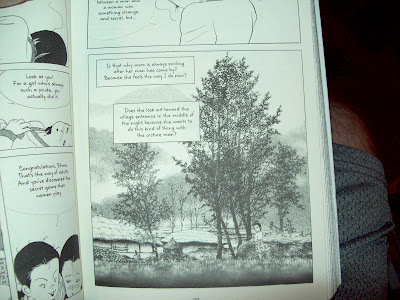
I recently found a graphic novel on the shelves at the library called The Color of Earth. It turned out to be the first book in a trilogy (the other volumes being The Color of Water and The Color of Heaven), so I put in my request for the other two volumes and read the entire trilogy. And am I glad I did.

The Color Trilogy (as I’m calling it here) is written and drawn by Kim Dong Hwa, a Korean comics creator; the term for Korean comics, which I’d never encountered before, is “manhwa”, and The Color Trilogy is apparently the first work by Kim to be translated and published in the United States.

The idea of romance comics is appealing to me, but the ones I’ve tried reading have, for the most part, been a mixed batch, so I was a bit apprehensive about this series. It turned out, fortunately, that The Color Trilogy is much more than a romance comic. It’s a coming-of-age story, a picture of life in small village Korea many years ago, a meditation on the meaning of love, and a wonderful character study of two compelling women.

As The Color of Earth opens, we meet a widow who runs a tavern in a small farming village somewhere in Korea, with her daughter, Ehwa, who is on the cusp of puberty and just starting to wonder about things like boys. Over the course of three volumes, Kim chronicles the lives of these two women, the older and the younger, as both begin to find love again, the older with a wandering artist who comes through town every few months, and Ehwa with several young men in the area before she settles on the one whom she loves.

Along the way, Ehwa wonders about the changes her own body is undergoing, so a great deal of the trilogy consists of discussions between her and her mother about the nature of female maturity and the nature of a woman’s heart and how women approach love as opposed to how men do. Occasionally there are long monologues, such as this, by the widow:

The heart of a woman is really strange.

There are days we long for a fireplace where we can warm our hearts through the night. If we don’t have one, we grumble, but we take solace in the company of family and friends.

Yet through it all, we yearn for that fiery hearth that we can tend to all through the night.

Though summer is already here and the summer solstice is just around the corner, my heart aches and I feel cold. I long for that someone and I feel cold…For no apparent reason, I feel cold.

The pacing in these books is slow and bucolic, reflecting the turning of seasons and the passing of time as Ehwa grows from pre-pubescent girl to young woman on the verge of marriage herself. I liked the slow pacing a lot; the books take their time not only to take the emotional drama of Ehwa and her mother seriously, but they also allow the village to take on a life of its own, through additional characters such as the raunchy-tongued men who frequent the tavern and Ehwa’s best friend, who is a lot more open about sexual experimentation than Ehwa is, both to Ehwa’s partial distaste and partial envy.

The books have a number of motifs wound throughout its narrative, foremost among them being discussions of native Korean flowers and how their own reproductive life cycles illustrate truths about men and women. I also appreciated how the book’s translator doesn’t substitute English metaphors for Korean ones, but simply uses the Korean ones and then provides an asterisked footnote explaining what each metaphor means. (Much of this, admittedly, has to do with Korean slang for sexual organs or situations.)

The art of the books is simply wonderful; beautiful compositions abound, and it sometimes feels as though every other page consists of a panorama of the Korean rural countryside. Some pages are dense with so much detail that the work almost resembles a woodcut; others are clean and sparse in the best way of traditional Asian art. Characters are drawn in a less-stylized way than in manga, so readers acquainted with Asian comics primarily through manga (or anime) may be surprised by the expressiveness given the characters’ faces. The Color Trilogy is a beautiful work. Here are a couple of art samples:

This series is highly recommended.

Share This Post

Something for Thursday

Oh, crap.

Yes, it finally happened. It’s not that I didn’t get around to posting this until now, or that time got away from me. It’s that I literally forgot today was Thursday.

Ugh!

So anyway, here’s something I’ll be returning to in a future post: the miraculous third movement of Rachmaninov’s Second Symphony, in its entirety. This person has helpfully divided it into two videos, but done so in a very logical way. I’ll be exploring his performances of the entire symphony, because I’ve long had it in mind to write a really exhaustive post annotated the work and why I think it’s such a towering masterpiece. But for now, here’s the movement. Play the second part after the first, obviously. This works very well, actually, as there is an actual break in the music as Rachmaninov wrote it, a second or two of heavenly silence before things start again.

(I think a part of my deep internalization of this piece is helped by the fact that I never heard the awful pop song based on melodies from this movement, Eric Carmen’s “Never Gonna Fall In Love Again”, until just a few years ago. I heard it, of all places, on the Muzak at The Store. I stopped in my tracks and just stood there in some kind of shock when I realized that the crappy musical wallpaper I was hearing was my beloved Rachmaninov. Betrayer most foul!)

(Apropos of my recent complaint about the Buffalo Philharmonic’s almost wonderful performance of this beloved piece of mine, the section they cut from the performance starts at the 1:20 mark of the second video (roughly) and picks back up at about 3:55.)

Share This Post

ForgottenStars.net

The official site of Kelly Sedinger: Reader, writer, photographer, and dreamer

Skip to content ↓