

The Final Answers!

OK, I’m finally getting around to finishing off Ask Me Anything! 2010. It was, as usual, a lot of fun, and maybe I’ll start doing this twice a year instead of just once. Every six months seems good, so maybe we’ll play again in August.

Anyway, to finish up the queries, we have a question on writing from “Quince”: Some “how to” books on writing think the idea of keeping notes is pointless as this time is better spent on writing. I thought keeping a file of possible characters and plot lines for future writing would be helpful. What is your opinion? How do you organize your writing?

There’s more than one way to skin a cat. Ultimately, the best answer is to do what works best for you. Unfortunately, figuring out what works best for you can be a chore in itself. If the writing’s easy and the stories pour out, and yet you never make a professional sale (if selling your work is a goal in the first place), then maybe one thing to re-evaluate is the approach. But then, maybe not. There’s just no way of knowing.

The caution against keeping notes can be well taken, as some folks will spend all of their time creating notes and character sketches and plot outlines and backstories and all the rest, and never actually tell the tale they want to tell. It’s the writing equivalent of the “Just one more source!” malady that can afflict graduate students, who put off starting their dissertations until they read just one more source. If you’re an outliner or a character-sketcher or both, you have to be able to step back at some point and say, “OK, time to actually start writing.”

As for me…I’m incredibly unorganized. I make no outlines whatsoever. None. I also make no character sketches at all. None. I don’t make a list of each character’s physical appearances, likes, dislikes, personal histories, and so on. I’ve tried going this route, and it just never feels like writing to me. I always find the whole exercise a little humdrum; I’d much rather see what my characters are doing.

Part of that comes from viewing my characters as beings in themselves: I don’t want to know them as well as possible before I ever write because I view my writing as the vehicle in which I get to know my characters. The benefit here is that they often end up surprising me and that I always learn things about them that I didn’t know when I started.

So I’ll go into a new story with only a few vague notions to mind about what the characters are like, and then I’ll make up the rest as I go, finding out new things along the way. I have a story right now involving a married couple whose big hobby is big white water kayaking; their marriage isn’t in the best shape because she tends to dominate him and disrespects his motivation for kayaking because of his love of nature, where she kayaks purely for the challenge and competition of it. That’s all I know as I start. I don’t know what things they’ll tell me along the way. And that’s the way I like it.

Now, with regard to the space opera project I’ve been working on of late, I’m not making notes beforehand — but I am keeping notes as I go, both names of characters mentioned or introduced and locations mentioned or introduced. Otherwise, the thing will get away from me and I’ll end up with continuity gaffes galore. But that’s after-the-fact note taking, not generating notes before.

But again: this is all my approach. There’s nothing that says it’s the right one, except that it’s right for me.

Roger has two questions in waiting:

You have a nom de plume. But now your Facebook page, with your real name, shows up on your blog. So Jaquandor wasn’t an attempt at some pseudonym-driven privacy?

It was, initially, years ago. “Jaquandor” was created in 1998 or thereabouts for me to use on Usenet, which was the main way of discussing stuff back in the day. I’m not sure if people who posted pseudonymously constituted a majority or not, but many folks on the old newsgroups used noms de plume. So when blogging came along and I jumped aboard in February of 2002, I brought the “Jaquandor” name (or “brand”) along for the ride. The plan was to continue being pseudonymous, but over time I felt that staying strictly pseudonymous was proving an obstacle to the kind of posting that I wanted to do. The “official” end of my pseudonymous posting came when I joined Green Man Review as a reviewer. I wanted to link my reviews from the blog, but they were under my real name, so I decided, hey, what’s the difference.

I still use the name “Jaquandor” because…well, I just like the name and figured I’d keep using it. There was never any “moment” where I decided to “come out”; it was just a process over time. One interesting thing I’ve discovered is that as I reveal more and more stuff about myself, just how much of it gets no reaction at all. I think a lot of people get freaked out by “putting themselves out there for the whole world to see”, and they never really consider that maybe the world will look, say “Huh”, and move on to something else. I mean, there’s stuff I’ve said in this space that I thought would surely have someone asking, “Hey, what’s up with that?” And aside from the whole overalls thing, nobody has. That interests me.

By the way, I’ve indicated a number of times that I got the name “Jaquandor” from a comic book, an SF comic from Marvel Comics’s “Epic” line, that came out in the mid-1980s, called Six From Sirius. The book was written by Doug Moench and had art by Paul Gulacy. I really would love to see more of those characters, but there were only two four-issue limited series featuring them, sadly enough. But anyway, I suddenly thought, “Hey, I can take a picture of the comic in which Jaquandor appears!” So here he is, the fat bearded gent in green:
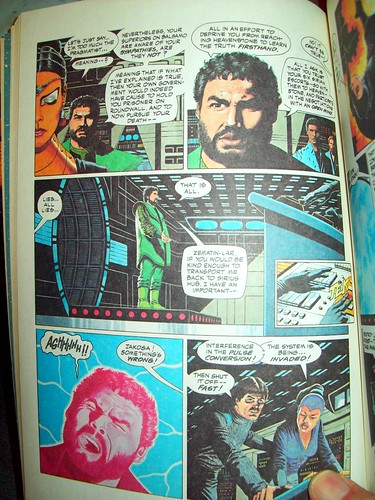
The fate of "Jaquandor"!

He only appears in one scene, during which he briefs our secret-agent heroes as to their mission (which is basically the Cuban Missile Crisis in space). That lower-left panel is Jaquandor’s last hurrah, as he is “beaming” out on their transporter thing at the same moment that something evil decides to beam in. So yes, I named myself online after a comic book character who appeared in one scene and then suffered a grisly death. Huzzah!

Roger also asks:

I’m interested in your development of faith, or lack of same. Did you grow up in a church-going family? Do you attend religious services currently? How do your current values/faith diverge from your former or current religious tradition? How has faith and/or belief in a supreme being helped or hindered you in times of personal difficulties?

Well now…there’s a tough bunch of questions. In order, no, I did not grow up in a church-going family. I saw this, and continue to see it, as a wonderful gift given my by my parents; I was allowed to develop my own worldview, and to see that worldviews will continue developing all our lives. What I believe now is different from what I believed when I was in college, and what I believe now is different from what I suspect I’ll believe twenty years from now. Or forty years, if I’m still around.

I do now attend church services regularly, but here’s the thing: my faith is so weak that I’m not sure it can be called faith at all. It’s more of a yearning, I suppose. I go to church because I love the story of it all, but I’m not sure I believe the story. I have a lot of points that trip me up on the whole thing: the omnipotent and good God who creates a world containing evil, the idea of humans as inherently flawed before we’re ever born, the fact that the Old Testament openly depicts a God in whom I’m surprised anyone would want to worship, and so on. I’m just not sure that I really believe. Maybe I don’t.

See, for me, the problem with saying “I am a Christian” means that I’m also saying “I am not a Buddhist”, or “I am not a Taoist”, or “I am not a Muslim”, and so on. Any “I am X” statement implies “I am not Y”. And I see too many things in other religions that speak to me deeply for me to rule them out completely. Putting it another way, the single part of the Bible that gives me the most trouble is John 14:6. The most common interpretation I’ve heard of this is that only those who believe in Christ will reach Heaven; everyone else does not. That passage bothers me, has always bothered me, and likely always will bother me. I cannot in my heart endorse the “Only Christians go to Heaven” view. If I get to Heaven and the Dalai Lama has been sent elsewhere, I’m going to wonder what God’s priorities are.

One can probably tell that belief in the supreme being hasn’t been terribly helpful to me in times of need. I just don’t know that God is there, listening. What is always helpful is people.

This answer probably hasn’t been terribly satisfying.

Roger also asked my thoughts on this interview with former Canadian figure skater Elvis Stojko.

From the introduction:

But some members of the skating community believe the sport’s effeminate image is increasingly a problem. Last year, Skate Canada told athletes and officials to talk up the sport’s toughness in order to attract more of a “hockey crowd,” and three-time world champion Elvis Stojko, the first man to land a quadruple-triple combination jump in competition (in 1997) and a skater known for his butch style, has spoken out on the issue. The sport really needs to start emphasizing “masculinity, strength and power,” Stojko has argued, if it wants to be taken more seriously. His remarks infuriated some gay groups, who perceived them as a slap in the face to the sport’s traditional fans.

Skating does tend to seem a bit effeminate, I suppose. At times. Not always, but right now, the effeminate stuff seems to be pretty dominant (except for the Russians, who seem utterly sexless — if there’s a more robotic skater than Evgeni Plushenko, I haven’t seen him). But there’s always been a healthy mix of that, so I’m not really sure. Saying that men’s skating should be more about masculinity and power seems possibly correct at first glimpse, but I fear that it would lead farther and farther into the dominance of jumping.

I confess that I haven’t much thought about these kinds of issues within skating. I do know that I’ve lost touch with the sport in general the last couple of years, because for whatever reason, it doesn’t seem to be as big a deal as it was ten years or so ago. I remember the World Figure Skating Championships being a big deal, always televised in prime time (at least the big events). The last couple of years, World’s has been hard to find. Why is this? I’m not sure. Has the sport waned a bit? Is it “too effeminate”? I don’t know. I do think that some of the personalities in the sport have become pretty outlandish, but…you know, I just don’t have a big opinion on this right now. I do think there’s a degree to which the sport is kind of homogenized these days; everybody kind of looks the same, which wasn’t the case during the 1990s when you had wildly different types of skaters in Stojko, Philippe Candeloro, Todd Eldridge (perhaps my favorite skater ever — I loved the guy) and, yes, the sexless Russians (Alexei Yagudin excepted — I thought he was amazing).

I’m not sure if the problem is too little butch as too little personality.

Finally, Charlie actually reminded me that I never answered a question that he had e-mailed last year. Basically, he was wondering about a falling-out I had with a professor in college. I was reticent to answer this one, and over time I pretty much put it out of my mind until I’d forgotten it completely, but I think it does deserve something of an answer, even if the story…well, I didn’t really present the best side of myself on this one, and the “Hey, I was only 20!” excuse rings hollow at this point.

It had to do with the band director, a guy named, believe it or not, Robert E. Lee. Dr. Lee was beloved of band members and alumni, but from the outside, he was seen as a highly quirky individual. He was pretty eccentric, even by tenured college music professor standards. One time, when the band was on tour, we stopped to get lunch at a McDonalds, and Dr. Lee bought a Happy Meal. When someone asked why he’d bought a Happy Meal instead of one of the other combo meals, he replied in his typically booming voice, “Because I’m happy!” His conducting could be hard to follow at times, when he really got into a piece, because he’d dispense with the traditional beat pattern and just start windmilling his arms a lot. He’d stop a rehearsal in its tracks to suddenly give the band a lecture on why they shouldn’t take up the offers of the prostitutes in the cities in Europe, never minding that the band wasn’t slated to go to Europe for another year and a half. He would talk to wind players about the need, when playing their instruments, to have a “wall of teeth”. (Not one person ever understood what he meant by this or why it was good.)

He had some maddening habits as well; the one that drove me batty was his tendency to cut pieces of music if certain passages were proving troublesome. He would just say “We’re not going to play that part, so when you get to two measures before point D, jump to five measures after point G.” I hated that. My view was that if a part of a piece was hard, you worked on it until it wasn’t, and that cutting music was basically denying what the composer had written. (Obviously, my attitude on this has not changed.) He became obsessed with a modern composer whose work I didn’t much like, so starting with my sophomore year, this composer’s newest work was always on our program.

Of course, it was always easier to see the negative than the positive. Yes, the music cutting was maddening and yes, Dr. Lee seemed in my eyes to waste a lot of good rehearsal time talking about odd topics. But I would only realize later on other things, such as the fact that for an old guy who’d been in the band business for more than thirty years by the time I came under his baton, he was constantly looking for new pieces and new works to learn, and his general enthusiastic approach to music — all music was singing, to him — was, I later realized, utterly correct.

But at the time I was pretty clueless, and Dr. Lee, for all his usual warmth and gregariousness, could, at times, be amazingly tone deaf at times in dealing with people. There were times when he would say something that was so insensitive that one almost couldn’t believe he’d say them. Lots of people had stories about things he’d said in that vein.

My own story, which is pretty brief, involves the European tours. The major music ensembles at college (at the time, the band and choir) would go on a European tour every four years. The way that broke out for me was that the European tour would be my senior year. However, the tour cost each student a couple of thousand dollars, if I remember correctly. I didn’t have a job, and I wasn’t about to try to ask my parents to foot that bill — they were already spending enough just to send me to school in the first place — so I decided that, regrettably, I wouldn’t be able to be in band my senior year.

So on audition day, I was walking through the music building, and Dr. Lee stopped me in the hall and asked if I was going to be in band. I replied, “Do you want me to be?” He thought for a moment and said, “Well, you’re not going to Europe, so…no.” And away he walked. It was very blunt and, I felt at the time, very dismissive of a person who’d been part of his band for three years prior. In short, it really pissed me off, and I made little effort to keep my ire secret. Of course, what I didn’t see then was that his position, however bluntly phrased, was the correct one: the entire year, for the band, would be preparation for Europe, so what use would I be if I wasn’t going?

I filed that under “Live and learn” and pretty much forgot about it until just a couple of years ago, when I got home from work, opened the mailbox, and took out an envelope that was addressed with handwriting I hadn’t seen since college. Dr. Lee had distinctive handwriting, and even after not seeing it for thirteen or fourteen years (whatever it had been at the time), I recognized it immediately. Inside the envelope was a brief note of apology from Dr. Lee for “what he had done to hurt me”. It couldn’t have possibly been more unexpected. I’d had no idea that he’d ever even been aware of how I’d felt at the time.

So yes, I wrote back, telling him basically what I admit above: that I’d overreacted to a perceived slight and never really considered, until much later, the correctness of his position. I said some things about music, told him about my life since college, and signed off. I also inquired as to his health, since it’s not unusual for people who are in bad health to seek to make redress for things they’ve done earlier in life. Dr. Lee wrote back one more time, to indicate that he was doing just fine and planned on many more years of life (he’s been retired for some time now, and I think that 1993 tour ended up being his last European tour) and that he was glad the hatchet was buried. It all felt very surreal; when I read his first letter, I remember having to stop and think a minute to remember why I’d been so pissed at him in the first place. Once I did remember, I almost immediately thought, “Oh, you 20-year-old dumb ass, he was right, even if he was kind of a dick in the way he went about it.” So, chalk another ass-kicking my younger self is going to receive if I ever get hold of Doc Brown’s DeLorean.

You know what keeps me up at night? Wondering what my fifty-eight year old self is going to want to come back in time and kick my ass for when he gets hold of Doc Brown’s DeLorean.

And that brings Ask Me Anything! 2010 to a close. Thanks for asking, everybody!
Share This Post

I see you!

I loved Avatar.

I really did. I loved the thing. It hit so many of my sweet spots that I found myself utterly involved in it barely fifteen minutes in. Even with its dialogue that often barely manages to rise above the level of “serviceable”; even with its Cameron-style foreshadowing delivered with all the subtlety of a ball-peen hammer to the forehead; even with its cardboard cut-out villains who have almost no depth, no characterization, and no complexity to their motivations other than money-making and gratuitous warmongering.

I loved it despite those flaws, because Cameron is just such a damned good storyteller that he can usually make big flaws disappear into the background and yes, because the visuals amazed me.

I was going to write a long piece about the movie, but then I decided to just go the “randomly unconnected thought” route. So here are random thoughts about Avatar:

:: Yes, I lost myself in the visuals. The movie was just beautiful to look at. I was awestruck by one shot after another. Especially the tree that has the spores that bob in the air like jellyfish, and the way the ground lights up when the Na’vi walk on it.

:: No, I wasn’t bothered by the word “Unobtanium”. Sure, maybe they should have come up with a name of their own, but really — if they’d done that, no one would remember it as soon as the lights came back on at the end of the movie. And besides, if you look at the names of some of the lab-created elements on the periodic table, some of them are just as goofy: “Californium”, anyone?

:: The movie seems to paint the military with a pretty broad brush, but I think Cameron was trying not to do this, although not terribly successfully. He does make clear that these aren’t actual US military (a point Gregg Easterbrook missed completely when he bitched about the movie on his Tuesday Morning Quarterback column, but I’m not looking for the link right now), by pointing out that they’re hired by whatever corporation hired them and by showing them, in a briefing scene toward the end, as being not all guys in fatigues but also fat guys in crappy T-shirts. But Cameron didn’t do enough to draw this distinction, so his depiction of military, seems kind of damning. (Of course, I’m not sure how fair this perception is, since in the course of the film we only really get to know two military people other than our hero, Jake Sully: the helicopter pilot with a conscience, and the lunatic “Roger Ramjet” who is the main baddie anyway.)

:: The movie is not original in the least degree, except for one idea that never really gets any kind of great SFnal treatment: the notion of the movie’s biosphere as being an enormous information transfer thing. Cameron flirted with a really nifty idea there, in positing that the spiritual “We’re all connected!” thing common to “savages” is an actual physical reality on this planet, but he didn’t take it far enough. That should have been the starting point for an amazing movie, not the ending point. It really is “Dances With Wolves In Space”, but I was fine with that.

:: In talking about the movie in his football columns, Easterbrook (again no links, because I’m lazy) kept referring to the movie as a “cartoon”, thus displaying the commonly held belief that animated movies are inherently lesser works than live-action movies. Easterbrook can suck it.

:: James Horner’s score is OK. There are a couple of big moments when the score takes flight, but for the most part, if you’ve heard Horner a few times, you know what to expect here.

:: Sometimes I really wish James Cameron would hand his script to someone and say, “Can you make this a little more subtle, please?” The movie was awash in the occasional foray into dialogue so clunky it made me laugh (a lot of the warmongering military talk fell in this vein), and as usual, Cameron sure likes to beat us over the head with foreshadowing. “Wow, that body-suit weapon thing looks cool! I sure hope someone goes mano a mano with that guy in that suit!” “So, you say that there’s this one flying beastie whom nobody’s ever been able to ride? Interesting….” “You can theoretically transfer everything from one brain to another? That may come in useful….”

:: SamuraiFrog hated the movie. I understand most of his criticisms, even if I don’t share them.

:: For the most part, Avatar is…well, it’s a movie. I liked it a lot. I had a great time watching it. It entertained me. I don’t see it as some kind of magnificent game-changer, though. Visually it raises the bar. Story-wise, it’s just good.

Share This Post

Tapping the microphone….

Hey, folks! Sorry for the lack of posting the last day or so. I actually intended to post something or other yesterday, but I got bitten suddenly by the most obnoxious of all bugs. You know the one. It’s the bug that makes you look around your primary workspace and think, “Oh my God, this area is a complete disaster that is unfit for any human activity whatsoever! Bring me a garbage bag and a Swiffer, Jeeves! There’s a good man!”

Anyway, I’m still not back in the swing of things, but I’ll get there. Right now I don’t have a hell of a lot to say, so why not go watch the trailer for TRON Legacy?

Share This Post

Sentential Links #197

Linkage. Closing in on 200 of these posts, wow!

(As an added bonus for this week, no politics! I’m a bit burned out on reading about Republicans right now.)

:: I am seriously in love with this game right now. (Super Mario Bros. was one of the initial games we got for our Wii, in addition to Wii Play, which I got more because it came with an extra Wiimote than anything else. I’m starting to look into other games, but it’s a testament to how good Super Mario Bros. is that it’s taken this long for us to start thinking, “Hmmm, we should get another game or two one of these days.” And I have to note that there’s something weirdly meta about me wearing a red shirt and overalls and playing a video game where the character I’m controlling is a guy wearing a red shirt and overalls. Whoa….)

:: In 1966, a show that was about some young and very attractive people stranded together on a deserted island could get away with pretending that the young and attractive people wouldn’t notice that they were young and attractive and act upon it. Gilligan and the Professor were assumed to be as blind as little boys to the fact that Ginger and Mary Ann were girls, and, despite Ginger’s occasional vamping, she and Mary Ann were only that much more aware of sex than a couple of sixth grade girls would be than they’re younger brothers. The four of them were very tall children because most of the audience was made up of children and to them life on a desert island would be no phone, no lights, no motor cars, not a single luxury, but they wouldn’t count sex as one of those missing luxuries. Parents knew better but they were glad to let it slide because of the kids. (A Gilligan’s Island movie. I’m frankly surprised it took this long for this to come about. I, too, don’t much see the point, because it’ll have to be all “contemporary”, which means lots of crude sex jokes and whatnot where Lance points out that the show didn’t have any sexual content at all. Oh well. It’ll probably suck, but it could redeem itself a bit with some good coconut cream pie action, I suppose. BTW, in spite of my lifelong fascination with red-heads, in this particular case I was always in the Maryanne camp.)

:: And God so loved us that He sent us his Messenger, whose wings were golden and wondrous! And this Messenger did help us out once in a while, but often He would mope, or complain, or forget where He was or what He was doing. The disparity in earning power between Him and His wife was always a source of tension…

:: When we first saw Jurassic Park and the T-Rex came out of no where to kill the Velociraptor at the end, we all thought the same thing… awesome. It was just that, not much more thought went into it. Upon a thousand viewings later though questions like these start to crop up.

:: Oh, those wacky Latinos and their crazy funeral traditions involving respect for the dead. Don’t they realize that the true purpose of funerals is for therapy and that any other consideration is just plain silly and old-fashioned?

:: I went into it completely open to any new experience that might visit itself upon me. It was late, and I went around the living room lighting candles and switching off the electric lights. I put the Chopin nocturne on the stereo and went to the little bar area that sits between the dining room and the kitchen. (Steph drinks absinthe so you don’t have to!)

All for this week. Tune in next week!

Share This Post

Random Oscar Thoughts before I go to Bed

Just some stuff before I decide that I can’t watch anymore (which should be in a few minutes):

:: If they awarded the Best Picture Oscar based on the first half of a movie, Up would be a shoo-in. Its second half was a major let-down, though.

:: Michael Giacchino has deserved an Oscar for several years, and Up is a fine score. I liked what he did with Star Trek better, though. That score has grown on me hugely since it came out last year.

:: I’m reading a new book about John Hughes and the Brat Pack right now, so it freaked me out a little when they did a special memorial for Hughes and brought out some of the Brat Pack. Wow.

:: Speaking of which, the degree to which Matthew Broderick’s voice hasn’t changed at all since Ferris Bueller is a bit unnatural.

:: The applause for the Hughes memorial seemed a tad unenthusiastic, didn’t it? And they showed some young people in the audience looking bored or confused, as if they wondered why they were honoring a guy who made noted movies in the 1980s and then dropped out of sight.

:: So far my favorite acceptance speeches are the guy who wrote Precious and the costume designer who opened with “Yeah, I’ve already got two of these” and proceeded to point out that costumers who do films set in real life today deserve recognition as much as those who do the Elizabethan epics do.

:: I liked the “Best Original Score” ballet they did. And if James Horner’s score to Avatar had been as good as the sixty seconds or so they played of it, that score would have won. But it wasn’t.

:: I’m liking Alec Baldwin. But then, what do I know? I’m the one person who liked Jon Stewart and David Letterman as hosts.

:: I don’t care if it lengthens the ceremony, Lifetime Achievement Awards should happen on Award Night. Roger Corman deserved to stand up there on stage.

:: I think that Queen Latifah is a beautiful, beautiful woman. No real point here, just that she’s beautiful.

:: Back to Alec Baldwin: he really seems to tone Steve Martin down a bit, nicely.

:: We’re in the greatest era of visual effects ever, and only three movies get nominations in that category? Hey, Academy of Motion Picture Arts and Sciences: WTF?!

:: I think I must be the only person in the world who doesn’t think that James Cameron was being a dick when he did his “I’m the King of the World!” thing in 1998 when Titanic won. I just thought it was a funny mimicking of a famous moment from his movie. Didn’t bother me at all.

:: 11:10 pm and the show’s still going strong. I, on the other hand, am not. So I’m off to bed.

Share This Post

Rossini, Ravel, and eighty percent of Rachmaninov

Last night, for the first time in more years than I like to admit, The Wife and I attended a Classics concert by the Buffalo Philharmonic Orchestra. How long has it been? Well…a while. Maximiano Valdes was the music director; the concert we attended back then was conducted by Arie Lipsky, and it wasn’t even at Kleinhans. It was in the auditorium of the high school in Olean, before we were even married.

Yeah, it’s been a while.

Since then, the orchestra has gone through the financial hard times that every orchestra has gone through, but it’s also gone through an artistic revitalization that began when Valdes left and JoAnn Falletta took over. Since then the visibility of the orchestra in cultural circles has gone up dramatically, with new recordings on Naxos and the orchestra’s private label, concerts broadcast on national radio, performances at Carnegie Hall, and so on. This week the orchestra embarks on its first tour — of Florida — since it traveled on a month-long journey to Europe in 1989. Heady, heady times for the BPO!

And yet, we didn’t attend until last night. (We did attend a “Family” program a couple of years back and are going to another in two weeks.) We were gifted some time back by my sister with a gift certificate for orchestra tickets, and the first of the concerts we chose for ourselves was last night’s program. Why that one? Well, because the major work on the program was one of the biggies in my life, a work I’ve referenced many a time in this space over the years. They were playing Rachmaninov’s Symphony No. 2 in E minor, a work without which I could not live, and a work that I know so well that I can quite literally “play” it in my head. More on that later, though.

The first half of the program was utterly wonderful, starting with Rossini’s overture to Semiramide. I confess that I’m not totally up to snuff on my Rossini; aside from William Tell and Barber of Seville, I can’t readily discuss his music much. But this overture was scintillatingly played, featuring some wonderfully deft work by the woodwinds and the horns. I was terrifically impressed with the orchestra’s level of unison playing; Maestro Falletta’s work has clearly made the orchestra play with more precision than I ever remember hearing from them before.

The Ravel Piano Concerto came next. Our soloist was an Italian pianist named Fabio Bidini. I’d never heard of him before, but in my experience, that doesn’t matter one whit. Along with the BPO. he turned in an amazing performance of the Ravel Concerto, a work of many influences: French impressionism mixed with jazz motifs. I’d never heard this work before (in fact, until a few days ago, I thought the orchestra was performing the more famous Ravel Piano Concerto for Left Hand), but I enjoyed it a great deal. It has all the “big Ravel moments” one could ask for, in addition to many quieter, meditative moments, such as the way the second movement is seemingly played halfway through by the solo piano alone, in an effect so captivating that it was almost a surprise when I saw the string players lift their instruments at last. It felt almost like a reverse of Beethoven’s Emperor Concerto, in which the symphonic exposition is so good and so long that when the soloist finally reappears, it almost comes as a surprise.

Mr. Bidini made it very easy to tell that the Ravel had ended, when he exploded out of his seat and was pumping Falletta’s hand even before the clapping had swept through half the hall. Bidini eventually offered an encore, which he did not identify (I believe it was a nocturne or etude by Chopin).

Intermission came, and we had already had a memorable night of music making. And the Rachmaninov Second Symphony was still to come. And sadly, this is where things got a bit problematic.

My first intimation came before the concert even started, when I read the program notes for the piece. The Philharmonic likes to print running times for pieces in the programs, and they indicated that the Rach 2 would take 46 minutes. That made my brow furrow a bit. As I’ve noted, I’ve lived with this piece for over twenty years now, more than half my life, and I’ve heard it performed live once before as well (in college, by the Shanghai Symphony Orchestra). I’ve never once seen a recording of this work that took less than 55 minutes, and some go over an hour, if the conductor’s tempi are particularly broad. To bring this piece in, in 46 minutes? Unless Maestro Falletta was about to set some very quick tempi indeed, there was only one way I knew of that the Rach 2 could be that short.

It goes back to the history of the piece in question. Rachmaninov was the “next in line” in Russian Romanticism in music to Tchaikovsky. Rachmaninov’s problem was that his brand of brooding Russian Romanticism was quickly going out of style. The Second Symphony premiered in 1908; Stravinsky’s game-changing ballet Le sacre du printemps would premiere just five years later. While the Rach 2 was initially a success, over the course of the 20th century Rachmaninov’s music tended to be viewed as anachronistic, especially the poor Second Symphony, whose 60-minute average length seemed to mid-century modernist ears as bloated self-indulgence.

So it was that through most of the 20th century, the Rach 2 was only performed in editions that removed up to twenty minutes of music. Many of these cuts were sanctioned by Rachmaninov himself, although I would be very surprised if these cuts were not somewhat coercive in nature — it was either cut the piece, or never get it played. The era of long symphonic works was, for the most part, over. It wasn’t until the 1970s that conductors started exercising fidelity to Rachmaninov’s original score, starting with Andre Previn in the very 1973 recording that was my eventual introduction to the work. Every recording of the Rach 2 I have ever heard has been made since Previn’s, and every one has been of the complete symphony. In truth, I had simply assumed that the edited version was no more, and that forevermore the Second Symphony would be known in the way that Rachmaninov himself originally conceived and composed it.

Alas, it turns out that the edited version is alive and well and in the hands of the Buffalo Philharmonic.

For me, it was literally like hearing eighty percent of the work. Not a huge amount was cut — they didn’t take an hour work and make it into a 35 minute work — but enough was cut that every time I started to lose myself in the piece, there would be a cut, which would eject me from the piece. I just can’t fathom why Maestro Falletta would have chosen to perform the edited version, except for one possible reason: that the length of concerts is mandated by musician’s union by-laws, and the program simply could not have accommodated the entire piece. If that’s the case, then…well, they should have performed Rachmaninov’s Third Symphony instead, as that one actually is about 45 minutes long.

The orchestra’s sound is amazing — it’s almost as if the orchestra was built to play this kind of repertoire. The winds and the brass complement the strings so wonderfully, and the strings’ sound is so lush, that the Rach 2, at times last night, sounded almost perfect. So why not play the entire piece? Especially to cut the third movement, eliminating the amazing passage where the violins reprise the long melody that had first been sounded by the solo clarinet?

Rachmaninov’s Second is an epic work. That’s the only way I can describe it. It’s the musical equivalent of a long Russian novel. By cutting it, the epic is made smaller, and I don’t understand why. An hour is not abnormally long for a symphony — it’s long, to be sure, but not abnormally so. Beethoven’s Ninth takes 65 to 70 minutes. Berlioz’s Symphonie fantastique tends to clock in at around 55 minutes. I don’t think that Bruckner or Mahler ever wrote a symphony between them that took less than an hour.

The Buffalo Philharmonic played most of the Rachmaninov Second about as well as the piece can be played. I just wish they had played all of it.

Share This Post

Sunday Burst of Weirdness

Oddities abound!

:: I’ve linked Wookieepedia, the Star Wars Wiki, before. But I don’t remember if I’ve linked its non-canon counterpart, Banthapedia, before, so here it is. From its entry on Han Solo:

While reports vary, Han apparently was affiliated with the Empire at some point, and he decided to throw his military career away in order to rescue one or more Wookie slaves. This is how he met Chewbacca who became his companion and co-pilot for many years. Han and Chewie flew around in the Millenium Falcon smuggling drugs, solving mysteries, leading the authorities on wild chases, and jumping over things. Sadly, their close relationship came to an end when Han got married.

…

Han and Chewie were spending the morning drinking away a ahangover in a crazy bar, when an old man and an obnoxious putz showed up looking for a ride. Since they offered considerably more than his usual asking price, Han accepted. After mercilessly gunning down some low-level goon, Han flew his passengers to the Death Star. Where he met Princess Leia, then ran around like a crazy person shooting Stormtroopers to try and impress her. Unfortunately, she was too busy flirting with her brother to notice.

Though they were able to eventually escape, Han decided to cut his losses and get the hell out of there before the Death Star came back and blew them all up, but later changed his mind when he realized how impressed the princess would be if he saved everyone. While he was instrumental in its destruction, Luke fired the critical shot and hogged most of the glory- though Leia did give Han the Medal of Holy Crap That Was Some Insane Ish You Pulled That Will Never Be Duplicated

It hurts to realize how accurate that is, huh?

:: OK, I don’t much like “Yo momma is so fat” jokes either. But these, employing a “science nerd” voice, are actually kind of funny. (And gross.)

:: Goodnight Forest Moon. Go to sleep, little stormtrooper!

More next week.

Share This Post

I heart Miranda Bailey

I’ve been watching Grey’s Anatomy ever since somewhere around the midway point in its first season, and in all that time, Dr. Miranda Bailey has been one of my favorite characters. The show’s focus tends to remain on Meredith Grey and the original surgical interns who worked under Bailey, but Bailey often steals the show and often provides the show’s grounding during its odder flights of fancy.

So, Bailey was originally one of my favorite characters on the show. And then, after several seasons, this moment took place, involving a teenage kid who had tried to impress a girl by jumping into a pool of cement, not realizing that he’d jumped into quick-drying cement:

The wisdom of Star Wars!

Share This Post

Something for Thursday

Sorry to be so late on this week’s entry! I have no idea as to the genesis of this and I’ve never heard of the band before, but everybody in Facebook is linking or embedding this, and it’s not hard to see why once you watch about thirty seconds of it:

Wow!

Share This Post

Sink Row Nissity

Mary Kunz Goldman wrote a post about Cooking Light that is eerily similar to my post about Cooking Light. Clearly she traveled forward in time, plagiarized my post, went back in time, and posted her post first. Or something like that. Weird!

But seriously, aside from the specific article that she didn’t like (I enjoyed the “Mistakes You’re Making in the Kitchen” article), her criticisms of the magazine are dead-on. A shame about the magazine, really.

Share This Post

ForgottenStars.net

The official site of Kelly Sedinger: Reader, writer, photographer, and dreamer

Skip to content ↓