“These Viennese certainly know good music when they hear it!”

I was mulling over today the answer I gave last week in how to help raise a musical child, and I feel the need now to revise and extend my remarks a bit, because I neglected to mention a blindingly obvious means of stoking a child’s interest in music, or at least stoking their realization that music is interesting in itself and is a very real thing that people do in addition to just having on in the background. I’m talking about attending live music.

Now, one should be careful and selective, depending on the age of the child, but live music has to enter into the equation, if one is being serious. This need not necessarily mean whisking the kid to this Friday evening’s performance of Mahler’s Resurrection Symphony, or to hear Bach’s St. Matthew Passion; that probably won’t help matters, for the same reason that having a kid’s first movie be Citizen Kane or The Seventh Seal isn’t the best idea. But most symphony orchestras nowadays, I suspect, have some kind of regular programming during the season for children, and these programs can be delightful — we took The Daughter to a performance of Beethoven Lives Upstairs a year ago, and a great time was had by all.

If a children’s program isn’t in the offing, then any “pops” type concert will do, depending on the repertoire one wishes to hear. We’re coming up on the 4th of July; those concerts are always a blast, and if you can’t attend one, watch it on teevee. Go see The Nutcracker at Christmastime. Watch the annual New Years From Vienna concert. And don’t limit it to orchestras, either; if a good ensemble of any kind is performing, take the kid to hear them. Yes, they will be intermittently bored, but the more you do it, the more they will see music as an interesting activity and less as sonic wallpaper.

And finally, don’t overlook the most basic of all musical instruments: the human voice. Encourage singing!

Share This Post

A book quiz!

Haven’t done a quiz in a while, so here’s one I grabbed from Steph. It’s about books, so longtime readers probably won’t see any surprising answers here.

1) What author do you own the most books by?

Probably Guy Gavriel Kay; I own everything he’s published.

2) What book do you own the most copies of?

I don’t actually tend to acquire lots of copies of individual books. I do own two copies of Lord of the Rings, and I have two copies of most of GGK’s books. (I currently own only one Tigana, because at the time I was buying up new ones on eBay, I couldn’t find a Tigana I wanted, and there’s only been one version of Beyond This Dark House.) I own three Bibles — a KJV I bought years ago, a newer KJV that I picked up because it has better reference materials in it, and a TNIV study Bible I bought because its reference materials are really good. (Although it wasn’t like I could do a whole lot of camparing, since Bibles are often shrink-wrapped, for reasons I’ve never been able to fathom. I hate that practice.)

I do own four “Complete Shakepeare” tomes, so that’s probably my answer here. I’m a sucker for complete Shakespeares, when I see a neat one somewhere, available cheaply. My problem with each is that they are all too big to carry around on a regular basis. I pine for someone to put out a Complete Shakespeare that is printed similarly to a Bible; surely we can get all of the Bard into a more portable package than the massive volumes I have sitting around here!

3) Did it bother you that both those questions ended with prepositions?

It does now. Yeesh! I do appreciate good grammar, but ending sentences with prepositions doesn’t tend to strike me as the most egregious of grammatical sins. Neither do split infinitives.

4) What fictional character are you secretly in love with?

Literary crushes? Can there be such a thing? Probably Jehane from The Lions of Al-Rassan.

5) What book have you read the most times in your life?

Wow. I’m not sure. In the running would be GGK’s Fionavar Tapestry, The Lord of the Rings, John Bellairs’s “Lewis Barnavelt” books, and Lloyd Alexander’s Prydain Chronicles.

6) What was your favorite book when you were ten years old?

Hmmmm, ten. Ten, ten…that was 1981. Probably Lloyd Alexander’s The Book of Three.

7) What is the worst book you’ve read in the past year?

Man, there is no contest at all here: Twilight, which was just embarrassingly awful. I couldn’t believe its sheer badness (here’s my review), and as I realized just how awful the book was, I was increasingly befuddled by its popularity. How can something this terrible be this beloved by so many obsessives out there? I’m at a complete loss, really. The best explanation I have is that Twilight is basically the single most successful “Mary Sue Story” in the history of English letters. It interests me that every single person I know who loves this book and its sequels is a woman, but even that throws me off a bit; one of them told me that I hated it because “it’s not a guy thing”, but come on! I’m a guy who loves Titanic, Sleepless in Seattle, Love Actually; I’m a guy who bawls like a little girl during that last scene of An Affair to Remember every time I watch it; I’m a guy who gets excited when Nicholas Sparks has a new book out. Believe me, it’s not a guy thing. If ever a book should have been “in my wheelhouse”, as it were, Twilight should have been it: I love a good teen romance, I love a good vampire tale, and I love stuff set in the rainy Pacific Northwest. Instead, I had one of the two or three most viscerally negative reactions to a book that I’ve ever had in my life. The only books I remember loathing more were Atlas Shrugged and The Fountainhead…and those, at least, made me think a bit. Twilight just made me want to scream to the literary gods, “Why? Why? WHY??!!“

So yeah, I hated Twilight.

8) What is the best book you’ve read in the past year?

I won’t say much about it, because I haven’t blogged it yet, but The Terror by Dan Simmons is some seriously brilliant writing.

9) If you could force everyone you tagged to read one book, what would it be?

Wow, I’m not sure. Not everyone would respond the same way I would, right? I’d force everyone to read, oh, Four Centuries of Great Love Poems, an anthology that Borders put out a while back. It’s a really good collection, and everybody should read more poetry.

10) Who deserves to win the next Nobel Prize for literature?

Heavens, I don’t know. I wouldn’t mind seeing it go to a genre writer, though, so I’ll pick Neil Gaiman. Or Gene Wolfe.

11) What book would you most like to see made into a movie?

Hmmmm…they could make a wildly entertaining flick out of Scott Lynch’s The Lies of Locke Lamora, couldn’t they? In fact, Quentin Tarantino could direct it. A medieval fantasy, directed by Tarantino…that idea just occurred to me, and now I love it. I wonder if someone could send Tarantino a copy? It would be right up his alley — lots of blood, unlikeable characters, and foul language to the max.

12) What book would you least like to see made into a movie?

The notion of the “unfilmable” book has come under some assault of late, but for sheer unfilmability, Bryan Talbot’s stunning Alice in Sunderland can only exist as a graphic novel.

13) Describe your weirdest dream involving a writer, book, or literary character.

Well, maybe this sounds like I’m ducking the issue, but I honestly don’t remember dreaming about writers, books, or literary characters.

14) What is the most lowbrow book you’ve read as an adult?

What does “lowbrow” mean, anyway? I don’t believe in “highbrow” and “lowbrow” books — just “good” and “bad” books. I read a bunch of “Extended Universe” Star Wars books back in the day, if that suffices for this question. But some of them are pretty good (Timothy Zahn’s, for instance.)

15) What is the most difficult book you’ve ever read?

Probably a philosophy text from college — possibly something from my “Existentialism” class — or maybe The Brothers Karamazov, which I’ve failed to finish three times.

16) What is the most obscure Shakespeare play you’ve seen?

I’ve never seen a Shakespeare play. Because I suck.

17) Do you prefer the French or the Russians?

Well, since we’re talking lit here…I finished, and loved, The Three Musketeers, while I’ve failed to finished Brothers K. Advantage, French. (But in music, this battle would come down to Berlioz versus Rachmaninov…aieee! I suspect a very very very tiny edge here would go to the French as well.)

18) Roth or Updike?

Haven’t read either.

19) David Sedaris or Dave Eggers?

Eggers, but neither is really my cup of tea.

20) Shakespeare, Milton, or Chaucer?

Shakespeare, but it’s not as if I’m terribly familiar with those other two fellows. (One of my favorite literary quotes is from CS Lewis, and goes something like, “If one has a choice between reading a new book about Chaucer and simply re-reading Chaucer, one should re-read Chaucer.” This question made me think of that.)

21) Austen or Eliot?

Austen, I suppose. Which Eliot, though? Comparing Jane Austen to TS Eliot seems odd.

22) What is the biggest or most embarrassing gap in your reading?

I have tons of gaps in my reading. Tons. In SF? I’ve yet to read Dune or much Heinlein or Niven or Mieville. In fantasy, I’ve not yet read Brust. “Regular” lit? You name the author, I haven’t read enough of him or her (Shakespeare, Milton, Dickens, Byron, et al). I constantly feel as though I am behind on my reading.

23) What is your favorite novel?

The Lions of Al-Rassan by GGK.

24) Play?

Macbeth.

25) Poem?

List time, here: “Annabel Lee”, by Poe. “Green Grow the Rashes”, by Burns. Any of Shakespeare’s sonnets. Various works by Li Po. And so on.

26) Essay?

I don’t recall the title, but it’s the selection in Leonard Bernstein’s The Joy of Music about why Beethoven is great.

27) Short story?

See? I need to read more short fiction. One that always stands out in my mind is “The Secret Shih-Tan” by Graham Masterton. Also “The Body” by Stephen King.

28) Work of non-fiction?

Cosmos, Carl Sagan; On Writing, Stephen King; The Joy of Music and The Infinite Variety of Music, Leonard Bernstein; The Lives of the Great Composers, Harold Schonberg; Little Chapel on the River, Gwendolyn Bounds; anything by Bill Bryson.

29) Who is your favorite writer?

Pressed to limit myself to just one, the obvious: Guy Gavriel Kay.

30) Who is the most overrated writer alive today?

Stephenie Meyer. Seriously, she is terrible.

31) What is your desert island book?

Boat Construction and Celestial Navigation for Dummies, right? Or, keeping with the spirit of the question, I suppose I’d want a complete Shakespeare.

32) And … what are you reading right now?

The Sagas of the Icelanders (I’m not going to read the entire volume, but two or three selections within); In a Sunburned Country by Bill Bryson; The Demon by Jack Kirby.

And there we have it! Hooray!

Share This Post

Sentential Links #173

Time for the clicking of links.

:: This is a disgrace, and is emblematic of everything that’s wrong with Buffalo. (Some salty language here, but seriously, what Alan’s describing here and in a series of subsequent posts is nauseating. It’s sometimes as if Buffalo enjoys sucking.)

:: Official Russian history. The gold standard for truth and objectivity.

:: It’s interesting to me to see how my perspective on stories and characterization has evolved over the years; TRUE LIES is a quite different experience for me now than I remember it being on first, or subsequent viewings. (I wish I could remember where I first read this suggestion, but somebody once wrote that the movie’s perfect ending would have had Arnold saying something to Jamie Lee Curtis something like, “How can I make up that other stuff to you?” and then, cut to a hotel room, lights out, with Curtis sitting in a chair as Arnold starts doing a striptease. That would have been better than the actual ending.)

:: The amazing science fiction future is actually fantasy. Jetpacks and rayguns are the equivalent of dragons and magic. Buck Rogers is the scientific equivalent of Harry Potter. You can’t have your jetpack any more than you can have Excalibur.

:: I think there is a presumption that people should be able to decide for themselves what facts about themselves to reveal; and that decent people should respect this, absent some compelling reason not to. (Ed Whelan is a shit, pure and simple. He deserves the flak he’s getting. He pitched a hissy fit in the only way he could think of; what he did is the blogging equivalent of the time in grade school when some other kid got mad at me at the lunch table so he squirted mustard onto my cookie. What an ass. Hilzoy has it exactly right, here.)

:: Mr Buchanan made the argument for her himself with his confidence that his audience would know what he was sneering at when he sneered at Pinocchio and the troll under the bridge.

A language isn’t an assemblage of words. It’s a collection of shared references.

You can’t speak English well unless you know what troll and what bridge and what happened to him.

:: I wish I could personally slap every single person who ever used the phrase “legislating from the bench”. That’s just code for “making decisions I disagree with.” (Couldn’t agree more.)

:: Why wouldn’t Archie want to marry Betty?

The answer is simple. (Another salty language alert…but a hilarious post. But I sure wish somebody could explain just why Archie has a tic-tac-toe sign shaved into the side of his head. I asked on Facebook and nobody knew!)

:: Yet another piece of evidence that, in a lot of ways, the 1970s and ’80s were a much better time… (I remember that intro well; Kung Fu used to air in the afternoons on the independent teevee station in Portland that also had Star Trek on after school. I didn’t quite understand Kung Fu, but it was there. Once, when I was working in the restaurant ten years ago, I was standing near the front door with our hostess, who was an older lady with a wicked sense of humor. A guy walks by on the street outside with a backpack filled to the gills, walking in that slow amble of a guy walking very far, and my hostess says, “Huh. Guy looks like Kung Fu.” She was happy that I got the joke.)

:: When people who are the “other” in this society succeed, they’ve often learned to navigate both the majority culture as well as their own. For instance, I know there are things that I don’t have to endure because I’m a male. I don’t always know what they are, but I surely know they exist.

:: I do know that if love transcends the boundaries of life and space and time, I have amassed more than enough to carry me safely to my next destination. And I hope that I have left enough behind to help light a path so that we may one day meet again. (I saw this linked on the AOL main page — it’s the final post of a man who died of cancer last week. It’s…well, it’s exactly what you’d expect. Deepest condolences to his family.)

More next week.

Share This Post

Books! Books! Books!


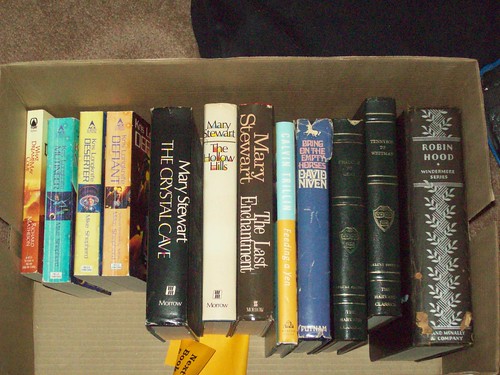
Book sale haul!, originally uploaded by Jaquandor.

This weekend marks the quarterly Used Book Sale at my local public library, and this photo shows the books I bought for myself. (There were other things for The Wife and The Daughter.) This sale was more productive, owing to the fact that they were able to have the sale in the usual room again; the sale in March was put in a tiny room about one-third the size of the usual room, owing to remodeling that was going on at the time.

From left to right, we have:

:: What Dreams May Come, by Richard Matheson. I never saw the movie, but I like Matheson a lot.

:: Three SF books featuring a heroine named “Kris Longknife”. I’m not sure I’ve ever heard of these before, but they looked fun, so there they are.

:: Mary Stewart’s King Arthur trilogy. (The books are in order.) I was thinking a few weeks ago that I really should re-read these, as I adored them when I first read them way back in 1992 and I’ve never re-read them since. Now I have nicer hardcovers to read. My MMPB’s of these books are OK, but the problem is that with many fantasy books published MMPB format in the late 80s and early 90s, maps tended to be nearly illegible. (I had a MMPB Lord of the Rings where the map was almost completely unreadable.)

(There was a fourth book that Stewart added later on, called The Wicked Day, which tells the story of Camelot’s fall from the viewpoint of Mordred. She wrote a sympathetic Mordred that was so effective that I’ve had trouble with standard, “villainous” Mordreds ever since.)

:: A food book by Calvin Trillin. I’ve heard good things about Trillin and not much read him.

:: Bring On the Empty Horses! by David Niven. I’ve wanted to read this for years, but the Buffalo and Erie County Public Library’s copy is non-circulating, for some reason. This is a Hollywood memoir by one of the wittiest men ever. (The title is from one of the more notable set directions from Michael Curtiz, one of Hollywood’s great directors but also a man who had trouble with English as a second language. When, after a number of nominations, he finally won the Oscar, he started his speech with: “Always a bridesmaid, and never a mother.” My favorite Curtiz fractured-English tale is when he told someone he wanted a poodle on the set, so the prop guy went and got him a poodle; Curtiz exploded and yelled, “Not a dog! A poodle! A poodle of water!”) Anyway.

:: Two poetry collections, because I can’t help myself. Too bad they didn’t have the third volume.

:: An old illustrated version of Robin Hood. I picked it up, hoping it was Howard Pyle, but it wasn’t. Still, it’s a handsome volume and I’ll do more research on it at some point.

All in all, a satisfying take, even if I didn’t see anything that I thought would make a good sale on eBay.

Share This Post

Unidentified Earth #70

OK! We have two identifications: UI 66 has been pegged as the Johnson Space Center in Houston, TX — otherwise known as the location of “Mission Control”. (Although I’m not sure what the object pictured there is — some kind of antenna, maybe?) Also, UI 67 was finally pegged as Riverside, IA — the town that has proclaimed itself the future birthplace of Captain James T. Kirk. Hooray! UI 68 is, however, still Unidentified, which strikes me as a poetic turn of events, and no one has yet shown enough pioneering spirit to peg the location of last week’s UI 69. Hmmmm.

And that brings us to the new puzzler:

Where are we? Rot-13 your guesses, folks!

Share This Post

Sunday Burst of Weirdness

Oddities abound!

:: I’m sure we’ve all noticed that sooner or later, everything reputed to be bad for you turns out to be not so bad for you, as long as you use it in moderation. Hence, lard makes a comeback. I’m interested by this, seriously.

:: If you are near death, take care of your parking arrangements first, because….

:: Can any fans of M*A*S*H refer me to the episode that featured a female Arabic suicide bomber? I’ve seen a lot of the show, but not every episode.

:: Oddly, for all the weird behavioral tics of our two very dumb cats, jumping on the counter isn’t one of them, which means that I won’t be able to put this plan into action.

More next week!

Share This Post

Serves me right for not being musical.

A reader recently asked how one goes about cultivating an interest in music in children, apropos of this post of mine from last week in which I noted that The Daughter has this year taken up the string bass. Some thoughts on that:

:: I suppose that making an instrument a simple requirement might work — “You’re taking piano lessons, Johnny, so suck it up and practice your Czerny!” — but that also runs the risk of backfiring, in the same way that forcing the reading of Shakespeare on eighth graders can permanently stunt their desire to read the Bard (or see his plays).

But music is such a useful thing to learn. It doesn’t always seem useful, though, which is part of why music is always one of the first items on the chopping block when school budget cuts happen. In addition to simply enriching one’s life if one can appreciate music beyond whatever the “pop crap of the day” happens to be, music can also be a good path to the learning of discipline and work that might not reveal itself in other pursuits. It’s a lot easier for a kid to understand why it’s important to practice scales over and over again than it is for them to understand why they should have to do 40 examples of the same math problem in a single night. (Or, maybe not. I rarely did all of my math homework.) So how to encourage it?

Well, one general rule can be adapted from the usual advice as to how to raise a good reader: it helps if the parents read themselves. A kid who grows up surrounded by books and who regularly observes her parents reading and taking pleasure in reading is exponentially more likely to enjoy reading herself. Likewise, a kid who grows up surrounded by music will, I suppose, by exponentially more likely to take at least some kind of passive interest in music when the time comes.

This doesn’t necessarily imply that the parents have to play an instrument. Just having an environment in the home where lots of music is heard helps, and the more diverse the music, the better. I remember hearing, as a small child, music from classical to Broadway to country, and more. Music was a standard feature in our home, so it was perfectly normal.

Now, I was also predisposed to see music as a respectable activity by virtue of my sister’s constant practice of piano and, eventually, the French horn. (I even remember, very vaguely, the place we bought our piano from. I don’t recall a whole lot, but it was in Portland and we rode upstairs in an immense cargo elevator.) Even so, I didn’t decide that I wanted to play an instrument on my own until my school band teacher, Mr. Beach, summoned me to the band room to inquire as to my interest. I thought, “Hey, why not.”

It was fifth grade when Mr. Beach recruited me for band. After one year of French horn, I switched over to cornet/trumpet, and I played that for a further two years before I finally decided that I actually wanted to be good at the damned thing. So after about two-and-a-half years of bring in band, I finally saw the virtue of practice. It takes time. Practice is drudgery, right up until the moment of epiphany when a music student realizes that practice is nothing more than playing for an audience of oneself. But up until that, getting me to practice was like getting a kid to enjoy bathing. My parents had to order me to practice every night.

As for The Daughter, she simply announced last year, either just before the school year or a few days into it, that she wanted to play an instrument. We’d occasionally made the suggestion to her before, with a “maybe someday” answer, but we never forced it. She knew that The Wife and I both played instruments in our youths, and she’s been around music all her life, especially in church. I figured she’d show an interest sooner or later, and she did.

So that’s my advice: don’t try to force music on your kids, but surround them with it. The rest will take care of itself.

Share This Post

Something for Thursday

I haven’t made much reference to my fiery passion for the music of Hector Berlioz in quite some time, so I’m going to rectify that. YouTube turns out to be an interesting source for older recordings of classical music — older recordings, with mono sound that can still provoke a deep thrill, with that ability mono has to allow many details in the orchestration to shine through in a way that stereo recordings, for all their warmth and vitality, can sometimes allow to fall back into the mix. For those who only know Berlioz through the Symphonie fantastique, here is one of his other popular compositions, his thrilling concert overture Le corsaire. Sir John Barbirolli conducts the Halle Orchestra. Note how far back the orchestra sits from Barbirolli; he’s a good seven or eight feet from his concertmaster. I found that interesting.

Share This Post

“Let your memory be like a blade in my soul.”

Tigana was Guy Gavriel Kay’s fourth novel published, and the first after the Fionavar Tapestry trilogy. It stands with a number of marked differences from Fionavar, pointing the way toward themes and a general approach to fantasy that would dominate GGK’s work for the next six novels, until Ysabel. (Time will tell whether Ysabel represents a momentary diversion or a whole new direction for GGK.) With Tigana we get not a series novel but a stand-alone work that focuses on the political goings-on in a fantasy domain that is nevertheless based closely on a real locale, the better for GGK to examine historical themes and events without being constrained to observing the outcomes of history too precisely. Here, GGK delves into the fantastical history of a fictional analogue of Renaissance Italy.

As the book opens, we find ourselves enmeshed in the politics of the peninsula of The Palm, a roughly hand-shaped peninsula that is divided into a number of smaller duchies and principalities, many of which look upon the others with suspicion. Each of the kingdoms owes allegiance to one of two tyrants, both wizards: Alberico and Brandin. Alberico is an extremely harsh dictator, killing any messenger who brings him bad news and responding to acts of insurrection with the random executions of dozens of people. (His preferred method of execution, “death-wheeling”, is never described, but its brutality can be inferred from afar). The other tyrant, though, is the one who commands more attention, because of the events that have gone before, roughly twenty years prior to the main action of the book.

The title Tigana refers to one of the kingdoms of the Palm, the principality of Tigana, a land of very long and proud history whose royalty traces its lineage all the way back to the god and goddess they worship. However, in the time of the novel, Tigana is a forgotten land – literally forgotten. In the final battle of the war in which Brandin took control, his son was killed; and in his grief, Brandin used his powers of wizardry to call the worst curse he could think of down upon the whole of Tigana. He strips the land of its name. Only those who are native to Tigana remember it, but anyone else not only forgets it, but they can’t even hear the name “Tigana” when spoken. Brandin insures that Tigana itself will die out completely once all of her native sons and daughters are dead, a generation hence. Working against this curse is the exiled Prince of Tigana, Alessan, and a band of fellow natives of Tigana he recruits throughout his travels as a wandering musician. His plan is to engineer a war between Brandin and Alberico, knowing that to destroy one tyrant whilst the other lives is to allow that other to rush in and fill the power void. What ensues is an amazing story of war, patriotism, revolution, court politics, magic, the morality of adhering to causes in the face of complete destruction, and all through that, love.

What makes Tigana such an effective novel is, in addition to GGK’s gifts for language and character, the moral ambiguity he conveys throughout. It would be easy enough to cast both tyrants as completely evil and Prince Alessan and his cohorts as pure and good, but GGK isn’t content to do this, and it is this – his willingness to present heroes as partly villains and villains as partly heroic – that tends to elevate his novels above many others. Alessan does things in the course of the book that cast question on his goals and his devotion to them; we wonder, at many junctures, if he is really doing the right thing in striving so hard to bring Tigana back into the world. At one point, he uses his own magical power as a Prince of Tigana to bind a free wizard to him, literally enslaving the man; the wizard, Erlein di Senzio, bitterly points out that things in the Palm have actually been much better since Alberico took over. There are no easy answers in Tigana.

Moreover, while Alberico himself is depicted as a sadistic and cruel lout, Brandin is portrayed with a startlingly high degree of sympathy for a dictator in a fantasy novel. Brandin’s grief for his son is very real, as his love for his wife, Dianora. This kind of thing makes Tigana a very refreshing read: I find myself not entirely rooting for Alessan, nor did I find myself rooting against Brandin. The eventual moment of reckoning, when it comes, is partially satisfying and partially bittersweet and partially very sad. Tigana is a book where some villains get what they deserve, while others don’t deserve what they get.

Tigana was the first GGK novel I read all the way through, way back in fall of 1993. I had previously started, but not finished, A Song for Arbonne. (I don’t recall why I didn’t finish that one, except that it wasn’t because I wasn’t enjoying it. Even while reading it I made a mental note to get back to this one.) I last re-read Tigana in 1999 or 2000, if memory serves; it had been a while, so long, in fact, that I was happy to discover that some of my earlier preconceptions about the book no longer held. I liked certain characters more than I recalled liking them before (Dianora chief among them), but I was again struck by what I’ve always felt is a problem with the book’s pacing. GGK’s books never stick to a single point-of-view the whole way through; instead, he switches back and forth among fairly large casts of characters. With Tigana, I have always felt as though he didn’t quite have the kinks worked out of this particular approach, as entire sections of the book become engrossing, only to bring on a switch to another person’s POV. What’s more is that the early part of Dianora’s part of the tale is given over to a long section of backstory. It’s basically an infodump. Now, GGK is a far superior writer to, say, David Weber, to name a writer who is famously prone to disastrously momentum-killing infodumps, so when GGK does this, it’s not fatal to the book. But it is noticeable.

Another facet of GGK’s books that is always noticeable is that they rarely end with a full-stop. He is superb at leaving that lingering sense that life does go on for the characters, even if we can’t follow along and see what that life entails. I won’t spoil it here, for those who haven’t read it and might, but the device he uses to end the novel is inspired, and it’s generated some serious discussion on nearly every forum on which I’ve seen this book discussed. The other thing that always stands out for real GGK fans are the tiny references he includes in all of his books to Fionavar; remember, Fionavar is the first of all worlds, so each of his novels to come along after that reflects this in some tiny way. It’s a tradition that actually started with Tigana, the first of his books after the trilogy.

Tigana is a wonderful, superb book, and it’s a testament to GGK, I think, to say that it’s never been my favorite book of his. But on this re-read, I found myself appreciating it a great deal more.

Share This Post

ForgottenStars.net

The official site of Kelly Sedinger: Reader, writer, photographer, and dreamer

Skip to content ↓