Books! Books! Books!


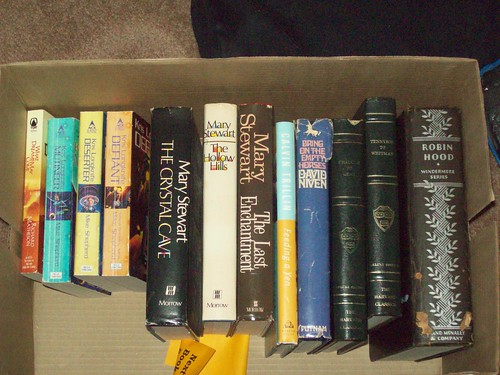
Book sale haul!, originally uploaded by Jaquandor.

This weekend marks the quarterly Used Book Sale at my local public library, and this photo shows the books I bought for myself. (There were other things for The Wife and The Daughter.) This sale was more productive, owing to the fact that they were able to have the sale in the usual room again; the sale in March was put in a tiny room about one-third the size of the usual room, owing to remodeling that was going on at the time.

From left to right, we have:

:: What Dreams May Come, by Richard Matheson. I never saw the movie, but I like Matheson a lot.

:: Three SF books featuring a heroine named “Kris Longknife”. I’m not sure I’ve ever heard of these before, but they looked fun, so there they are.

:: Mary Stewart’s King Arthur trilogy. (The books are in order.) I was thinking a few weeks ago that I really should re-read these, as I adored them when I first read them way back in 1992 and I’ve never re-read them since. Now I have nicer hardcovers to read. My MMPB’s of these books are OK, but the problem is that with many fantasy books published MMPB format in the late 80s and early 90s, maps tended to be nearly illegible. (I had a MMPB Lord of the Rings where the map was almost completely unreadable.)

(There was a fourth book that Stewart added later on, called The Wicked Day, which tells the story of Camelot’s fall from the viewpoint of Mordred. She wrote a sympathetic Mordred that was so effective that I’ve had trouble with standard, “villainous” Mordreds ever since.)

:: A food book by Calvin Trillin. I’ve heard good things about Trillin and not much read him.

:: Bring On the Empty Horses! by David Niven. I’ve wanted to read this for years, but the Buffalo and Erie County Public Library’s copy is non-circulating, for some reason. This is a Hollywood memoir by one of the wittiest men ever. (The title is from one of the more notable set directions from Michael Curtiz, one of Hollywood’s great directors but also a man who had trouble with English as a second language. When, after a number of nominations, he finally won the Oscar, he started his speech with: “Always a bridesmaid, and never a mother.” My favorite Curtiz fractured-English tale is when he told someone he wanted a poodle on the set, so the prop guy went and got him a poodle; Curtiz exploded and yelled, “Not a dog! A poodle! A poodle of water!”) Anyway.

:: Two poetry collections, because I can’t help myself. Too bad they didn’t have the third volume.

:: An old illustrated version of Robin Hood. I picked it up, hoping it was Howard Pyle, but it wasn’t. Still, it’s a handsome volume and I’ll do more research on it at some point.

All in all, a satisfying take, even if I didn’t see anything that I thought would make a good sale on eBay.

Share This Post

Walking through Italy

So, in my first ever “Make Me Read” poll, you all chose for me to read Hemingway’s A Farewell to Arms over Sylvia Plath’s The Bell Jar. I must admit that I was a bit surprised; for some vague reason I thought you would all select the Plath book, but it was Hemingway by a wide margin.

Before this, I had only read Hemingway once, and that was way back in high school when one of my teachers (I can’t even remember which one) assigned The Old Man and the Sea. I don’t remember my impressions of that book, except that even then I noticed Hemingway’s sparse literary style and bare-bones approach to telling a story.

Farewell is autobiographical in nature: it tells the story of an American soldier in World War II who is wounded and falls in love with one of his nurses, as actually happened to Hemingway himself. The real-life drama, of course, turned out differently than does the tale in Farewell, at least so far as I know. But it’s not hard to see how the state of affairs at the end, as Frederic Henry walks back to his hotel, could lead him to a long life of depression and eventual suicide – the path that Hemingway himself would follow. Of course, that wasn’t Hemingway’s thought when writing Farewell, as he published it in 1929, when he still had more than thirty years of life ahead of him.

One thing that often bothers me when I read a work of classic literature is that since the work is a classic, familiarity is often assumed, even by the books themselves. I have a feeling that I would have found Farewell a bit more involving, and effective, had I not already been informed by the dustjacket blurb that the novel is a tragedy, focusing on the “doomed” affair between Frederic and Catherine. I suppose most people who haven’t read Hemingway are supposed to know that he’s not the sunniest of writers, so this is to be expected, but as it was, I kept reading the book with a sense of impending doom that I’m not entirely certain Hemingway intended. Nevertheless, that tragic outcome really is terribly sad, when it arrives. It’s an interesting kind of tragedy, totally different from Greek tragedy (where everything is already ordained by the Fates) or Shakespearean tragedy (where tragedy unfolds from fatal character flaws). No, Hemingway’s tragedy is the more mundane sort, which makes it doubly haunting: Hemingway’s tragedy is nothing more than the observation that we live in a world where awful things happen for no particular reason at all.

For the first two-thirds of the book, the love affair between Frederic and Catherine proceeds along nicely enough, along with the travails of a soldier at war. It’s only in the last third of the book that the affair becomes torrid, at the same time that the war becomes well and truly insane. The last third of the book is harrowing, starting with the breakdown in the Italian army and the insanity that soon grips everyone, even as the war itself is dying down. Frederic’s escape from the Italians, after he’s been marked to be executed, and his subsequent escape with Catherine are all gripping episodes, but it’s in the final chapters that we learn that all has been for naught anyway.

Here is a quote that stood out to me, when I got to it. Frederic Henry ruminates a bit after someone protests that the Italian war effort “cannot have been in vain”:

I was always embarrassed by the words sacred, glorious and
sacrifice and the expression in vain. We had heard them, sometimes
standing in the rain almost out of earshot, so that only the shouted words
came through, and had read them, on proclamations that were slapped up by
billposters over other proclamations, now for a long time, and I had seen
nothing sacred, and the things that were glorious had no glory and the
sacrifices were like the stockyards at Chicago if nothing was done with
the meat except to bury it. There were many words that you could not stand
to hear and finally only the names of places had dignity. Certain numbers
were the same way and certain dates and these with the names of the places
were all you could say and have them mean anything. Abstract words such as
glory, honor, courage, or hallow were obscene beside the concrete names of
villages, the numbers of roads, the names of rivers, the numbers of
regiments and the dates.

Thanks to my readers for having chosen A Farewell to Arms. I’m glad I read it.

Share This Post

Make Me Read!

OK, I am now working my way through Guy Gavriel Kay’s A Song for Arbonne, which means that it’s time for you, the Readership, to decide what I read next. Up for selection this time are two works of old literature that I’ve meant to read for years, and it’s time to knock one of them off. And that’s where you come in!

First is The Nibelungenlied, the great German epic poem that tells the tale of Siegfried and his adventures; the other is The Sagas of the Icelanders, which is a collection of, obviously enough, Icelandic sagas. I’ll run this poll for one week, so let the voting commence!

(The poll is in the sidebar, near the top.)

Share This Post

Rising Darkness

The Daughter and I recently finished working our way through Susan Cooper’s Dark Is Rising Sequence, a five-book series where each novel tells a distinct story that is part of a larger whole, depicting the final battle between the Old Ones, who serve the Light, and the servants of the Dark, who would seize the magic of the world and dominate the lives of men forever, or something like that. The books are interrelated, so that reading them out of order is not advisable, as each one assumes knowledge of what has gone before. However, the books don’t exactly tell the entire story in strict sequence, which took some getting used to. There are two different sets of viewpoint characters, and the novels switch back and forth between the two, to sometimes odd effect.

I’m probably already giving the impression that I didn’t like the series, and I don’t want to give that impression, because I did. It’s full of great stuff. But for some reason I never found myself really drawn in. It never really involved me, and I’m not sure why. So what to do? Why, a rambling blog post! (Which is filled with spoilers, by the way.)

The series opens with Over Sea, Under Stone, in which three siblings – Simon, Jane, and Barney – go to spend a summer at their Uncle Merriman’s house in a town in Cornwall, where they find themselves involved in a modern-day quest for the Grail. The term “Holy Grail” is never used, nor is the history of the Grail ever much discussed in full. (That sets a tone for the entire series, which surprisingly assumes a knowledge of the Welsh and British folklore that forms the underpinning of all five books.) Their Uncle Merriman, whose last name is Lyon, soon turns out to be more than he seems, and in the second book, The Dark is Rising, he reveals himself to Will Stanton as an “Old One”, the magical race who stand forever opposed to the actions of The Dark. The point in this book is for Will’s powers to be awakened, as he is to be the last of the Old Ones, after whose birth and awakening everything is to begin building toward the final battle between the Light and the Dark. Will’s goal in this book is to find the “Six Signs”, magical talismans with powers to be revealed later on.

Book Three, Greenwitch, brings Will and the three children from the first book together, where they must assist the denizens of the Cornwall village from the first book in a very clearly pagan tradition: the construction of the Greenwitch, a wooden idol that is always offered to the sea, and then must recover an object lost at the end of the first book. Book Four, The Grey King, has Will traveling to Wales where he meets an albino boy named Bran who also turns out to be much more than he seems, and who is to be another ally in the battle against the Dark. Finally, the fifth book, Silver on the Tree, brings everything together: Will, Bran, the Drew children, Merriman, and everyone else for the last battle against the minions of the Dark.

The entire series is full of startling imagery, good characterizations, and some very lyrical prose. Reading these aloud, I found myself amazed by some of the most gorgeous passages I’ve read in a long time. Here’s a sample, from The Dark is Rising:

Will was never able afterwards to tell how long he spent with the Book of Gramarye. So much went into him from its pages and changed him that the reading might have taken a year; yet so totally did it absorb his mind that when he came to an end he felt that he had only that moment begun. It was indeed not a book like other books. There were simple enough titles to each page: Of Flying; Of Challenge; Of the Words of Power; Of Resistance; Of Time through the Doors. But instead of presenting him with a story or instruction, the book would give simply a cnatch of verse or a bright image, which somehow had him instantly in the midst of whatever experience was involved.

He might read no more than one line — I have journeyed as an eagle — and he was soaring suddenly aloft as he winged, learning through feeling, feeling the way of resting on the wind and tilting round the rising columns of air, of sweeping and soaring, of looking down at patchwork-green hills capped with dark trees, and a winding, glinting river between. And he knew as he flew that the eagle was one of the only five birds who could see the Dark, and instantly he knew the other four, and in turn he was each of them….

He read: …you come to the place where is the oldest creature that is in this world, and he that has fared furthest afield, the Eagle of Gwernabwy…and Will was up on a bare crag of rock above the world, resting without fear on a grey-black glittering shelf of granite, and his right side leaned against a soft, gold-feathered leg and a folded wing, and his hand rested beside a cruel steel-hard hooked claw, while in his ear a harsh voice whispered the words that would control wind and storm, sky and air, cloud and rain, and snow and hail – and everything in the sky save the sun and the moon, the planets and the stars.

Then he was flying again, at large in the blue-black sky, with the stars blazing timeless around his head, and the patterns of the stars made themselves known to him, both like and unlike the shapes and powers attributed to them by men long ago. The Herdsman passed, nodding, the bright star Arcturus at his knee; the Bull roared by, bearing the great sun Aldebaran and the small group of the Pleiades singing in small melodic voices, like no voices he had ever heard. Up he flew, and outward, through black space, and saw the dead stars, the blazing stars, the thin scattering of life that peopled the emptiness beyond. And when he was done, he knew every star in the heavens, both by name and as charted astronomical points, and again as something much more than either; and he knew every spell of the sun and moon; he knew the mystery of Uranus and the despair of Mercury, and he had ridden on a comet’s tail.

But as I note above, I still found it hard at times to really get emotionally involved in the stories. I think that it’s because of the way Cooper frames her story: everything that is transpiring is doing so according to ancient prophecies, and all of the wise old people in the stories are constantly making it sound as though various outcomes along the way are preordained. This event will happen, because it must happen before the next event can happen, which we already know will happen. Also, the children are constantly told that the Dark can do them no real harm, so there’s a sense in which the books undermine any sense of danger that you really need in a story involving the final, cataclysmic battle between Good and Evil. The books never really have that sense of risk, the feeling that even if victory is to be achieved, a heavy price must, and will, be paid. Come to that, there really isn’t a great sense of what happens to the world if the Dark wins out.

For this reason, the most effective parts of the series, for me, were those which did not deal with the actual lead protagonists, but rather those that dwelt with the normal people, the non-magical folk, who found themselves drawn through no fault of their own into a conflict that has been raging through the centuries. It’s here that the Dark is Rising Sequence finds it most effective voice. Some of these characters – most notably, Caradog Lewis and John Rowlands – endure outright tragedies, their individual responses to which shape greatly what is to come later on. I suppose that’s my major problem with the series: the moments in the books that are the most emotional are the ones that deal with supporting characters whom I didn’t know well enough to really be invested in. But come to that, those parts of the books tend to have that Greek Tragedy feel to them, in which people suffer because they have no choice but to suffer. That’s well and good, but I tend to prefer the Shakespearean approach to tragedy, where people suffer because of the choices they make. (That’s not a rigid distinction, mind you.)

There was one other aspect of this series that bothered me greatly: the ending. I’ll yellow this next bit out, if you’re reading the series and want to avoid the spoilers:

There’s a particular problem that faces any writer who crafts a story in which the real world, the world in which we live, is threatened by magical forces: namely, that at the end, when the battle is won, what does one do with the characters who have just saved the world and now have to live the rest of their lives knowing what they’ve done and not being able to really discuss it? Guy Gavriel Kay faced this problem in his Fionavar Tapestry, and he showed his solution – which wasn’t entirely satisfying, in my opinion – in last year’s Ysabel. But in the Dark Is Rising Sequence, Susan Cooper does something else: at the end of the series, when the battle has been won and the Dark defeated, all of the children’s memories, save Will’s, are ‘erased’, so they will live the rest of their lives with no knowledge at all of the things they’ve done and their actions in that final war.

I hated this development. Hated it. It just seems so wrong somehow, like having a contest where the prize is that you get to carry around a briefcase filled with one million dollars for a single day, but you can’t spend any of it and when the sun goes down the briefcase is taken away and all you are is the person you were at the beginning. Inducing magical amnesia may have been the right thing to do for John Rowlands, who is the one character who really does pay a heavy price in the tale in order to allow the victory of the Light; to wipe the memories of all the children struck me as cruel. I found this a serious mis-step, and it bothered me tremendously. It left a seriously bad aftertaste in my mind after I set the book aside the last night we read it.

I was reminded of the movie Heaven Can Wait: if Warren Beatty is brought back from the dead by taking over some other guy’s body, but the other guy’s memories and personalities are what remain and Warren Beatty’s are allowed to vanish utterly, in what possible way can the guy who’s alive at the end of the movie be thought of as the original Warren Beatty character at all? He’s not, he’s some other guy we don’t give a crap about. Well, ditto with the magical amnesia in The Dark is Rising.

But the books are still very much worth reading, because they are deeply steeped in the ancient folklore of Britain, and Cooper is able to draw on that folklore without giving us long infodumpish passages of exegesis; the spectre of King Arthur looms over the entire series, but there’s never anything so ham-handed as the story grinding to a halt while someone talks about who Arthur was and the glory of Camelot and all the rest of it.

I do recommend this series; after all, we’re talking about a series that boasts not one but two Newberry awards. There’s a lot of wonderful stuff here, and it’s a journey well-worth taking, even if it felt for me like a journey observed rather than a journey shared.

Share This Post
Readin’

Since I’m going to finish my re-read of Tigana this evening, I’ve closed my “What to read next” poll. There were only ten votes, with Dan Simmons’s The Terror taking six votes over Stephen King’s It. So there it is. I haven’t read Simmons before, so this will be interesting, I hope.

After The Terror, I need to plow through a couple of books for the sake of obligation, and then it will be back to GGK and A Song for Arbonne. And when I get to that, a new reading poll will appear. Thanks, voters!

Share This Post

Make Me Read!

I’m just about finished with A Farewell to Arms, which means that in the next day or two I’ll be reading Tigana. And that means that it’s time for my next poll of what I need to read after Tigana, which is where you all come in!

I’m thinking that I’m in the mood for a bit of horror, so I’ve chosen two titles from that fine genre. First is The Terror by Dan Simmons, and the other is It by Stephen King. Let the voting commence!

(A post on A Farewell to Arms is forthcoming, obviously.)

Share This Post

A Farewell to Sylvia

Well, voting has closed on my inaugural “Make Me Read!” poll, and it wasn’t even close. Sylvia Plath got stomped. I guess there are no fans of hers among my readers? Or maybe people just think that Hemingway is better. Who knows — but The Bell Jar got a single lone vote, while A Farewell to Arms got fourteen. So, Hemingway it is. Bring him on! And thanks for voting. The next poll will appear when I finish Arms, and thus begin GGK’s Tigana.

Share This Post

Make Me Read!

OK, I decided that what this blog needs is a new feature. So here’s a new feature. Over there on the sidebar — go ahead and look, you might need to scroll down slightly, so I’ll wait for you to come back…waiting…waiting…OK, we’re back — you’ll see a little poll. I’ve been waffling on my 2009 Guy Gavriel Kay Re-read project, as to whether I should just plow through everything he’s ever written at once or alternate other books in between. I’ve decided on the latter, because I want a little bit of time to reflect on the preceding GGK book each time I come to the next one, and because I fear the latter books in his output may suffer during this project if I don’t “clear my literary palate”, so to speak. Thus, I will read other books in between each GGK book. But what other books?

And that’s where you come in, readers! What I’m going to do is each time I begin a GGK book (or thereabouts, roughly, kinda-sorta speaking) I’ll choose two options for the next thing I read, which will then appear in a poll over in the sidebar — it’s right near the top, just below the link to The Promised King. Readers will vote, and whichever book gets the most votes will be the one I read after the current GGK tome. (I may keep doing this after I get all the way through GGK, picking my own books and then polling results for the alternating books, depending on how this experiment goes.)

If the books are tied when the poll closes (I think it’s set up for a week), I’ll flip a coin between the two books. Now, what kinds of books will I offer as options? Well, sometimes I’ll choose literary works; other times I’ll choose graphic novels, or works of classic SF, or just about anything I can think of. For the inaugural Make Me Read! poll, the choices are:

A Farewell to Arms, by Ernest Hemingway

and

The Bell Jar, by Sylvia Plath

Why did I choose these two? No particular reason. I just have copies on hand neither of which I’ve read yet. So I leave it up to you all! Which one do I read after I finish The Fionavar Tapestry later this week? Vote in the sidebar!

(I should point out that I’ll only be doing this for my fiction reading; I tend to be all over the map with my nonfic, and I may need to set aside the poll winner for a bit if review novels come in that need to be kicked out of the way. I do need some wiggle room, but this should work.)

Share This Post

Brightly Weaving

After clearing the decks of some earlier reading I wanted to get out of the way, I’m finally embarking on something I’ve intended to do for a couple of years now: I am re-reading every word Guy Gavriel Kay has written, in the order that he wrote them. Why? Because he’s my favorite living author, and it’s been a while since I’ve gone through his work. Here’s how it breaks down:

:: My last re-read of The Fionavar Tapestry was almost exactly three years ago. This will be, by my count, my fifth complete re-reading of the trilogy, although I have dipped into it to read favorite passages too many times to count.

:: Then comes Tigana, viewed by many as GGK’s finest work. It’s not my favorite of his, but it is wonderful. It is also the first of GGK’s books that I ever read in its entirety. The last time I read it was, I believe, in 2000. That’s far too long.

:: After that is A Song for Arbonne, which seems to be held in less regard than GGK’s other works. It was the first time I ever encountered his writing, when I saw the book at the Olean Library and was intrigued enough by its cover to check it out, but for some reason I didn’t finish it at that time. I think school got in the way or something…I’m not sure. This was in 1992 or 1993. My last re-read of Arbonne was in 2001; that I remember because I recall the apartment we lived in at the time. This will be the third time I’ve read it.

:: In 2005 I re-read The Lions of Al-Rassan for the third time, so this will be my fourth trip through what is my favorite of all of GGK’s books. This book, with its tragic love stories and its wonderful characters and gorgeous setting just hits on every level for me.

:: Of the two volumes that make up The Sarantine Mosaic, I have only re-read the first, Sailing to Sarantium, a single time, and that was in preparation for the release in 2000 of the second book, Lord of Emperors. I have never re-read Lord. This may be the one I’m looking forward to the most, at this point.

:: GGK’s book of poetry, Beyond This Dark House, came out in 2003. I read it, and since have dipped back into it a bit, but now I’ll re-read it in its entirety.

:: I reviewed 2004’s The Last Light of the Sun for GMR, and since then I have not re-read it. I remember this book very favorably and look forward to seeing if it measures up to my memories of it.

:: And finally, 2007’s Ysabel, which I blogged about when I read it. This will end up being the shortest period of time I’ve ever gone between full re-reads on a GGK book.

All this means that if GGK has a new book out next year, which seems a reasonable expectation (he seems to go about three years between books), I’ll be totally up to speed on his oeuvre. And that’s a good thing.

Even though I already own every one of his books, for the sake of this project I spent some time on eBay last December searching out new copies of each, in different editions. I’ve sometimes found that when you re-read a book that’s very familiar to you, but you read it in a different edition than the one you’re used to, with a different typeface and different cover art and so on, some details in the story stick out more than they otherwise would. I’m already noticing this in Fionavar. I already owned two editions, one a mass-market paperback edition that was my first copy and a trade paperback edition with new cover art; but both editions were done by ROC Books, and both used identical type-settings. This edition I’m reading now uses a totally different font, even, so I’m finding the experience of re-reading just slightly different. This may sound goofy, but we’re talking about books I’m sufficiently familiar with that with some passages, I know where they physically appear on the page. Now those passages will have, well, shifted.

(Besides, my original copy of Last Light of the Sun is actually an advance reading copy; the thing doesn’t even have cover art. I’ve rectified that with a hardcover version, albeit a book club edition. Nothing’s perfect.)

I’ll blog my way through these, obviously. I’m not sure if I’ll be reading them all back-to-back-to-back, or if I’ll read something else in between once or twice, just to cleanse the palate a little, but I’m hoping to be done with this at least by the end of summer, if not sooner. We’ll see…but for now, I’m off to Fionavar!

Share This Post