Cut-rate parasites

In the comments to my final post in my Top 100 movies list, an anonymous reader objects to my statement, regarding Casablanca, that Letters of Transit signed by General de Gaulle wouldn’t hold much weight in Vichy France, or a Vichy-governed territory like Morocco:

In Cssablanca, the letters of transit were signed by Vichy General Weygand, not Free French General de Gaulle. Listen to the soundtrack carefully.

Well, I’ve just listened to the soundtrack carefully, and I have to say, I still hear Peter Lorre saying “General de Gaulle”, not “General Weygand”. Now, both names will sound somewhat similar in the proper French pronunciation, but not exactly alike, and after replaying that sequence about eight times, I’m still hearing a distinct ‘D’ sound from Lorre (the ‘de’ in ‘de Gaulle’), as opposed to a ‘W’ for ‘Weygand’. This is a bit more tenuous, but I also don’t see Lorre’s lips moving in a way that suggests a ‘W’. The lips don’t need to move at all from the last syllable of ‘General’ to ‘de’, where they would have to purse slightly to form the ‘W’ sound in moving from ‘General’ to ‘Weygand’. I don’t see his lips move at all, which also suggests to me that he’s really saying ‘de Gaulle’.

Searching out the film’s shooting script isn’t terribly helpful, since the film’s script wasn’t even finished when the film started shooting and hasty rewrites were the order of the day, right up until the shooting of the final scene. I will note that Casablanca‘s Wikipedia entry indicates that Lorre says ‘de Gaulle’ and is subtitled in English on the DVD in the same way, while the French DVD subtitles say ‘Weygand’. (I haven’t checked this.) Also, the book Casablanca: Behind the Scenes indicates that the line references de Gaulle and makes no mention at all of Weygand.

So, absent more conclusive evidence, I’m sticking with my original hearing of the line. But hey, why take my word for it? You be the judge! Here’s the scene from the movie; the specific line of dialogue in question comes at about the 1:45 mark.

Next week, we’ll discuss whether or not Mark Hamill accidentally shouts “Carrie!” at the end of A New Hope. (Personally, I’ve always heard his shout as a meld of “Hey!” and “Yeah!”. But we can hash that apart another time. Yay, obsessive movie geekery!)

Share This Post

Department of Technical Annoyances

Earlier today I downloaded and installed the newest version of my Internet security program (Norton 360, for those who care), which seems to be working fine. But now Firefox seems to be in the habit of clearing my “personal data” each and every time I close the program, which wouldn’t be annoying in itself if it wasn’t also clearing my entire browsing history with it, no matter how many times I go under “Tools” and un-check the “Clear Personal Data at the end of every session” box or change the settings so the browsing history is left alone.

That could get annoying.

Share This Post

Bring on the Gelatinous Cubes!

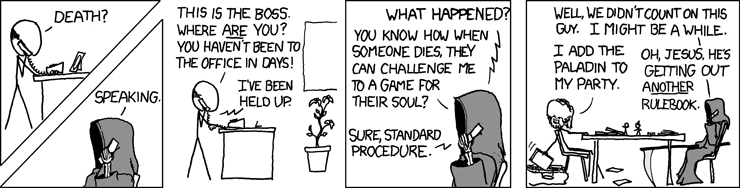
As just about everybody with a blog already knows, Gary Gygax, one of the inventors of Dungeons and Dragons, died last week. I’ve been too busy to post about it until now, and I also didn’t want to make the same obvious joke that everybody else did about Gygax failing his last saving throw. (A favorite geek humor joke of mine is: “Jesus saves! The rest of you take full damage.”) I, of course, choose to envision God as the ultimate Dungeon Master, and with regard to Gygax, he did the old DM trick of dropping a bunch of dice on the table behind his screen and then shaking his head and saying, “Ooooh, bummer, dude.”

But of course, leave it to xkcd to come up with the best Gygax tribute I’ve seen anywhere:

I was never a huge AD&D player, although there was a period in sixth grade when everybody in school was seemingly obsessed with it for some reason, to the point where cliques formed within our class based on whose character was a God and whose was a Demon. (What can I say? We were a bunch of dumb-assed eleven year olds.) Strange thing was, for all the D&D babble we all indulged, we did almost no actual playing of the game, which was a bummer. I didn’t actually get to play the game in anything close to the manner in which it’s meant to be played until college, when I was a part of two separate campaigns, the first in our freshman year and the next when we were juniors and seniors.

The DM of our first campaign was hard core on the role-playing aspect of the game. He and his high-school mates had used AD&D campaigns partly as means of honing their improv theater chops (this guy was really into drama), so we had to make a lot of effort in his campaign to be “in character”. This occasionally led to interesting results. Our second campaign, spread over the latter portion of junior year and a big chunk of senior year, was run by a guy who was a more action-oriented DM; with him, there was less emphasis on role-playing (although there was that) and more on pacing and excitement. He was really good at managing combat so that the “battle sequences” were exciting, and he was also good at managing the treasure and rewards, consistently finding the “sweet spot” between extreme stinginess (“The red dragon is dead, leaving his horde of one hundred copper pieces to be split amongst the party, after you pay these six NPCs their agreed price!”) and Monty Haul (“Your party of level eight characters has slain the duo of bugbears, taking their horde of one million platinum pieces, five swords +6, and eight scrolls with one Wish spell on each!”).

Both campaigns took place in the Greyhawk setting, so I never got to play in the Forgotten Realms. My own campaign, had we not petered out as a group in senior year, would have been a Forgotten Realms campaign. I also bought a lot of the “Al Qadim” materials for another campaign, in the style of the 1001 Nights, that never took place.

AD&D was, of course, lots of fun, and we usually had a blast whilst playing. I haven’t played a single game since college, fifteen years ago now, and while I don’t have a whole lot of desire to play again (mostly because I know that I just don’t have enough time), I’m glad I got to play the games that I did, and I do wish we’d had some time to get more playing in there. So, like every geek these days, I owe a certain debt to Gary Gygax.

Share This Post

If adventure has a name….

It’s amazing how time slips away from you, isn’t it? I file things away in the back of my mind to blog about one of these days, and then I realize it’s been a couple of weeks. But hey, it’s also nice how since it’s my blog I can blather about what I want, when I want!

So, with all that said, it’s time for me to geek out a bit about the trailer for Indiana Jones and the Kingdom of the Crystal Skull.

First of all, I know that they’ve apparently decided that every one of these tales needs to be titled along the lines of Indiana Jones and the [insert hazy reference to the story’s Maguffin here], but really, that’s an unwieldy title. Just as the very first ever Indiana Jones story for me will forever be Raiders of the Lost Ark, so too should this one simply be either Indiana Jones and the Crystal Skull or Kingdom of the Crystal Skull.

(Of course, this is all pretty much a useless point anyway; stand to one side of the theater box office when this opens, and what you’ll hear is “Two for Indiana Jones” all night. In fact, have you ever heard anyone approach the box office and refer to a movie with a long title by the entire title? Wouldn’t it sound weird to hear some one actually say “Can we get three tickets to the 9:15 showing of The Lord of the Rings: The Return of the King? We use shorthand when referring to movies with long titles anyway.)

Where was I? Oh yeah, the Crystal Skull trailer. It’s a good trailer. Of course, most trailers are, but this one really seems to be an “Old School” trailer in that it just has little hints of what’s in the movie, as opposed to most trailers these days, where the approach seems to be “Tell the entire movie in two minutes and make sure to give away all the best stuff”. (The worst example of this I’ve ever seen is the trailer to The Perfect Storm. They just had to put the movie’s money shot, the Andrea Gail trying to surmount the unsurmountable wave, into the trailer. Oy.)

So what does the trailer say about the movie itself? Luckily, not much. It doesn’t have much dialogue at all, except for a couple of lines in the typical “Indy’s amazed at what he just did” vein, and the nice exchange where the kid (who may or may not be Indy’s son, according to fan speculation) says “You’re a teacher?” and Indy replies, “Part time”. (There’s a beat in the kid’s line, which makes me think the actual line in the movie is a bit longer and may contain an expletive.) And there are no references to the Crystal Skull at all! The trailer’s constructed of pure visuals. That being the case, what can we tell about the story?

The big revelations seem to be a quick appearance of the word “Roswell” (possibly referring to the Roswell Incident), and some derring-do that appears to take place in a Mayan pyramid. So maybe the movie’s archaeological Maguffin is the long-mysterious fall of the Mayan empire in Central America, and maybe the movie’s explanation involves aliens of some sort. I know that the previous Indiana Jones adventures have all dealt with mystical and religious themes, so a possible aliens-from-Space angle of the Erich van Daaniken variety may seem at first out of place. I’m willing to withhold judgment on this point; as Roger Ebert has said many times, “It’s not what a movie is about, but how it is about it”. There’s no reason why an aliens-and-UFOs story can’t involve religious mysticism; in fact, if you delve into UFO subcultures, you can’t really avoid religious mysticism. Indy has dealt with Old Testament relics, New Testament relics (well, kinda-sorta), and Hindu relics, each of which has very real powers. So maybe the mystical element will be present here.

Anyhow, I’m looking forward to this movie eagerly, and I actually think it’s got lots of potential to be good. What I’m really hoping for is a good adventure without too much of the “Indy’s getting old” subtext. Indiana Jones isn’t about depth; he’s about adventure and excitement. We’re supposed to trust him, even as we know that he’s making it up as he goes. My other big hope is that this film doesn’t reduce its recurring character from Raiders, Marion Ravenwood, to comic relief as Last Crusade did with Sallah and Marcus Brody. In fact, the treatment of those two characters in that movie is a big reason why it’s my least favorite Indy flick to date.

So bring on Dr. Jones!

Share This Post

Drink up me hearties!

So in the last month we’ve finally caught up on our Johnny Depp swashbuckler viewing by watching the second and third Pirates of the Caribbean movies, Dead Man’s Chest and At World’s End. Prevailing opinion of these movies, so far as I can tell, is that each could have been an hour shorter, each is a mess with too much incomprehensible plot, each consists of a couple of large-scale action set pieces surrounded by boring scenes in which characters continually doublecross each other. In fact, the one word that seems common to nearly every review of these two movies I’ve read is “mess”. Ouch. They must really be bad, right?

Well, wouldn’t you know it: I love the two sequels, I found the plots of each fairly easy to follow, and I wasn’t in the least bit confused by all the apparent switching of loyalties. Go figure. These aren’t great movies, but they’re really very good, in my view. I can’t see why so many people hated them.

I don’t understand the critiques of the films from a story point of view, at least as far as the claims that there isn’t enough story to sustain the films and that the second movie is nothing more than set-up for the third. Well, DMC is designed to lead directly into AWE, so of course it’s a large set-up: it’s literally one-half of a story, with the other half contained in AWE. The PotC movies are less like, say, the Indiana Jones or James Bond films, each of which contains a single story that has no bearing on the next. They’re more like the Star Wars or Lord of the Rings movies, in which they are intended clearly to serve as parts of a larger whole. Since DMC is the first half of a story, to say that it’s set-up for the third movie is actually praise rather than complaint: the movie does its job well.

So what of that larger whole, anyway? I genuinely didn’t have much problem with it. Some stuff isn’t handled as well as it should be, but for the most part, I was never totally confused by the machinations of the story, even when characters start betraying one another and apparently switching sides. I say “apparently” because, for all the double-crossing that goes on, the actual motivations of the characters never changes, which is nice: they’re always acting toward the same goal. Will Turner’s actions are driven first by his desire to be free to marry Elizabeth, and then by his desire to free his father from Davy Jones’s servitude. Captain Jack Sparrow’s actions are always driven by his desire to be free, and by the fact that he defines his freedom in terms of having a ship such that he can always sail wherever he wishes. Now, it may be the case that the various motivations aren’t always cleared up right away, and sometimes when they really should be, but they’re there. Basically, I found that the characters stay true to themselves throughout, which is something I appreciate.

Taking the two films separately, I can certainly see how the plots can be seen as convoluted, but really, they aren’t that complicated after all. Jack’s actions at the beginning of DMC are explained soon enough: he became Captain through making a bargain with Davy Jones, who raised the Black Pearl from the ocean floor for Jack to command, with the proviso that after thirteen years of being Captain, Jack would owe Davy Jones one hundred years of servitude aboard the Flying Dutchman, a bargain Jack is clearly eager to circumvent; this he plans to do by capturing the Dead Man’s Chest, which contains the very heart of Davy Jones. Leverage. Captain Jack Sparrow is always all about leverage.

Meanwhile, Will Turner and Elizabeth Swann are to be married, but they are arrested for piracy instead by Lord Cutler Beckett, the new Big Cheese in the Caribbean. Will is offered freedom in exchange for retrieving Jack’s compass, which we later learn points in the direction of whatever one wants most; meanwhile, Elizabeth escapes and goes after Will, not understanding why he’s left without telling her where he was going.

What’s so confusing about this? Nothing that I can see, really, but the film does derail itself a bit with a lengthy set-piece that involves an escape from a tribe of cannibals. Maybe that bothers some viewers, but I didn’t have much difficulty with this either, as the whole sequence is nicely in keeping with the gonzo action sequences of the first film. (I particularly love the double-take both sets of pirate prisoners do when they realize that there’s really no reason for both groups to survive and escape to the Pearl.)

I don’t need to go into the plot details beyond that, but I note that it’s not all that hard to follow, and with one admittedly large exception, just about everything that happens actually gets explained at some point. Why do Jack Sparrow, Will Turner, and James Norrington all want the Dead Man’s Chest? Who is Tia Dalma, and why does she have the presumed-dead Captain Barbossa ready at hand? Why is she already apparently planning a voyage to World’s End, to save Jack Sparrow? Why is Lord Beckett trying to get Jack’s compass? Why is Davy Jones always playing emotionally-laden music on the organ in his quarters? What is the significance of his locket? All of this is explained, and within the dense and happily gonzo mythology the PotC writers have created, it all fits together pretty nicely. With the exception of a couple of action sequences, just about everything that happens in these movies actually leads on to the next thing. Fine by me. Sometimes the movies take their sweet time in explaining why one thing leads to the next thing, but that’s not the same thing as not explaining it at all.

I also loved how the afore-mentioned gonzo mythology of the film draws from all manner of sea lore, with great sea monsters, buried treasures, curses, a ghost ship called the Flying Dutchman, Davy Jones’s locker being a real place belonging to a very real Davy Jones, and so on. I loved the design of the creatures, from the skeletal cursed crew of the Black Pearl in the first movie to the men of the Dutchman, who are gradually becoming one with the sea and are thus taking on the appearance of all the creatures of the ocean. I loved how many of the minor moments of the first movie came into play in the later films: that one guy’s wooden eye, the way that Will gets Jack out of a prison cell, and so on. The visuals of these films are magnificent, with every ship seeming to move through real water with very real weight, and Gore Verbinski’s direction of the action sequences is extremely well-handled. In the final “Maelstrom” sequence of AWE, all hell is breaking loose, and yet Verbinski keeps everything clear to the point where the sequence is very easily followed. I never found any of the action sequences hard to follow, and it’s these kinds of sequences that are the hardest to get right.

So, what else? Most commentators I’ve read have mentioned that Orlando Bloom and Keira Knightley are barely adequate in the films, but I generally had little problem with them, so there’s that. As for the other actors, I loved all but one. We’ll get to that in a minute, but first the good: if they make more of these movies, focusing on Captain Jack Sparrow, I could watch Johnny Depp playing him forever. I nearly cheered at the end of DMC when Captain Barbossa was revealed to be very much alive; one great thing about AWE is the way Barbossa becomes one of our heroes, as opposed to one of our villains, and yet he remains the same character. He hasn’t had a change of heart; it’s the allegiances of everyone around him that have changed. That was great, and Geoffrey Rush could play Barbossa for life, as far as I’m concerned, as well.

The films also have a lot of fine dialogue, with lots of exchanges that gave me pleasure. This, between Jack Sparrow and Barbossa, when they are standing beside the body of the dead kraken, really stood out in my ear:

BARBOSSA: Still thinkin’ of running, Jack? Think you can outrun the world? You know the problem with being the last of anything, by and by there be none left at all.

JACK SPARROW: Sometimes things come back mate. We’re livin’ proof, you and me.

BARBOSSA: Aye, but that’s a gamble of long odds, ain’t it? There’s never a guarantee of comin’ back. But passin’ on, that’s dead certain.

JACK SPARROW: Summoning the brethren court then, is it?

BARBOSSA: It’s our only hope, lad.

JACK SPARROW: That’s a sad commentary in and of itself.

BARBOSSA: The world used to be a bigger place.

JACK SPARROW: World’s still the same. There’s just less in it.

“There’s just less in it.” What a great sentiment, and what a perfect line for Captain Jack Sparrow, a man who would rather live free in a world where he can die in the grasp of a vicious “beastie” like Davy Jones’s kraken than any other. Jack is mourning the monster who killed him. I loved that.

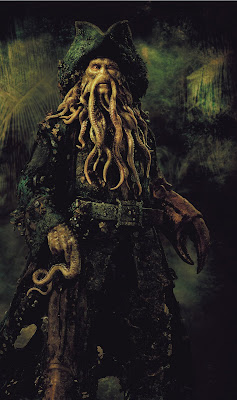
Another great bit of casting is Bill Nighy as Davy Jones. His face is obscured by the visual effects of the tentacles they give him, but he is still able to emote strongly with his eyes, and it’s clear that the facial expressions of his tentacled mug are models on the real expressions he made at the time, so much so that I found him totally believable as a character. His performance here is along the lines of Andy Serkis as Gollum in the Lord of the Rings films: even though we see almost nothing of the actual man, he gives a full-on performance through and through, as the man fearsome enough to make Captain Jack Sparrow afraid. And as long as I’m on the subject of Davy Jones, he’s really a great character, a man who has become somewhat twisted and refused to carry on his duties as Captain of the Dutchman in his bitterness over his doomed love for Calypso. The scene between him and her in the hold of the Pearl is a really good scene: he demands to know why she wasn’t there for him when she’d said she would be, and she replies, “It is my nature.” Isn’t that the truth? The beautiful sea has been betraying sailors ever since men first put boats into water. There’s quite a lot of insight in these films that slides right by, almost unnoticed.

So who, then, is the weak link in the cast whom I mention above? Sadly, it’s a big one, and it’s probably the biggest reason I think that the PotC sequels miss the mark of being potentially great adventure movies. It’s the guy who plays the main villain of the two films, Lord Cutler Beckett. I can’t remember the name of the actor, and that’s the problem: he’s as white-bread a villain as you’ll find, basically using two facial expressions and a British accent to establish his villainy. This is a person who aspires to ruling over all the seas of the world, and he is brazen enough to take command over Davy Jones himself, and he’s played by one of the blandest actors I’ve ever seen. He’s supposed to be the virtual equal of Captain Jack Sparrow, having been the man who branded the Captain a pirate, and yet, the actor is blown off the screen by Johnny Depp in their one big scene together. Heck, he’s even dominated on the screen by Orlando Bloom. For this part, an actor was needed who was at least equal to Johnny Depp, and this simply didn’t happen. A great adventure movie needs a great villain. This one could have had a great villain, but it didn’t. (Aside from Davy Jones.)

The failure of Lord Beckett isn’t just the actor’s fault, though; the script leaves him too blank. We learn that Beckett and Jack Sparrow have a history, but we learn nothing at all of what that history is. Jack points out that his compass won’t help Beckett because what Beckett most wants is Sparrow dead. This is an interesting little twist, but the obvious question — why does Beckett want Sparrow dead – is never answered. Beckett is more cypher than character, and it hurts the film.

Other problems with AWE are smaller, but real. The freeing of Calypso from her human bonds is a good scene – Captain Barbossa’s interpretation of what it means to “speak to a lover” is hysterical – but then there’s a very odd bit where Calypso suddenly becomes a fifty-foot giant before exploding into a million crabs. This was just silly.

Also faulty is the nature of the final battle. While it’s certainly true that we only really need to see a clash between the Black Pearl and the Flying Dutchman, since those are the two ships we’re actually invested in, this needed a bit more set-up, since the film has to this point been setting up a massive battle between the pirate fleet and the English. Even worse is that there was an obvious way to do this: by resorting to the Pirate Code of the Brethren. (“I call on the right of Single Combat by ship: one vessel from each fleet. The Pearl versus your flagship.” Which Beckett could then use to seize the upper hand by sending not his flagship, but the invincible Dutchman.) Truth is, as much as I loved watching these two films, they definitely could have used another run-through in the script-writing phase. A lot of necessary exposition in these movies comes at very odd times: it’s from the dead Governor Swann (whose demise really should have been shown onscreen, come to that) that we first hear the fateful words “The Dutchman must have a Captain”, and the explanation for Tia Dalma’s resurrection of Captain Barbossa goes by in a flash, even though it makes perfect and utter sense (he’s one of the Pirate Lords, and without him, she can never be freed from her human bonds as Calypso).

So the second and third PotC films are big, loud, exuberant films that feature many conflicting loyalties and actions on the part of their characters that are sometimes a bit hard to follow. But that’s not the same as saying that these films are a “mess”.

(I’ll say something in a later post about Hans Zimmer’s music for these films. Zimmer’s a troublesome figure in film music.)

Share This Post

Top Men

Indiana Jones, standing on some crates:

Who cares about crates? Well, remember the very last shot in Raiders of the Lost Ark…a warehouse full of crates…and what’s in one of those crates….

(via)

Share This Post

Top Ten Bond Females

So I was thinking of stealing a posting habit from Tosy and Cosh, and start doing Top Ten lists of random stuff, and the other night, as The Family Unit sat down to watch For Your Eyes Only, I figured I had the obvious starting list: my personal Top Ten Bond Girls. Well, lo and behold, it turns out that someone went and took a poll to determine who the Top and Bottom Ten Bond Girls happen to be, at least as far as British public opinion goes. I’ll give my own list below, but first, I must discuss the polling results, because they’re, well, really bad.

First, here are the lists, with the Worst Bond Girls first, followed by the Best Bond Girls.

(Wait a minute, actually, before I do that, let me renew my objection to the somewhat sexist term “Bond Girls”. I only use it here because the linked article already uses it, and it’s pretty much the accepted way of referring to these characters as a group.)

OK, the lists:

Worst Bond girls

1. Denise Richards as Dr Christmas Jones in “The World Is Not Enough”
2. Tanya Roberts as Stacey Sutton in “A View To A Kill”
3. Corrine Clery as Corinne Dufour in “Moonraker”
4. Maryam D’Abo as Kara Milovy in “The Living Daylights”
5. Karin Dor as Helga Brandt in “You Only Live Twice”
6. Britt Ekland as Mary Goodnight in “The Man With the Golden Gun”
7. Carey Lowell as Pam Bouvier in “License to Kill”
8. Lois Chiles as Holly Goodhead in “Moonraker”
9. Lynn-Holly Johnson as Lili Bahl in “For Your Eyes Only”
10. Maud Adams as Octopussy in, you guessed it, “Octopussy”

Best Bond girls

1.Ursula Andress as Honey Ryder in “Dr. No”
2. Honor Blackman as Pussy Galore in “Goldfinger”
3. Diana Rigg as Tracey Divicenzo in “On Her Majesty’s Secret Service”
4. Eva Green as Vesper Lynd in “Casino Royale”
5. Barbara Bach as Anya Amasova in “The Spy Who Loved Me”
6. Famke Janssen as Xenia Onatopp in “Goldeneye”
7. Michelle Yeoh as Wai Lin in “Tommorrow Never Dies”
8. Lotte Enya as Rosa Klebb in “From Russia With Love”
9. Jill St. John as Tiffany Case in “Diamonds Are Forever”
10. Carole Bouquet as Melina Havelock in “For Your Eyes Only”

Got all that? Well, where to begin?

First of all, we should probably establish just what a “Bond Girl” is, since by my personal reckoning, some of those listed aren’t “Bond Girls” at all. When I read these lists, I had to think to myself, “Hmmm, they seem to be pretty liberal in what they consider to be a Bond Girl”, which then led me to wonder what a Bond Girl really is. My personal definition, therefore, is as follows:

A Bond Girl is a female character with whom James Bond engages in the act of sexual congress who is either (1) on Bond’s side, (2) totally incidental to Bond’s mission, or (3) initially against Bond but comes to his side after the afore-mentioned act of sexual congress.

This definition automatically rules out several of the “Bond Girls” listed in the polls. Taking their “Worst Girls” list first, we can exclude Helga Brandt (You Only Live Twice), because she’s a villain and although Bond gets her to not kill him by using his manly charm, she doesn’t change her allegiance, and we can likewise toss aside Bibi Dahl (For Your Eyes Only), who is a notable female character in that not only does Bond not sleep with her, he actually refuses to do so, and quite vehemently, at that. Those two are not Bond Girls. (By the way, you’d think that whoever wrote this article could at least get the character names right. It’s Bibi Dahl, not Lili.)

As for the second list, GoldenEye‘s Xenia Onatopp is disqualified on two counts: first, she’s a villain who doesn’t change allegiance, and second, she doesn’t actually sleep with James Bond. (They engage in some kinky swimming pool foreplay before Bond grabs his gun and forces her to take him to the boss.) The same goes for From Russia With Love‘s Rosa Klebb, whose presence on this list is almost laughable: not only is she a villain through and through who never considers changing sides for one second, and not only does she not sleep with James Bond, it’s doubtful that Bond would ever even attempt to sleep with her because she’s and old, ugly, and frumpy woman, to be quite frank. (If you’re having trouble placing her, this should help.) The notion that Rosa Klebb can be thought of as a Bond Girl makes one wonder if the people putting the poll together just gathered a list of female characters who appear in Bond movies and called them all “Bond Girls”; if that’s the case, one rightly wonders why Miss Moneypenny doesn’t appear on the list. (Not that she should, since she’s not a Bond Girl either.)

And besides, the lists are just bad anyway, on other grounds. Ursula Andress is the best Bond Girl? Huh? Sure, that shot of her, bikini-clad as she emerges from the water, is a famous shot, but as a character, she’s of almost no interest at all, and Andress’s performance is pretty much monotoned throughout. Honor Blackman, second? Ahead of Diana Rigg? Really, folks, we need to get over the notion that Goldfinger is the best of the Bond movies. Pussy Galore’s got that name, of course, but again, she’s not a terribly interesting character and it doesn’t help that Blackman comes in third among the other potential Bond Girls in the very same film, in terms of plain physical beauty. (Both of the doomed Masterson sisters are prettier, and it’s a shame Tilly had to die, because she was potentially interesting.)

Likewise, I’ve always thought that Barbara Bach is a tad overrated as well in The Spy Who Loved Me. Her accent is unconvincing, and while the idea of Bond having a female counterpart in the KGB who’s as capable as he is could be interesting, the movie doesn’t really do much with this notion, making Anya a damsel-in-distress several times, including at the end of the movie. And Jill St. John’s Tiffany Case (Diamonds Are Forever)? Huh-whuh? Bond himself calls her a “stupid twit”, and that’s pretty much what she turns out to be.

Of course, the lists aren’t complete bollocks. Some Bond Girls fail on the basis of their performances (Honey Rider), while others fail because the characters aren’t well written (Stacy Sutton), and all this is opinion, anyway. It’s always struck me as unfair that Tanya Roberts gets pilloried for her character’s wailing (“James! Don’t leave me! James! James!”) and her failure to notice things like propeller-driven airships coming up behind her, when none of that was Roberts’s fault, unless she did some script-doctoring and didn’t receive screen credit for her work in that capacity. Likewise, Denise Richards can’t be blamed totally for her character’s lack of focus in the script to The World is Not Enough, but frankly, as an actress she’s blown right off the screen by Sophie Marceau (not a Bond Girl, because she’s a villain to the end).

So there are names I’d bump from the “Best” list, but what of the “Worst” list? Who would I bump there? Well, frankly, I’ve always liked Lois Chiles (Moonraker), Maud Adams (Octopussy), and Maryam d’Abo (The Living Daylights). They perform well, they’re beautiful, and the characters are nicely written. Chiles, I think, may be the most underrated of all “Bond Girls”; she’s the CIA female equivalent of Bond, as Anya Amasova was one film earlier in the KGB, but she doesn’t end up the damsel in distress, instead being an actual equal and partner in Bond’s heroics. Maud Adams and Maryam d’Abo also show a lot of spunk, with d’Abo particularly displaying nice character growth as she becomes more and more capable as the film goes on.

But anyway, time for what I meant to do in the first place: a list of the Top Ten Bond Girls.

1. Diana Rigg as Teresa di Vicenzo, On Her Majesty’s Secret Service.

2. Eva Green as Vesper Lynd, Casino Royale.

3. Carole Bouquet as Melina Havelock, For Your Eyes Only.

4. Lois Chiles as Holly Goodhead, Moonraker.

5. Claudine Auger as Domino Derval, Thunderball.

6. Jane Seymour as Solitaire, Live and Let Die.

7. Carey Lowell as Pam Bouvier, Licence to Kill.

8. Izabella Scorupco as Natalya Simonova, GoldenEye.

9. Maud Adams as Octopussy, Octopussy.

10. Maryam d’Abo as Kara Milovy, The Living Daylights.

And there you have it. No, I’m not doing a worst list.

Share This Post

The Big E

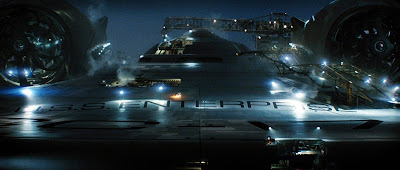
The USS Enterprise under construction in JJ Abrams’s upcoming Star Trek movie:

That’s a pretty cool image, even if shots of the Enterprise in drydock are getting a little passe, aren’t they? I mean, the various Enterprises are shown in drydock in eight of the existing movies already. If you look closely, you can make out the front of the warp nacelles, flanking the saucer section behind. Maybe it’s a trick of perspective, but those nacelles seem awfully close, don’t they? And big? I wonder what the actual Big E for the movie will look like. I suppose it’ll be like every iteration of the Big E: same basic shape but some different bells and whistles.

I’m still not wild about Abrams in charge of Trek, but then I’m not terribly wild about Trek anymore anyway. We’ll see.

Share This Post