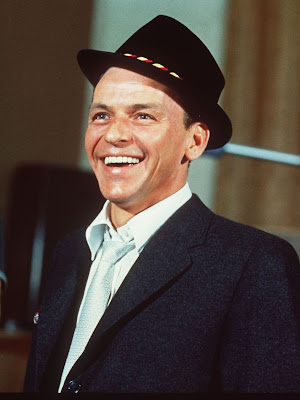
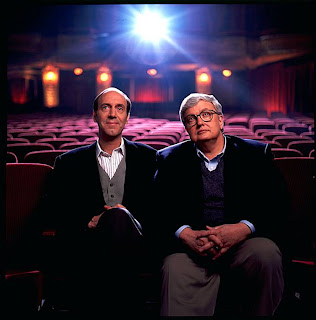
The Chairman of the Board will see you now.


Sheila O’Malley has a typically lovely post about Frank Sinatra, whose birthday is today. I started composing a comment on her site, but then I realized that my thoughts were getting away from me, so I decided to bring it over here. Sinatra has been a part of my universe for as long as I can remember; my parents owned a bunch of his records, which were on constant rotation in my childhood. I remember his distinctive sound, sometimes clear and sometimes with just a hint of rasp (depending on what he wanted to express), his sense of rhythm (he could make a song swing without any assisting percussion at all), his lyricism, and his unfailing sense of how to land the emotional beats of a song. This last gift is rare indeed, and it’s interesting to me that I’m featuring two singers so highly gifted in that regard on the same day (scroll down to today’s Daily Dose of Christmas post). And of course he wasn’t just a singer; Sinatra was also a very fine actor with a lot of range. He was in a lot of movies and he won an Oscar along the way and he still might be underrated as such.

The earliest of his roles that I’ve seen is Anchors Aweigh, in which he plays a Navy sailor who is very young and naive, who has to be instructed by his older buddy Gene Kelly in the ways of the world (meaning, how to flirt without seeming weird about it…in the late-1940s meaning of ‘flirting’). Somehow he pulls this off without getting blown off the screen by Kelly; in fact, the two men have a partnership in that movie that elevates it. Anchors Aweigh isn’t quite one of the immortal musicals–it’s no Singin’ in the Rain–but it’s damned close.

Just eight years later Sinatra put his dramatic skills on display in a dark turn as Private Maggio in From Here to Eternity, a movie that hit me between the eyes when I watched it in high school. I was channel-flipping lazily, and I happened to land on the opening credits; next thing I knew it was two hours later and the movie was over and I hadn’t touched the remote the entire time. Sinatra plays the cocky, arrogant young hothead whose actions end up costing him everything. There are some weird stories–legends, actually–about how Sinatra got the role in the first place, but it doesn’t really matter how he got it. The man ended up winning a Best Supporting Actor Oscar for it, and there’s a reason for that. Last time I watched From Here to Eternity I found it every bit as gripping as I did when I accidentally watched it as a sixteen-year-old.

Sinatra would bounce in and out of musicals a lot, and his dramatic turns always seemed to be in the crime genre. There was a teevee movie in the 70s called Contract on Cherry Street that I remember, and there’s his amazing performance in The Manchurian Candidate. He even turned up in the 1980s in an episode of Magnum PI, a show that often leavened its generally light-hearted tone with detours into espionage thrillers and, in the case of Sinatra’s episode, pure noir.

Maybe it’s easy to discount Frank Sinatra a little because of the genres in which he worked or the popular forms he pursued, but for my money, you can’t tell the story of American art in the 20th century without talking about Frank Sinatra.

Sheila starts her post with this quote (possibly aprocryphal) by Bing Crosby: “Frank is a singer who comes along once in a lifetime, but why did he have to come along in mine?” I can’t read that quote without thinking of High Society, a movie that was also a favorite of both my parents. It’s a musical remake of The Philadelphia Story, with Crosby as C.K. Dexter Haven (the romantic lead who is pining for Grace Kelly), and Sinatra as Mike Connor, the gossip rag reporter sent to cover Kelly’s impending nuptials. (Those roles were originated by Cary Grant and James Stewart, with Katherine Hepburn in the later-Grace Kelly part.) High Society is a fun movie, though this story is really better told in the original, as parts of the script had to be set aside to make room for the musical numbers, and…well, I have to agree with my sister, who once said on a Christmas Eve when one of Crosby’s Christmas movies was on and we’d all taken in a few beers, “Whoever thought to cast Bing Crosby as a romantic lead was out of their mind.”

Well, I don’t know about that, but it’s always struck me as very strange that this movie has Bing Crosby and Frank Sinatra together, and it gives them exactly one number together…and that number had to be added at the last minute when the producers suddenly realized that they had Crosby and Sinatra in the same movie with no shared numbers. Astonishing! Can you imagine such a thing? Almost making an entire movie with two of the 20th century’s greatest American singers in it and only realizing near the end that you’ve given them zero duets? That’s like having Babe Ruth and Mickey Mantle on the same team, but benching one of them at all times. Luckily for High Society, that one number is a hell of a number:

Of course, I can’t write about Sinatra without discussing his singing a little bit. Many years ago I read an interview with one of my personal musical heroes, the great Chicago Symphony orchestra trumpet player Adolph Herseht, in which among many other things he recommended that young trumpet players (among others) listen to great vocalists like Frank Sinatra, on the basis that all music, even for instrumentalists, starts with the human voice, and I remember Herseth citing Sinatra for always telling a story with his singing. That is absolutely true.

I’ll close this with my favorite track from my favorite Sinatra album, Frank Sinatra Sings for Only the Lonely. Just listen to Sinatra’s absolute control in this song! He fades away at the end, fading fading fading (“Answer, echoes, dying dying dying,” Tennyson might write), but his pitch never wavers, which is something that requires enormous technical skill: singing (or playing, if you’re on an instrument) a note correctly, and making it sound full, while also making it piano or pianissimo is a skill that many musicians don’t realize they need until well into their careers. And I’ll have to write sometime about my father’s favorite Sinatra song…but that needs a post of its own.


Share This Post

Tone Poem Tuesday

One of the eternal questions in relating to art is how to separate one’s feeling for the art from one’s feelings for the artist. This is not the least bit new; it’s a problem that is probably as old as art itself. There have been so very many artists whose own lives and statements fall well short of the art they produce. I find myself thinking anew, as one of the oldest and yet most irritatingly persistent of hatreds, anti-Semitism, just keeps arising again like the very worst of pennies, of Richard Wagner.

You can barely read a biography of Wagner that covers the man’s life in any depth beyond “He was born in 1813, died in 1883, and wrote operas” without confronting what a staggering boor he was, a fact which…

…[shit]…

You know what, to hell with that. I love Wagner’s music, but I don’t want to write about Wagner right now, not when my country’s discourse is once again mainstreaming awful crap about the Jews again.

Let’s talk about Jewish composers instead. We’ll start with Alfred Schnittke.

Schnittke, of whose music I am mostly ignorant, was a Russian composer of Jewish and German ancestry. I’m sure that particular blend of ethnicities and nationalities made for some strife in his life. He was born in 1934 in Russia, and started his musical education in 1946, after the war and after the Holocaust. Not long after, he moved along with the rest of his family back to Russia, where he lived for most of the rest of his life. Thus he had to toil in the air of state control that was the artistic scene in Soviet Russia, until he finally left for good in 1990. Schnittke died in 1998.

His music–and I am going on reference here, rather than my own personal insight–is influenced early on by the great Soviet composer Dmitri Shostakovich, but later on in his life, as great artists do, he developed his own sound and voice. It’s a voice I know little about. So many voices to hear, so little time!

This work is a ballet called Sketches. In a sequence of twenty-two short pieces, Schnittke puts on display a great deal of sardonic wit, seemingly poking fun at the entire proceedings. He even goes so far as to quote or reference other classical composers along the way, and his use of rhythm and color are infectiously amusing. One of the segments even utilizes a spoken-voice part, which threw me off the first time I heard it; at first I thought one of my other open tabs had stumbled upon a voice recording.

Here is Sketches by Alfred Schnittke.


Share This Post

Something for Thursday

Back, at last, to Leonard Cohen, while it’s still September. This time, we’ll look at “Take This Waltz”.

I’ve only heard “Take This Waltz” either on its own or in the context of a Cohen Greatest Hits album, so I didn’t know that it is actually based on a poem by a Spanish poet or that it first appeared on an album comprised entirely of settings of this poet.

The album was Poetas en Nueva York, and it was a collaborative project in which a number of artists, Cohen among them, paid tribute to Spanish poet Federico Garcia Lorca (1898-1936). Lorca’s short life was likely a difficult one, as he grappled with (among other things) being gay in early 20th century Spain, and he was eventually murdered by the Nationalists.

One of his poems, “Little Viennese Waltz”–which Lorca wrote during a two-year stint in New York City–was translated, adapted, and set to music by none other than Leonard Cohen for the afore-mentioned album, and in this setting Lorca’s poem has achieved a kind of new immortality.

Here’s the poem:

In Vienna there are ten little girls,
a shoulder for death to cry on,
and a forest of dried pigeons.
There is a fragment of tomorrow
in the museum of winter frost.
There is a thousand-windowed dance hall.

Ay, ay, ay, ay!
Take this close-mouthed waltz.

Little waltz, little waltz, little waltz,
of itself of death, and of brandy
that dips its tail in the sea.

I love you, I love you, I love you,
with the armchair and the book of death,
down the melancholy hallway,
in the iris’s darkened garret,

Ay, ay, ay, ay!
Take this broken-waisted waltz.

In Vienna there are four mirrors
in which your mouth and the ehcoes play.
There is a death for piano
that paints little boys blue.
There are beggars on the roof.
There are fresh garlands of tears.

Ay, ay, ay, ay!
Take this waltz that dies in my arms.

Because I love you, I love you, my love,
in the attic where the children play,
dreaming ancient lights of Hungary
through the noise, the balmy afternoon,
seeing sheep and irises of snow
through the dark silence of your forehead

Ay, ay, ay, ay!
Take this ” I will always love you” waltz

In Vienna I will dance with you
in a costume with
a river’s head.
See how the hyacinths line my banks!
I will leave my mouth between your legs,
my soul in a photographs and lilies,
and in the dark wake of your footsteps,
my love, my love, I will have to leave
violin and grave, the waltzing ribbons

And here is Cohen’s song. Cohen’s voice lends a kind of surreal gravity to the music and the words, as his gravely baritone seems to rise from the earth, barely conforming to the waltz rhythm at all at first. There’s a dreamy earthiness to Cohen’s setting; I wonder how Lorca might have felt about it.

Share This Post

Apollo at Fifty (a repost)


Sam Seaborn: There are a lot of hungry people in the world, Mal, and none of them are hungry ‘cause we went to the moon. None of them are colder and certainly none of them are dumber ‘cause we went to the moon.

Mallory O’Brian: And we went to the moon. Do we really have to go to Mars?

Sam Seaborn: Yes.

Mallory O’Brian: Why?

Sam Seaborn: ‘Cause it’s next. ‘Cause we came out of the cave, and we looked over the hill and we saw fire; and we crossed the ocean and we pioneered the west, and we took to the sky. The history of man is hung on a timeline of exploration and this is what’s next.

–from “Galileo Five”, season two of The West Wing, written by Aaron Sorkin

Anniversaries are a good thing, even if they’re leavened with the weight of years of thwarted expectations and deferred dreams, as the First Lunar Landing’s is: Why have we never gone back? Why are we stuck in low-Earth orbit? Was it all just politics and none of it the call of the stars?

But such anniversaries are a bit of a balm in times such as these, when humanity seems bound and determined to roll back on itself like some kind of distended, drunken serpent consuming its own tail in a weird and awful version of an ouroboros. We can look back on the Apollo missions as a reminder of the kinds of things humanity can do when the primary motive isn’t necessarily profit.

I was born in September 1971, which means that I have never lived in a world where the Moon was not a place where humans have gone. I hope that I live to see a day when the Moon is no longer the only place other than Earth that we’ve gone.


From Pale Blue Dot by Carl Sagan:

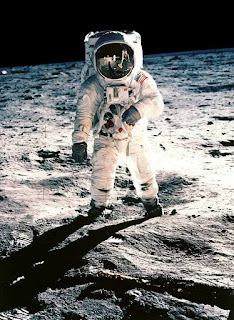
It’s a sultry night in July. You’ve fallen asleep in the armchair. Abruptly, you startle awake, disoriented. The television set is on, but not the sound. You strain to understand what you’re seeing. Two ghostly white figures in coveralls and helmets are softly dancing under a pitch-black sky. They make strange little skipping motions, which propel them upward amid barely perceptible clouds of dust. But something is wrong. They take too long to come down. Encumbered as they are, they seem to be flying — a little. You rub your eyes, but the dreamlike tableau persists.

Of all the events surrounding Apollo 11‘s landing on the Moon on July 20, 1969, my most vivid recollection is its unreal quality. Neil Armstrong and Buzz Aldrin shuffled along the gray, dusty lunar surface, the Earth looming large in their sky, while Michael Collins, now the Moon’s own moon, orbited above them in lonely vigil. Yes, it was an astonishing technical achievement and a triumph for the United States. Yes, as Armstrong said as he first alighted, this was a historic step for the human species. But if you turned off the byplay between Mission Control and the Sea of Tranquility, with its deliberately mundane and routine chatter, you could glimpse that we humans had entered the realm of myth and legend.

We knew the Moon from our earliest days. It was there when our ancestors descended from the trees into the savannahs, when we learned to walk upright, when we first devised stone tools, when we domesticated fire, when we invented agriculture and built cities and set out to subdue the Earth. Folklore and popular songs celebrate a mysterious connection between the Moon and love. The word “month” and the second day of the week are both named after the Moon. Its waxing and waning — from crescent to full to crescent to new — was widely understood as a celestial metaphor of death and rebirth. It was connected with the ovulation cycle of women, which has nearly the same period — as the word “menstruation” (Latin mensis = month, from the word “to measure”) reminds us. Those who sleep in moonlight go mad; the connection is preserved in the English word “lunatic”. In the old Persian story, a vizier renowned for his wisdom is asked which is more useful, the Sun or the Moon. “The Moon,” he answers, “because the Sun shines in daytime, when it’s light out anyway.” Especially when we lived out-of-doors, it was a major — if oddly tangible — presence in our lives.

The Moon was a metaphor for the unattainable: “You might as well ask for the Moon,” they used to say. Or “You can no more do that than fly to the Moon.” For most of our history, we had no idea what it was. A spirit? A god? A thing? It didn’t look like something big far away, but more like something small nearby — something the size of a plate, maybe, hanging in the sky a little above our heads. Ancient Greek philosophers debated the propositon “that the Moon is exactly as large as it looks” (betraying a hopeless confusion between linear and angular size). Walking on the Moon would somehow have seemed a screwball idea; it made more sense to imagine somehow climbing up into the sky on a ladder or on the back of a giant bird, grabbing the Moon, and bringing it down to Earth. Nobody ever succeeded, although there were myths aplenty about heroes who had tried.

Not until a few centuries ago did the idea of the Moon as a place, a quarter-million miles away, gain wide currency. And in that brief flicker of time, we’ve gone from the earliest steps in understanding the Moon’s nature to walking and joy-riding on its surface. We calculated how objects move in space; liquefied oxygen from the air; invented big rockets, telemetry, reliable electronics, inertial guidance, and much else. Then we sailed out into the sky.

The Moon is no longer unattainable. A dozen humans, all Americans, have made those odd bouncing motions they called “moonwalks” on the crunchy, cratered, ancient gray lava — beginning on that July day in 1969. But since 1972, no one from any nation has ventured back. Indeed, none of us has gone anywhere since the glory days of Apollo except into low Earth orbit — like a toddler who takes a few tentative steps outward and then, breathless, retreats to the safety of his mother’s skirts.

Once upon a time, we soared into the Solar System. For a few years. Then we hurried back. Why? What happened? What was Apollo really about?

For me, the most ironic token of that moment in history is the plaque signed by President Richard M. Nixon that Apollo 11 took to the Moon. It reads: “We came in peace for all mankind.” As the United States was dropping 7.5 megatons of conventional explosives on small nations in Southeast Asia, we congratulated ourselves on our humanity: We would harm no one on a lifeless rock. That plaque is there still, attached to the base of the Apollo 11 Lunar Module, on the airless desolation of the Sea of Tranquility. If no one disturbs it, it will still be readable millions of years from now.

Six more missions followed Apollo 11, all but one of which successfully landed on the lunar surface. Apollo 17 was the first to carry a scientist. As soon as he got there, the program was canceled. The first scientist and the last human to land on the Moon were the same person. The program had already served its purpose that July night in 1969. The half-dozen subsequent missions were just momentum.

Apollo was not mainly about science. It was not even mainly about space. Apollo was about ideological confrontation and nuclear war — often described by such euphemisms as world “leadership” and national “prestige”. Nevertheless, good space science was done. We now know much more about the composition, age, and history of the Moon and the origin of the lunar landforms. We have made progress in understanding where the Moon came from. Some of us have used lunar cratering statistics to better understand the Earth at the time of the origin of life. But more important than any of this, Apollo provided an aegis, an umbrella under which brilliantly engineered robot spacecraft were dispatched throughout the Solar System, making that preliminary reconnaissance of dozens of worlds. The offspring of Apollo have now reached the planetary frontiers.

If not for Apollo — and, therefore, if not for the political purpose it served — I doubt whether the historic American expeditions of exploration and discovery throughout the Solar System would have occurred. The Mariners, Vikings, Pioneers, Voyagers, and Galileo are among the gifts of Apollo. Magellan and Cassini are more distant descendants. Something similar is true for the pioneering Soviet efforts in Solar System exploration, including the first soft landings of robot spacecraft — Luna 9, Mars 3, Venera 8 — on other worlds.

Apollo conveyed a confidence, energy, and breadth of vision that did capture the imagination of the world. That too was part of its purpose. It inspired an optimism about technology, an enthusiasm for the future. If we could fly to the Moon, as so many have asked, what else were we capable of? Even those who opposed the policies and actions of the United States — even those who thought the worst of us — acknowledged the genius and heroism of the Apollo program. With Apollo, the United States touched greatness.

When you pack your bags for a big trip, you never know what’s in store for you. The Apollo astronauts on their way to and from the Moon photographed their home planet. It was a natural thing to do, but it had consequences that few foresaw. For the first time, the inhabitants of Earth could see their world from above — the whole Earth, the Earth in color, the Earth as exquisite spinning white and blue ball set against the vast darkness of space. Those images helped awaken our slumbering planetary consciousness. They provide incontestable evidence that we all share the same vulnerable planet. They remind us of what is important and what is not. They were the harbingers of Voyager‘s pale blue dot.

We may have found that perspective just in time, just as our technology threatens the habitability of our world. Whatever the reason we first mustered the Apollo program, however mired it was in Cold War nationalism and the instruments of death, the inescapable recognition of the unity and fragility of the Earth is its clear and luminous dividend, the unexpected final gift of Apollo. What began in deadly competition has helped us to see that global cooperation is the essential precondition for our survival.

Travel is broadening.

It’s time to hit the road again.

Someday we’ll look up with wonder again. Someday we’ll go. I firmly believe that.


Footage of Walter Cronkite’s live broadcast of the lunar landing. Note his happy amazement at what he gets to report, at the 1:58 mark. He takes off his glasses, shakes his head, and smiles at the person next to him. I can’t help contrasting that with another moment when, while reporting on air, he had to remove his glasses and shake his head with disbelief, less than six years prior to this moment.


And I know it’s not the right mission, but for the movie Apollo 13, James Horner managed to really catch some of the unbridled optimism of the entire Apollo era.


Seriously, humans: when are we going back, and when are we going farther?


Share This Post

A Repost: “Whacking. I’m hell at whacking.”

I first wrote this post in 2008, back in the days of Byzantium’s Shores. I repost it now on the occasion of Harrison Ford’s 80th birthday.


Sheila waxes poetic on one of my favorite movies, Witness. (Yeah, I didn’t rank it highly enough.) Here’s Sheila:

Let’s look at how delicately things are set up in this film – so much so that you don’t notice them. John Book has recovered (somewhat) from his wound and Samuel Lapp takes him on a tour of the farm. He shows him the well. (“It goes … it makes … it goes …” so cute) He shows him the silo and tells him how it works. He shows him the trap door. All of this will become crucial in the final scenes, as John Book sneaks around, trying to evade the murderers. But what becomes clear, beautifully, in subsequent viewings – is that it is SAMUEL who showed Book the way. It is SAMUEL who, innocently, gave John Book the tools for survival in those crucial end moments. And so the title of the film takes on even more meaning, more depth. WITNESS. “What’s up there?” asks John Book. “Corn,” answers Samuel. Notice the grace and simplicity of how that information is imparted. You might not even notice it. A lesser film would have just had John Book figuring out how the silo worked while he was under the gun (which is how so many thrillers operate – they ARE their plots. That’s it.) … but in Witness we are introduced, via Samuel, to “the way things work”. And he’s excited to show John Book around and to show him the well and also to show him how much he knows. It isn’t until later that we realize what Samuel Lapp has done, in that innocent tour.

She’s absolutely right. The exposition there is handled so well. Problems can often arise with this kind of thing, in movies like this; they’ve got to get that gun onto the mantle in Act One so it can go off in Act Three, but so many times, the filmmakers go overboard, making it blindingly obvious that they’re setting up something for later. This quiet scene between Samuel and Book, where Sam’s just showing Book around the farm, helps us get our bearings, and we never realize that we’re being set up for the climax.

Done wrong, this sort of scene-setting stands out like a sore thumb. A perfect example is in James Cameron’s Aliens, where we have that early scene where the one female Marine is demonstrating the robotic forklift-you-can-wear thing: there’s never one iota of doubt that Ripley will be putting that thing on and using it as a weapon by film’s end. That’s just badly done. Of course, Cameron would later get it right in Titanic, where he knew that he would have to make clear to the audience what exactly was going on at each stage of the ship’s sinking, but he also know that he couldn’t stop the tension of Rose and Jack’s harrowing exploits in the ship’s water-filled lower decks to explain it all, so he gives us the computer simulation of the sinking early in the movie. We never have to stop the action so Jack can tell Rose something like “See, the ship is going down by the head, so the stern’s going to rise up. I just hope the ship’s hull can withstand that pressure, because if it can’t, the ship will break in two!” Likewise, in Witness, we’re spared John Book talking to himself (us), saying things like “This is a silo! I’ll bet there’s corn up there!”

Sheila’s post also gives an appreciation for Harrison Ford’s work in Witness, a performance that Ford has never since come close to equaling. His work in this film is as good an example of character creation as I’ve ever seen. There’s not one moment in the film where Ford in the slightest way echoes something he did as Han Solo or Indiana Jones. His performance is full of tiny little touches, moments it’s so easy to miss, that add up to John Book being a real person, and not just a guy on a screen. I commented over there as follows (fixing my own typos):

Every time I watch this film I get a little more sad that this appears to be the last time Harrison Ford really used his talent to great effect. His performance is full of so many little details. I love how, after Eli interrupts his dancing with Rachel, he heartbreakingly wipes the sweat of his forehead on his shoulder. I love how the first time he’s handed a glass of lemonade (by Rachel) he downs the whole thing in one gulp, but the next time (by Hochleitner) he takes a single small sip and hands it back. I love how at the end, after he’s beaten the bad guys and all the cops are there on the farm, he’s standing there, leaning exhaustedly against a police car, having a much needed cigarette, when we haven’t seen him smoke at all in the whole film to that point.

I think that a good test for people I meet is to see if they give me a knowing smile when I tell them to “Be careful out among them English.”

Of course, I could go on. I love the bashful smile that Rachel gives John Book when they’re in the workshop and Book’s working on fixing the birdhouse he’d earlier driven into. She’s smiled at him politely before, usually with her lips, but this is different; she shows her teeth here in a full smile that’s at once more revealing and yet more shy than she’s been to that point. I think that’s when she first starts realizing her attraction to Book, because of the line that accompanies that smile, a very simple observation on her part: “You know carpentry.” In that moment I think that Book stops being something alien to her, some being almost literally from another world she can never know. I think that’s where it starts. Witness really is full of tiny moments of magic that you don’t even realize are there until you think about them.

On another tangent, a recent thread over at FSM included speculation on the relative lack of eroticism in the scores of John Williams. While only a couple of readers make the obvious point that John Williams really hasn’t scored any movies much at all that would call for an erotic kind of tone, others bring up as an example of a “sexy” score Jerry Goldsmith’s Basic Instinct. Now, that is a terrific thriller score, but I’m not sure how sexy it is. Basic Instinct, for all its kinky subject matter, just isn’t sexy to me. In the whole of that film, with all its nudity and violent sex and infamous shots of Sharon Stone’s privates, there is nothing at all that is nearly as erotic and beautiful and sexy as in Witness when John Book and Rachel Lapp dance in the barn to a golden oldie, with no clothing being removed at all.

(One of my favorite bits of trivia about Witness is that the barn dance was filmed during daylight in the middle of summer. Since it had to be night, the crew basically draped tarps over every entrance to the barn, thus creating the necessary darkness, but also making it really really hot in there; hence the sweating that only highlights the emotion of the moment.)

For me, just about the only flaw in Witness is the film’s score, by Maurice Jarre. It was the mid-80s, and at the time Jarre was into heavy synthesizer use, and this score is just about entirely on synth, if not entirely outright. Some of the atmospheric music early on works nicely, but it’s all mostly long chords that set a tone, and of course, the barn-raising scene is a wonderfully scored sequence. (When watching it, there’s a bit early on where John Book introduces himself to a new group of Amish men he hasn’t met before. The first one whose hand he shakes, the one in the light green shirt? That’s a young Viggo Mortensen, there, fifteen years before he’d take up his role as Aragorn son of Arathorn, King of Gondor.) The score’s “suspense” material is all fairly routine and a bit repetitive; none of the music hurts the film, but I’ve always thought that the film would have been better served with a more strong touch of melody, excepting that great barn raising set piece.

ADDENDUM: At the risk of sounding like I’m damning Jarre’s work with faint praise, the afore-mentioned barn-raising scene really is something. Here it is in a full orchestral version, and it’s really quite something:

More than that, while I’m still not in love with much of Jarre’s work on this film–much of it is pretty much what you’d expect to hear in any 80s synth-driven police prcedural score–it’s better than what I describe above. Jarre avoids some of the obvious choices he could have made; he doesn’t try at all to echo a Coplandesque “Appalachian Spring” approach; instead he writes music that echoes the “plain” values of the Amish without resorting to obvious attempts to quote “Simple Gifts”, for example.

Anyway, you all be careful, out among them English.

Share This Post

Something for Thursday

Continuing our survey of “Conversation songs”, in which the lyrics give us one side of a conversation, we have “I Don’t Want To Talk About It” by Crazy Horse.

“I Don’t Want To Talk About It” was written by Danny Whitten, a guitarist and songwriter with the band Crazy Horse before he died of an overdose in 1972. The song is a distillation of all the things a lover might want to say to his partner after their breakup, which to judge by the lyrics, was less than friendly. You can really hear the pain here, really feel it–and it’s not at all clear if the old lover is even there to hear any of this.

Share This Post

National Poetry Month, day 9: Tigers!

Minimalism is sometimes best, as the world learned four years ago when a poem by a then-six-year-old took the Internet by storm. Behold this bit of poetic genius:

“The Tiger”, by a kid named Nael

The tiger
He destroyed his cage
Yes
YES
The tiger is out

That’s even more minimalist than a haiku. Nicely done, Nael! The poem has narrative, and it conveys real emotion just by choosing words precisely (“He destroyed his cage”, rather than “He got out” or “He broke free“), and our narrator’s excitement just by changing case and capitalizing that second “YES”.

Nael is a poet for our times, I tell you what. He’s probably ten now. I hope he writes more.


Share This Post

Roger

Sheila O’Malley re-shared her post on the anniversary of Roger Ebert’s passing today, and I thought, why not do the same? Here’s what I posted the day he died. I still miss his writing. There’s something about those Chicago newspaper men….

I was trying to figure out something to write on the passing today of Roger Ebert, but nothing was leaping to mind, so I figured I’d just repost my original thoughts, from January 2012, on his book, Life Itself. I have loved and admired Ebert since I was nine, and his output of thoughtful writing even in the face of debilitating disease the last few years has been truly astonishing. It’s something of the ultimate motivator: When I think “I don’t really wanna write today”, I then thing, “Roger Ebert’s writing today, and that guy’s got some hardcore difficulties. So get in the chair and write.”

When I saw the news today — my first report came via Sheila O’Malley on Facebook, and she is frankly the exact person I would have wanted to hear this from — I commented thusly:

Amazing how something you totally expect and don’t find a surprise can still hit you between the eyes and make the world a little less shiny

Farewell, Mr. Ebert. If there is some realm beyond this one…well, whatever. At least on this side we’ll have your years and years and years of writings. I’ve come to see you as being to film what Carl Sagan was to science, and I mourn and salute you in the same manner. Congratulations on a life well-lived!

I was nine years old, and I wandered into the living room to find my mother watching some show on PBS. It was a show about movies – there would be a clip of a new movie that was out, and these two guys would then talk a bit about whether the movie was any good or not. One of these guys was a thin, lanky guy. The other was a squat, fat guy. The thin guy was named Gene. The fat guy was named Roger.

“What’s this?” I asked.

“It’s called Sneak Previews,” my mother answered. “Those two men are film critics. They tell us if movies are good or not.”

“Oh.”

And I watched the thing. I didn’t know anything about movies, but these two guys were interesting to watch. Another year or two later, their show was off PBS, which struck me as a bummer…but they turned up again, in a syndicated show that was on, like many syndicated shows, at whatever time some station or other felt like putting it on. No matter, it was fun seeing these two guys, Gene and Roger – who worked for newspapers in Chicago – talk about movies.

So I watched Gene Siskel and Roger Ebert for years, off and on, right up until Siskel’s deeply saddening death in 1998. Then I watched Ebert and Richard Roeper (a good enough fellow, but no substitute for Siskel) for a few more years, until we no longer had cable and thus the show was beyond my grasp. And then, a few years after that, Ebert himself started to have health issues, which eventually resulted in unsuccessful surgeries that have famously left him unable to speak or eat (he takes meals through a G-tube, which is something I understand all too well, thanks to Little Quinn).

Siskel and Ebert were, in my view, one of the great duos in the history of anything. Those two had such astonishing chemistry together, that it was a joy to watch them agree positively on a movie, an even bigger joy to see them agree negatively on a movie (seriously, watching the two of them tag-team on a bad movie was always great), and the biggest joy of all when they disagreed. Then you could see some fireworks. I remember Ebert being astonished at Siskel’s thumbs-down review of Scorsese’s Casino; “Thumbs down?!” Ebert yelped. And there was another time – I can’t remember the movie – where Ebert liked it and Siskel did not, and Ebert said something like “I don’t think you wanted to like this movie”, a suggestion that seemed to physically hurt the usually more acerbic Siskel. “I love to like pictures!” he protested.

One time on Late Night with David Letterman, there was a segment that had Mujibur and Sirajul, the two Indian owners of a local store, reporting to Dave from somewhere in the country. And Dave says, “If you two are out there, who’s watching the store? Can we send a cameraman to see who’s in charge at the store?” So a cameraman goes into the store, to reveal a very stern-looking Siskel and Ebert. OK, I guess you had to be there.

Anyway, Ebert has been writing about the movies for decades now, and he is, by nearly any measure, the critic whose work I find the most illuminating and the most evocative. I’ve been reading him nearly almost as long as I’ve been watching him on teevee, and for a number of years, his annual review collections were required book purchasing of mine. Now he has produced a memoir, which he has titled Life Itself.

Ebert’s health struggles in recent years are well-known, and it’s been truly fascinating to watch him take to blogging in the wake of the loss of his physical voice, a medium he had initially viewed with suspicion but which allowed his authorial voice to finally blossom to its greatest strength. Ebert has always been a fine writer, but oddly, his disability-due-to-cancer has, for many, made him even better. Maybe it’s similar to that old saw about how when you lose one sense, the others somehow make substantial gains in acuity.

Reading his blog, I’ve mostly been struck by Ebert’s ongoing zest for life, even when there were occasional posts that took an especially elegiac tone that made me wonder if he was preparing for his own departure from this world. Ebert is still with us, though, and now we have Life Itself.

The book is more a series of vignettes than a straight telling of Ebert’s life. The vignettes are more or less in chronological order, but Ebert seems to be more exploring various themes in his life than the chronology of events. The book is something of a memory album that gives an impression of a life, which seems to me a good way to structure a biography. Sometimes when I read biographies, I get a sense of “plot” that couldn’t possibly be there. Ebert is well aware that life is plotless, and that many of the things that shape the paths of our lives for good or ill are often accidental, a function of our coming into the circle of this person instead of that person, or even something so prosaic as taking this flight instead of that one.

It’s telling that the book gives more of a sense of his development as a writer than as a critic; I suspect that Ebert believes that he would have been a writer no matter what, and it was just an accident of various circumstances that led to him writing about movies for the last forty years. There’s no “Through all my life the cinema has grounded my being” or anything like that; Ebert grew up as a talented kid who liked going to movies with his buddies on Saturdays. I love when he recounts his first reviews of avant garde films; finding himself in confusion as to what the films were about, he took the approach of simply recounting his experience in watching the film. This is an approach that has gone on to inform his entire approach to movie reviewing and film criticism.

Sometimes, in the course of his blogging over the last few years, a tone has crept into Ebert’s writing – that he seems to deny whenever it is pointed out, but it is there – that he is, in long form, saying goodbye to his life. I deeply hope that this is not the case. Ebert is, for me, to film as Carl Sagan is to science, and he’ll be missed by me in equal measure when he is gone.

Here are some excerpts from Life Itself.

On Mike Royko:

At about six p.m. On New Year’s Day of 1967, only two lights on the fourth floor were burning – mine and Mike Royko’s. It was too early for the graveyard shift to come in. Royko walked over to the Sun-Times to see who else was working. A historic snowstorm was beginning. He asked me how I was getting home. I said I’d take the train. He said he had his old man’s Checker car and would drop me at the L station. He had to make a stop at a twenty-four hour drug store right where the L crossed North Avenue.

Royko at thirty-five was already the city’s most famous newspaperman, known for compelx emoitons evoked with unadorned prose in short paragraphs. Growing up as the son of a saloon keeper, he knew how the city worked from the precinct level up, and had first attracted attention while covering city hall. He was ten years older than me and had started at the old City News Bureau, the copperative supported by all the dailies that provided front-line coverage of the police and fire departments. Underpaid and overworked kids worked under the hand of its editor, Arnold Dornfeld, who sat beneath a sign reading: If your mother says she loves you, check it out. When I met him he’d been writing his Daily News column for two years. It was his writing about Mayor Richard J. Daley that took the city hall word clout and made it national. He chainsmoked Pall Malls and spoke in a gravelly poker player’s voice. He drank too much, which to me was an accomplishment.

That snowy night the all-night drugstore was crowded. “Come on, kid,” he said. “Let’s have a drink at the eye-opener place.” He told me what an eye-opener was. “This place opens early. The working guys around here, they stop in for a quick shot on their way to the L.” It was a bar under the tracks so tiny that the bartender could serve everyone without leaving his stool. “Two blackberry brandies and short beers,” he said. He told me, “Blackberry brandy is good for hangovers. You never get charged for a beer chaser.” I sipped the brandy, and a warm glow filled my stomach. It may have been the first straight shot of anything I’d ever tasted. I’d been in Chicago four months and I was sitting under the L tracks with Mike Royko in the eye-opener place. I was a newspaperman. A blackhawks game was playing on WGN radio. The team scored, and again, and again. This at last was life.

“Jeez, they’re scoring like crazy!” I said, after the third goal in less than a minute.

“Where you from, kid?”

“Urbana,” I said.

“Ever seen a hockey game?”

“No.”

“That’s what I thought, you asshole. Those are the game highlights.”

On books:

Chaz [Ebert’s wife] and I have lived for twenty years in a commodious Chicago town house. This house is not empty. Chaz and I have added, I dunno, maybe three or four thousand books, untold numbers of movies and albums, lots of art, rows of photographs, rooms full of comfortable furniture, a Buddha from Thailand, exercise equipment, carved elephants from India, African chairs and statues, and who knows what else. Of course I cannot do without a single one of these possessions, including more or less every book I have owned since I was seven, starting with Huckleberry Finn. I still have all the Penrod books, and every time I look at them, I’m reminded of Tarkington’s inventory of Penrod’s pants pockets. After reading it a third time, as a boy, I jammed my pockets with a pocketknife, a Yo-Yo, marbles, a compass, a stapler, an oddly-shaped rock, a hardball, a ball of rubber bands, and three jawbreakers. These, in an ostensible search for a nickel, I emptied out on the counter of Henry Rusk’s grocery, so that Harry Rusk could see that I was a Real Boy.

My books are a subject of much discussion. They pour from shelves onto tables, chairs, and the floor, and Chaz observes that I haven’t read many of them and I never will. You just never know. One day I may nee to read Finnegans Wake, the Icelandic sagas, Churchill’s history of the Second World War, the complete Tintin in French, forty-seven novels by Simenon, and By Love Possessed. That 1957 bestseller by James Gould Cozzens was eviscerated in a famous essay by Dwight Macdonald, who read through that year’s list of fiction bestsellers and surface with a scowl. I remember reading the novel late into the night when I was fourteen, stirring restlessly with the desire to be possessed by love.

I cannot throw out these books. Some are enchanted because I have personally turned all their pages and read every word. They’re shrines to my past hours. Perhaps half were new when they came to my life, but most were used, and I remember where I found every one. The set of Kipling at the Book Nook on Green Street in Champaign. The scandalous The English Governess in a shady bookstore on the Left Bank in 1965 (two dollars, today ninety-one). The Shaw plays from Cranford’s on Long Street in Cape Twon, where Irving Freeman claimed he had half a million books. Like an alcoholic trying to walk past a bar, you should see me trying to walk past a used bookstore. Other books I can’t throw away because, well, they’re books, and you can’t throw away a book. Not even a cookbook from which we have prepared only a single recipe, for it is a meal preserved, in printed form. The very sight of Quick and Easy Chinese Cooking by Kenneth H.C. Lo quickens my pulse. Its pages are stained by broth, sherry, soy sauce, and chicken fat, and so thoroughly did I master it that I once sought out Ken Lo’s Memories of China on Ebury Street in London and laid eyes on the great man himself, dining alone in a little room near the entrance. A book like that, you’re not gonna throw away.

On his wife:

I sense from the first that Chaz was the woman I would marry, and I know after twenty years that my feelings were true. She had been with me in sickness and in health, certainly far more sickness than we could have anticipated. I will be with her, strengthened by her example. She continues to make my life possible, and her presence fills me with love and a deep security. That’s what a marriage is for. Now I know.

On Siskel:

One of the things I miss about Gene Siskel is that he’s not around to make jokes about my current condition. He would instinctively know that at this point I wouldn’t be sensitive, having accepted and grown comfortable with my maimed appearance. He wouldn’t have started joking too soon. His jokes would have the saving grace of being funny. Here’s one I’m pretty sure he would have come up with: “Well, there’s one good thing about Roger’s surgery. At least he no longer needs a bookmark to find his chin.”

On movies:

I have seen untold numbers of movies and forgotten most of them, I hope, but I remember those worth remembering, and they are all on the same shelf in my mind. There is no such thing as an old film. There is a sense in which old movies are cut free from time. I look at silent movies sometimes and do not feel I am looking at old films; I feel I am looking at a Now that has been captured. Time in a bottle. When I first looked at silent films, the performers seemed quaint and dated. Now they seem more contemporary. The main thing wrong with a movie that is ten years old is that it isn’t thirty years old. After the hairstyles and the costumes stop being dated and start being history, we can tell if the movie itself is timeless.

What kinds of movies do I like the best? If I had to make a generalization, I would say that many of my favorite movies are about Good People. It doesn’t matter if the ending is happy or sad. It doesn’t matter if the characters win or lose. The only true ending is death. Any other movie ending is arbitrary. If a movie ends with a kiss, we’re supposed to be happy. But then if a piano falls on the kissing couple, or a taxi mows them down, we’re supposed to be sad. What difference does it make? The best movies aren’t about what happens to the characters. They’re about the example that they set.

Casablanca is about people who do the right thing. The Third Man is about two people who do the right thing and can never speak to each other as a result. The secret of The Silence of the Lambs is buried so deeply that you may have to give this some thought, but its secret is that Hannibal Lecter is a Good Person. He is the helpless victim of his unspeakable depravities, yes, but to the limited degree that he can act independently of them, he tries to do the right thing.

What I miss, though, is the wonder. People my age can remember walking into a movie palace where the ceiling was far overhead, and balconies and mezzanines reached away into the shadows. We remember the sound of a thousand people laughing all at once. And screens the size of billboards, so every seat in the house was a good seat. “I lost it at the movies,” Pauline Kael said, and we all knew just what she meant.

When you go to the movies every day, it sometimes seems as if the movies are more mediocre than ever, more craven and cowardly, more skilfully manufactured to pander to the lowest tastes instead of educating them. Then you see something absolutely miraculous, and on your way out you look distracted, as if you had just experienced some kind of a vision.

May Ebert’s spot in the balcony remain reserved for years to come.


Share This Post