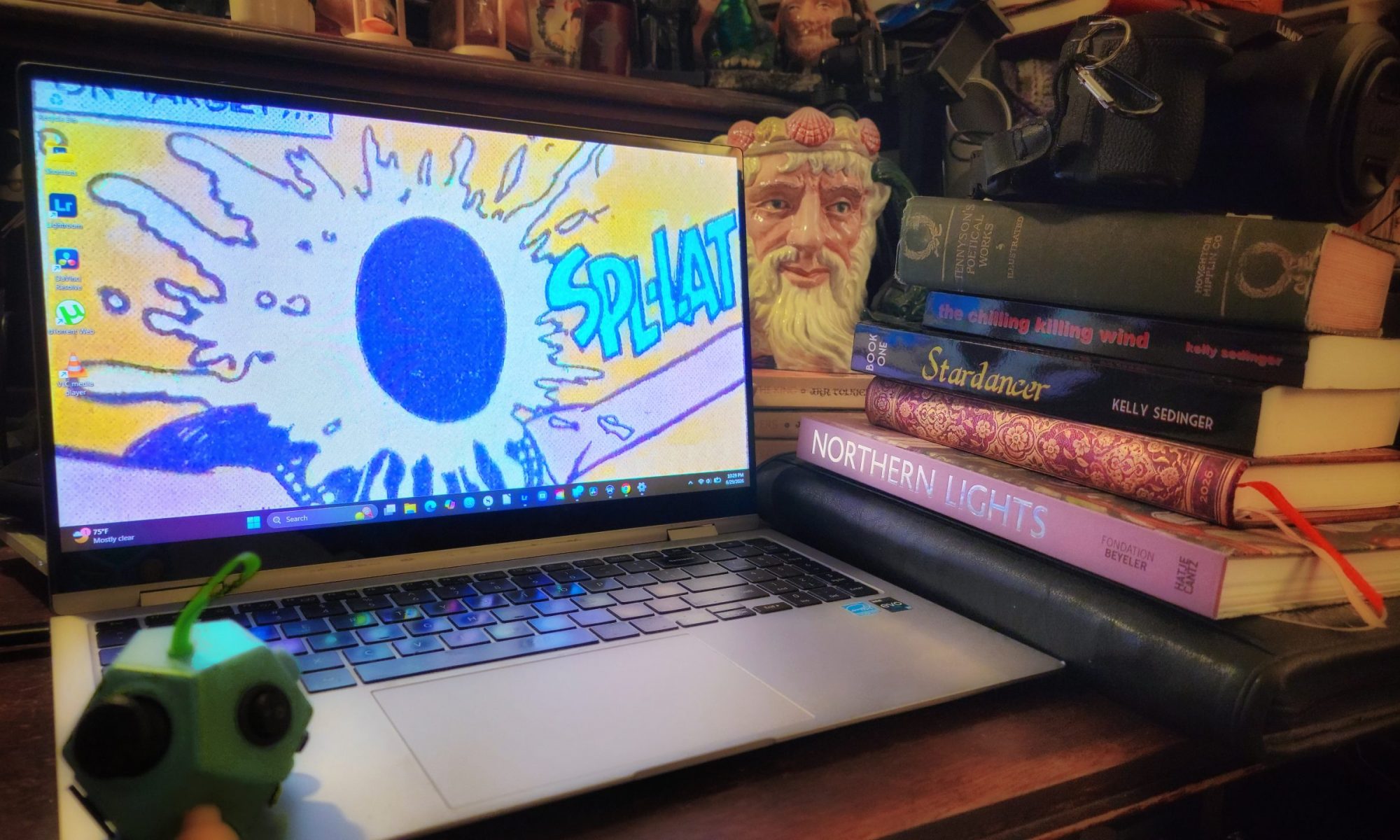
Luckily, I have a surplus of USB-C cords for just such an occasion.
(Not that anyone asked, but my favorite brand for such items is Anker. I have several of their bluetooth speakers, their bluetooth earbuds, two of their portable chargers, and a whole bunch of their cords.)
One of the eternal questions in relating to art is how to separate one’s feeling for the art from one’s feelings for the artist. This is not the least bit new; it’s a problem that is probably as old as art itself. There have been so very many artists whose own lives and statements fall well short of the art they produce. I find myself thinking anew, as one of the oldest and yet most irritatingly persistent of hatreds, anti-Semitism, just keeps arising again like the very worst of pennies, of Richard Wagner.
You can barely read a biography of Wagner that covers the man’s life in any depth beyond “He was born in 1813, died in 1883, and wrote operas” without confronting what a staggering boor he was, a fact which…
…[shit]…
You know what, to hell with that. I love Wagner’s music, but I don’t want to write about Wagner right now, not when my country’s discourse is once again mainstreaming awful crap about the Jews again.
Let’s talk about Jewish composers instead. We’ll start with Alfred Schnittke.
Schnittke, of whose music I am mostly ignorant, was a Russian composer of Jewish and German ancestry. I’m sure that particular blend of ethnicities and nationalities made for some strife in his life. He was born in 1934 in Russia, and started his musical education in 1946, after the war and after the Holocaust. Not long after, he moved along with the rest of his family back to Russia, where he lived for most of the rest of his life. Thus he had to toil in the air of state control that was the artistic scene in Soviet Russia, until he finally left for good in 1990. Schnittke died in 1998.
His music–and I am going on reference here, rather than my own personal insight–is influenced early on by the great Soviet composer Dmitri Shostakovich, but later on in his life, as great artists do, he developed his own sound and voice. It’s a voice I know little about. So many voices to hear, so little time!
This work is a ballet called Sketches. In a sequence of twenty-two short pieces, Schnittke puts on display a great deal of sardonic wit, seemingly poking fun at the entire proceedings. He even goes so far as to quote or reference other classical composers along the way, and his use of rhythm and color are infectiously amusing. One of the segments even utilizes a spoken-voice part, which threw me off the first time I heard it; at first I thought one of my other open tabs had stumbled upon a voice recording.
As a former Pizza Hut employee who spent four consecutive Halloweens becoming a nervous wreck driving pizza deliveries around town, please allow me to appeal to your humanity on this matter:
DO NOT ORDER PIZZA DELIVERY TONIGHT!!!
Seriously. Just don’t.
Halloween is a terrible night for pizza drivers. It’s a nerve-wracking night to be driving, with many children and families walking around in low-visibility situations. If you want pizza for an easy dinner, please order takeout early and grab it on your way home.
If you just have to order delivery, please take the drivers’ safety concerns into account and lower your expectations as far as delivery times go. Don’t give them shit about how it took 45 minutes, and tip them well. (You should tip them well anyway, but tip them even more tonight.)
And if you’re ordering delivery but you’re not giving out candy so you’ve got your light turned off so that the driver has to try to figure out which house is yours while they’re trying to not hit small children…well, that’s just being a straight-up jerk. Don’t be this person.
Look, folks, Halloween is why God invented frozen pizza, and we’re doing amazing things in the frozen pizza department these days. (Seriously! Try one of these. Or one of these! You’ll be happy you did!) Just get one of those and leave the overworked delivery folks out of it.
With the arrival of cooler weather comes the appetite for hearty crock-pot dishes, and a favorite of ours is good old chili! As I write this, the chili is crockpotting away in the kitchen; as you read this, we’ve already eaten a bit of it. With some cornbread!
(I’ll have to supplement this with a white-chicken-chili recipe I’ve found, next time I make it. And I also want to do Cincinnati Chili sometime this year, which I love and haven’t made in years.)
And now, the post:
I saw this pic on someone’s Instagram story last week and it made me laugh, because when it comes to food, I think I may be part-Southerner, in a lot of ways.
I have no idea whose IG account this is from! If you recognize it, let me know and I’ll credit!
The first pot of chili of the season is a big deal for me! I love chili. I love making it. I love how easy it is to make. I love how versatile chili is in the way you serve it. You can do so much with the leftovers over and above eating re-heated bowls of chili for the next four days. So yes, as a Northerner*, I get it!
Now, I make no claim that my way of making chili is “authentic” or “definitive”. Chili is like pizza or sandwiches: subject to enormous variety in how it’s made, from ingredients to flavor profile to cooking techniques used. I don’t even make one kind of chili! I have a recipe that I recently found to my liking (after trying several over the last few years) for White Chicken Chili, and I also love Cincinnati Chili, which is its own thing entirely, being at its root more of a thick chili-like meat sauce with Middle Eastern flavors enhancing sweetness rather than spiciness.
By way of some food history, here’s an excerpt from what Jeff Smith**, the “Frugal Gourmet”, wrote about chili in his cookbook The Frugal Gourmet Cooks American:
Most Americans think that the wonderful rich, beefy, and beany dish that we call chili came from some other culture. Mexico, perhaps, or Spain. Not so. I am afraid that both Mexico and Spain refuse to have anything to do with what we call good old American chili. One Mexican cookbook even goes so far as to scornfully describe chili as “A detestable food with a false Mexican name sold in the United States from Texas to New York City.” Hey, watch that! The rest of the country loves chili, too!
The original dish is truly American, though I have found that a lot of Americans in different locales think that it was invented in their backyard. After much research (two days) I have come to the following unquestionable decision. Chili was invented in San Antonio, Texas, in 1840. It was a blend of dried beef, beef fat, chili powder and spices, and salt. It was pressed into a brick and it was so potent that it would not spoil quickly. It was then taken by the prospectors to the California gold fields. There it could be reconstituted with water and cooked with beans. It was very much like the pemmican that had been used in earlier times but with spices added….
San Antonio has the distinct privilege in history of laying claim to “Chili Queens”. These ladies had little carts and tables and would appear late in the evening and sell chili and whatnot…I expect more whatnot was sold than chili. They were forced to close down in 1943 due to city health regulations of some sort…mostly sort.
I would have thought that all of Texas would have been involved in wonderful chili. But in 1890, when chili arrived in McKinney, a town just north of Dallas, all blazes broke loose. It seems that some wayward ministers claimed that chili was “the soup of the devil–food as hot as hell’s brimstone.” I wonder if these clergy ever bothered to taste a good pot of chili.
Well, isn’t that to be expected. Show me something, anything, being enjoyed by someone, and I’ll show you some tight-assed cleric who thinks it’s evil or the Devil’s work or some bullshit.
Anyway, I fully expect that most of you have your own method for making chili. I don’t say “recipe”, because I honestly believe that one should have a basic chili method that is so ingrained that the idea of referring to a recipe is simply nonsensical. Here is mine. Now, while I note above that I do make other kinds of chili, this is what I make when I simply say that I’m going to make “a pot of chili”.
This is a dish for the crockpot. We own two; for this I use our smaller one. I have no idea what the size is in terms of quarts. Into the crockpot (spray it first with cooking spray!) go the following:
1 can crushed tomatoes (28oz)
1 can diced tomatoes (15oz)
1 can black beans (rinsed)
1 can dark red kidney beans (rinsed)
1 can “chili” beans in sauce (not rinsed; I like Bush’s)
Half (or so) of one bottle of commercial chili sauce (I buy my store brand)
Hot sauce. No idea the measurement. I pour a bunch in and taste it. This is how hot sauce should always be used in recipes. If a recipe specifies an amount of hot sauce, ignore it.
I try to buy the “No salt added” versions of those first four canned ingredients, but it’s not a deal-breaker.
Here’s what all this looks like, if you want to see a picture of a crockpot full of cans of stuff that’s red:
Chili stuff. In the crockpot.
Obviously you can use a can of whole tomatoes, if you like your tomatoes in bigger chunks, and obviously you can change up the beans. I like a blend of beans and I like a lot of beans in my chili.
Meanwhile, into the frying pan goes:
1 onion, diced
However much garlic seems reasonable, and then double that
1 lb ground meat
Several tablespoons chili powder
(Sometimes I add 1 bell pepper, diced, if I have it on hand. Today I do not.)
Well…hold on. That all doesn’t go in at once. Heat up the pan, then add a few tablespoons oil and then the aromatic veggies. (Add the oil to the hot pan. As long as we’re talking about the Frugal Gourmet, remember his rule: “Hot pan, cold oil, foods won’t stick.” This actually works.) I like to saute the onion, garlic, and optional bell pepper on a high heat for a minute, and then reduce the heat to medium to sweat the veggies for a few additional minutes before I add in the ground meat.
Now: what ground meat to use? Sure, you can use ground beef or pork or whatever, but I prefer hot (or spicy) pork breakfast sausage (Bob Evans is a fine brand, and I’m not just saying that because The Wife and I both worked for Bob Evans at points in our lives), because you get more flavor this way. Remember Alton Brown’s commandment for stews: Never miss an opportunity to add flavor! Get it in there and start breaking it up with your spatula, splitting the chunks up as you go. Oh, and a minute or so after the meat’s in there and has started browning? Dump in the chili powder. A lot of it. The color of the stuff in the pan should noticeably change.
I generally stop breaking up my meat chunks when they’re about the size of a marble, because I like the meat in my chili to be in large pieces. (I’ve even done chili with stew beef, which is quite tasty. If you do that, flour and brown the meat before anything else, then set aside and re-introduce to the pan after you’ve sweated the aromatics.)
Here’s what the action in the frying pan looks like:
The frying pan part of making chili. And really, why don’t chefs wear overalls? I always wonder this. They’re perfect attire for cooking: protective, lots of pockets for stuff, and you can even hang a towel from the hammer loop.
Then what? Well, it’s obvious: Put the frying pan stuff in the crockpot with the rest of the stuff.
Into the pot!
Stir! Stir! Stir! (Actually, you don’t have to get super-aggressive about mixing the stuff up. Just a few gentle folding stirs should do it.)
Stir it up, lid it up, set the pot on low for, I dunno, six or seven hours. I like to crank it to high in the last hour, but that’s just me. The Wife makes fun of me for this (“How can I tell you if I like it? You served me a bowl of molten lava!”), but I’ve seen her send back way too many bowls of soup in restaurants for not being hot enough, and I am not making that mistake. Top it with cheese, or not. Sour cream, or not. Guacamole, or not. Chili is the pizza of stuff-that-comes-in-bowls, when it comes to versatility. (Stay in your lane, pizza! I don’t care if Steve Martin’s first movie The Jerk has a joke about the local “Pizza In A Cup” place.)
I’m writing this post, by the way, while we’re still two hours out from eating, so I don’t have a picture of a bowl of chili yet. Stay tuned. My stuff works great for chili dogs, though! And poured atop a bed of Fritos! And though I’ve never tried it, I always think it would taste good as an omelet filling.
And that’s how I make chili. Believe me, folks: a crockpot filling the house with wonderful aromas, be it chili or something else (the natives are already starting to clamor for Mississippi Roast!), is one of the finer pleasures that the autumnal time of year can give.
* By “Northerner”, do we mean anyone north of the Mason-Dixon line, or more along the lines of the Northeast? Because Buffalo is more a Great Lakes area. That’s a thought for another time, I suppose.
** Yes, I know. But I still own his books, I learned a whole damned lot about cooking from his books and his shows, and he’s been dead for years. I grant that he was a problematic sumbitch and will not litigate it here.
UPDATE: Since I wrote this last year, a lot of the old Frugal Gourmet shows have turned up on YouTube. This is always an ephemeral thing, but I also can’t entirely fathom anyone making this big of a copyright stink over forty-year-old cooking shows featuring a guy whose career was ended by a ghastly scandal. Here’s the episode on chili. (And yes, I’ve watched a bunch of his old episodes. His episode on Philadelphia has me planning on making pepper pot soup sometime this winter, once I get myself to an actual butcher shop and buy some tripe.)
I don’t entirely understand what Coca-Cola is doing with these new “weird” Coke flavors, but I will admit that I genuinely like this one.
That’s the current version. I don’t know if it tasted like a “dreamworld” or not, and like the others it’s hard to actually describe the flavor. This one tastes, to me, like someone dissolved a pack of Smarties candy in the Coke. I know that is probably not a terribly enticing way to describe this stuff, but…yes, I like it. Quite a bit, actually. The last couple flavors I enjoyed through single bottles purchased here and there, but the Dreamworld stuff? I bought a ten-pack of the little cans. And I might get another!
Oh, and I’ve decided that the little cans, the 7.5oz ones, are my preference for this sort of thing. I don’t really need 20oz of cola, or even 12 anymore. Seven-point-five is the perfect amount for me to scratch this itch, when I feel like a cola. (I’m also firmly a fan of the “zero sugar” sodas that are coming along now. Many of them are almost indistinguishable from the full-sugar sodas, and that can only be a good thing. I’ve cut down my soda consumption anyway; the major portion of my carbonization intake now comes from sparkling water.)
If the attitudes in Ancient Rome had anticipated attitudes on 21st century America, I suppose they would have razed the Coliseum after just a few decades because the rich and powerful–Brutus and Cassius, say–could have made more money on a newer venue farther out from the city core. But no, the Romans built a sports venue that would last them for centuries and whose stone guts would still be standing over 1500 years following the fall of their Empire.
Meanwhile, in the US we have absurd situations like the Atlanta Braves and Falcons, both of whom are playing in spiffy new stadiums built in the last couple of years, replacing aging venues built…in the 1990s. At least Chicago still has Wrigley and Boston still has Fenway…but here at home, in my neck of the woods, the Buffalo Bills are gearing up to start construction on their new stadium. (And this is literally my neck of the woods: we live less than two miles from Highmark Stadium, current home of the Bills, and the new facility is set to be built across the street from the current stadium, basically taking the stadium and the parking lots and flip-flopping them.)
Renderings for the New Bills Stadium (which I’m sure will sell naming rights to some local company so it’ll end up being a boring corporate-sounding name) were released the other day, all over news media and social media in the 716:
My reaction? Meh, whatever.
Look, it’s fine. It’s nice. Stadiums (stadia?) nowadays all tend to have this futuristic-shiny thing going on (exceptions exist–I do like the way Indianapolis’s Lucas Oil Stadium ended up), and architectural diagrams always make new buildings look shinier than they do in real life; that outside rendering up top looks less like a building and more like a Ralph McQuarrie concept-art painting for a 21st century remake of Close Encounters of the Third Kind. The field rendering? It’s fine. It’s a stadium. Inside, they all kind of look the same, because there’s really not a whole lot new you can do with a football field and 60-70,000 seats around it. It’s interesting that according to the scoreboard the Bills are beating the Jets 24-3, and according to the Gigantic Teevee Screen, the Bills are playing a home game in their white uniforms. Other than that, my basic reaction is “Yup, that’s a stadium.”
Do the Bills need a new stadium? Not exactly, in the sense that the current one is still perfectly capable of hosting games (they’re having one tomorrow night!), it’s not crumbling, et cetera. But in the sense of “Can the NFL, the Bills’ owners, and some others make a shit-ton more money than they already are if they rebuild?”, then the answer is, “HOLY SHIT YES, AND THEY CANNA BUILD IT FAST ENOUGH!!!” Which just happens to be what the answer always is, here in our era of Late-Stage Capitalism.
The worst part is the price tag that will be assessed not on the team’s owners, who are worth over 5 billion dollars, but on the public. This new stadium is supposed to cost well over 1 billion dollars, and it’s yet another example of the rich not being asked to pay entirely for the thing they want. So in a state and community with out-dated schools and infrastructure and loads of impoverished citizens, we’re spending over a billion dollars on a building that will help people who are already rich beyond comprehension get even richer.
I could rant about this, but at my vantage point of 51 years, I’ve given up on this sort of thing. If there is a point at which Americans become so sick of being fleeced by the rich that they start setting up the guillotines in the city squares, I’ve no idea what that point is. It’s tough shit, ’cause that’s just who we are as a country. We’ve equated “freedom” with “thank you sir, may I have another”, when it comes to the rich being showered with advantages they hardly need.
A while back the big debate around here wasn’t whether to build a new stadium, but where. Many people wanted it in downtown Buffalo, or as close to downtown as possible. The most frequently-mentioned site was a spot just off I-190, the main highway that accesses downtown Buffalo, where a bunch of mostly-abandoned buildings once used for public housing now stand. The arguments were that the stadium in that spot would benefit from downtown’s hotel availability and transit systems. Now, hotels I can maybe see, as there are a lot of new hotels in the downtown Buffalo area. (So much new hotel space that I often wonder why we have so much of it, given our city’s old, dilapidated, and entirely-too-small convention center that is in desperate need of replacing but probably won’t be for at least a decade now.) Transit, I’m not at all sure about. Yes, there are more bus lines in the city than all the way out to the suburbs, but that’s all there is, unless Buffalo’s Metro Rail system was somehow extended to the new stadium. (Our Metro Rail, built in the late 1980s, is literally a straight line. It was intended to be the start of a good regional light rail system, but nothing has ever been done to add to the original line.)
Building way out in Orchard Park isn’t awesome, but it makes sense on some other grounds. First, the site is shovel-ready; no demolition of existing property is needed at all. The new stadium is literally going onto the parking lot of the old one. There are lots of hotels kinda-nearby, but the area surrounding the stadium itself is not exactly a hotbed of lodging activity; just about any hotel is probably ten to fifteen minutes away. Public transit isn’t fantastic out here, either, with just a few stops that are meant more for commuters than for consistent access to and from the city. And sadly, neither of those is likely to change as long as the population of The 716 remains in its current neighborhood. Increased transit and lodging density aren’t going to happen unless this region starts growing its population in a major way again. (Which might happen longterm! Especially as climate change really starts digging it its heels. But it won’t happen fast enough to benefit the stadium.)
So, the new stadium will still be a place almost entirely accessible by car or bus or RV or whatever. It will still be a big building on a bigger piece of land with another big piece of land next door to house all the vehicles and such. In Buffalo, tailgating is a major part of the Bills’ fan experience; a downtown stadium would almost certainly have made tailgating mostly a thing of the past, at least as we know it now. Tailgating will survive now, so…yay. (This is the fanbase that drunkenly jumps through folding tables, so I won’t say that I was much swayed by nostalgic appeals to tailgating.)
The other big debate about the stadium was whether or not it should have a dome. As you can see by the renderings, the current design is not domed, which you might think a surprise given how the weather around here can be. Now, as always, it’s worth the eternal Buffalo-rejoinder about our weather: “On average it really isn’t that bad in winter here, you just hear about the few times it does get really bad, and anyway, it’s spring that’s massively unpleasant here, winter’s fine.” And yes, all of that is true. And while more teams play in enclosed stadiums now than ever before, there are still hold-outs that play in the open air in northern climes: the Packers, Steelers, Browns, Giants-Jets, and Patriots all play in open-air stadiums. It’ll be fine here, especially if, as built, it’s got a bit more cover than Highmark Stadium, which somehow manages to surround you with concrete and make you feel more exposed to the elements.
And with the “What, no dome?!” reactions come the real pie-in-the-sky dreamers, the ones who say (and yes, they really do say this), “But if it’s not a dome, then Buffalo can’t host a Super Bowl!”
Oy.
Look, folks. Buffalo could build the single-greatest domed stadium in the history of such venues. They could build it right downtown, and give it a Metro Rail spur with a station right there in the building. They could build it within walking distance of all those nice new downtown hotels…and Buffalo would still be unable to host a Super Bowl.
Like it or not, Buffalo for all its charms and all the work it’s doing to try to reverse its sixty-years of bad economic and demographic fortune is simply too small to host an event as big as a Super Bowl. One person actually said to me on Twitter, “How is Buffalo too small? Stadiums can only set 70000 people. It’s not like the stadium doubles its capacity for the game.” It’s almost like it comes as news to these folks that the Super Bowl brings quite a few times as many people to the host cities as can attend the game. I found an article indicating that when Atlanta hosted Super Bowl LIII in February 2019, more than half a million people flooded the city.
Buffalo, at this time, simply does not have the hotel stock or transportation infrastructure for a week-long influx of that many people. The most recent illustrative example is Jacksonville, FL, which hosted Super Bowl XXXIX in 2005. Jacksonville is often cited as the worst host city of the last couple decades; most famously, that city’s lack of hotel stock at the time was addressed by docking cruise ships in the city’s harbor to act as temporary hotels. And Jacksonville is a city that’s three times the size of Buffalo, in terms of population. (I think it’s obvious that docking cruise ships in Buffalo’s harbor in February is simply not gonna happen.)
So, summing up, my reaction to all this stadium talk is basically, “Sure, OK, looks fine, I’m sure it’ll be a lovely place to see a game if you can afford it, we shouldn’t have to pay for it but we will, and can we please knock off the Super Bowl-hosting talk? Anyway, Go Bills.”
Producer Jules Bass died the other day. If the name isn’t immediately familiar, it’s because people are probably more familiar with his name in the context of his partnership with Arthur Rankin, Jr, known as Rankin-Bass. Those two produced some of the classics of animation in the mid-to-late 20th century, including Rudolph the Red-Nosed Reindeer. For me, the best thing they did was their animated adaptation of The Hobbit, in 1977. I remember watching it on teevee, and then a year or two later going to a screening of it with my sister at our local library. (This, I believe, was when we lived in Hillsboro, OR.)
I’ve watched a lot of Rankin-Bass stuff over the years, but that adaptation of The Hobbit ranks with Star Wars in its influence on my tastes after I saw it. I suspect that my love of epic fantasy starts right there, with that film; a few years later I would read the actual book and notice all the material left out: Beorn, the whole matter of the Arkenstone, and the foreboding stuff regarding Gandalf and his concern about “the Necromancer” (who would later turn out to be Sauron, a.k.a., Sir Not-Appearing-In-This-Film). But that animated film really does The Hobbit justice in a lot of ways: it gets the tone and feel right, capturing Bilbo Baggins’s reluctance to go with these thirteen dwarves and one wizard on “an adventure”: Hobbits just don’t do that sort of thing! And yet, on some level, Bilbo actually not only wants to go on the adventure, he’s excited by it, and before long the various travails have Bilbo turning out to be the most resourceful person in the entire party.
It’s interesting to me, looking back, to note the very short length of time–just a few years long–in which I was exposed to so much of what would guide me in all the days since. In just a handful of years came Star Wars, Tolkien via the animated The Hobbit, Superman: the Movie, and at the end of that run, in 1981 or so, I read John Bellairs’s The House with a Clock In Its Walls. In the middle of that was Moonraker, and my introduction to James Bond. And through all that, my sister was a burgeoning musician, so I heard a lot of classical music in that period…and John Denver was a huge star…and on and on and on. An entire life of tastes and obsessions, kindled within three, four, five years or so. Jules Bass was a big part of that.
In his memory, here is the title song from The Hobbit, “The Greatest Adventure”. It’s really quite a fine song, in that late-70s folkish kind of way; it’s somehow both wistful and optimistic at the same time.
I know I’ve been doing “autumnal” music this year instead of “spooky” or “scary” music, but this one really does fall into both categories, and it’s one that I post every year this month anyway, so here we are: that wonderfully brooding The Isle of the Dead, by Sergei Rachmaninoff. This piece is so wonderfully magical in Rachmaninoff’s downbeat way, starting from the very opening when the 5-4 time feels like the oars rising and falling awkwardly. Then the rocking of the waves starts…and the work’s real drama and emotion kick in, leavened with Rachmaninoff’s trademark lyricism and the way he can make musical passages yearn and yearn and yearn before they finally reach a kind of resolution, not unlike the mustering of the sea before the waves break upon the cold sand.
I love this piece. Here is The Isle of the Dead by Rachmaninoff.
Here’s something that I’ve been thinking about all day. It’s a video of Senator Ted Cruz cheerfully walking up the aisle at Yankee Stadium, as Yankee fans make their opinions of him loudly known, right to his face.
There’s a LOT of very salty language here, so be careful…but what gets me here is Cruz’s demeanor here. He looks like he’s having the time of his life and that he’s surrounded by loved ones and supporters who can’t get enough of him or his presence…and nobody, not one single solitary soul, is the least bit happy to see him. At all.
I get that politicians have to cultivate a thick skin and all, and that this sort of thing is probably par for the course sometimes. But there’s just something about Cruz here that…how can I put this…it’s like he has a mental ability to simply remove it from his perception. He’s acting as if he genuinely doesn’t even notice this reaction. It’s not the mean enjoyment of it that wafts from Mitch McConnell’s body like a putrid death-stench; Cruz doesn’t strike me as enjoying being this hated. He strikes me as being completely unaware of it.
I guess this isn’t terribly surprising, given his history of sycophantic groveling and his cheerfulness as he spouts complete and utter nonsense that is so redolent of bullshit it often stuns other people in their tracks as they try to parse together enough of his absurdities to amount to something easily refuted. But this just really puts it front and center. He’s looking around, grinning and waving when the only people around are the ones shouting obscenities at him; he looks like he’s trying to shake hands with nobody who is offering their hand in return.
Someday, when the historians chronicle this period we’re being dragged through like prisoners in a chain gang, there will be entire chapters dedicated to attempting an explanation of Ted Cruz. If I were writing such a history, the entire chapter would simply be this:
CHAPTER 22: SENATOR TED CRUZ
That was some weird shit and there is no explanation for any of it.
They don’t make coliseums like they used to….
If the attitudes in Ancient Rome had anticipated attitudes on 21st century America, I suppose they would have razed the Coliseum after just a few decades because the rich and powerful–Brutus and Cassius, say–could have made more money on a newer venue farther out from the city core. But no, the Romans built a sports venue that would last them for centuries and whose stone guts would still be standing over 1500 years following the fall of their Empire.
Meanwhile, in the US we have absurd situations like the Atlanta Braves and Falcons, both of whom are playing in spiffy new stadiums built in the last couple of years, replacing aging venues built…in the 1990s. At least Chicago still has Wrigley and Boston still has Fenway…but here at home, in my neck of the woods, the Buffalo Bills are gearing up to start construction on their new stadium. (And this is literally my neck of the woods: we live less than two miles from Highmark Stadium, current home of the Bills, and the new facility is set to be built across the street from the current stadium, basically taking the stadium and the parking lots and flip-flopping them.)
Renderings for the New Bills Stadium (which I’m sure will sell naming rights to some local company so it’ll end up being a boring corporate-sounding name) were released the other day, all over news media and social media in the 716:
My reaction? Meh, whatever.
Look, it’s fine. It’s nice. Stadiums (stadia?) nowadays all tend to have this futuristic-shiny thing going on (exceptions exist–I do like the way Indianapolis’s Lucas Oil Stadium ended up), and architectural diagrams always make new buildings look shinier than they do in real life; that outside rendering up top looks less like a building and more like a Ralph McQuarrie concept-art painting for a 21st century remake of Close Encounters of the Third Kind. The field rendering? It’s fine. It’s a stadium. Inside, they all kind of look the same, because there’s really not a whole lot new you can do with a football field and 60-70,000 seats around it. It’s interesting that according to the scoreboard the Bills are beating the Jets 24-3, and according to the Gigantic Teevee Screen, the Bills are playing a home game in their white uniforms. Other than that, my basic reaction is “Yup, that’s a stadium.”
Do the Bills need a new stadium? Not exactly, in the sense that the current one is still perfectly capable of hosting games (they’re having one tomorrow night!), it’s not crumbling, et cetera. But in the sense of “Can the NFL, the Bills’ owners, and some others make a shit-ton more money than they already are if they rebuild?”, then the answer is, “HOLY SHIT YES, AND THEY CANNA BUILD IT FAST ENOUGH!!!” Which just happens to be what the answer always is, here in our era of Late-Stage Capitalism.
The worst part is the price tag that will be assessed not on the team’s owners, who are worth over 5 billion dollars, but on the public. This new stadium is supposed to cost well over 1 billion dollars, and it’s yet another example of the rich not being asked to pay entirely for the thing they want. So in a state and community with out-dated schools and infrastructure and loads of impoverished citizens, we’re spending over a billion dollars on a building that will help people who are already rich beyond comprehension get even richer.
I could rant about this, but at my vantage point of 51 years, I’ve given up on this sort of thing. If there is a point at which Americans become so sick of being fleeced by the rich that they start setting up the guillotines in the city squares, I’ve no idea what that point is. It’s tough shit, ’cause that’s just who we are as a country. We’ve equated “freedom” with “thank you sir, may I have another”, when it comes to the rich being showered with advantages they hardly need.
A while back the big debate around here wasn’t whether to build a new stadium, but where. Many people wanted it in downtown Buffalo, or as close to downtown as possible. The most frequently-mentioned site was a spot just off I-190, the main highway that accesses downtown Buffalo, where a bunch of mostly-abandoned buildings once used for public housing now stand. The arguments were that the stadium in that spot would benefit from downtown’s hotel availability and transit systems. Now, hotels I can maybe see, as there are a lot of new hotels in the downtown Buffalo area. (So much new hotel space that I often wonder why we have so much of it, given our city’s old, dilapidated, and entirely-too-small convention center that is in desperate need of replacing but probably won’t be for at least a decade now.) Transit, I’m not at all sure about. Yes, there are more bus lines in the city than all the way out to the suburbs, but that’s all there is, unless Buffalo’s Metro Rail system was somehow extended to the new stadium. (Our Metro Rail, built in the late 1980s, is literally a straight line. It was intended to be the start of a good regional light rail system, but nothing has ever been done to add to the original line.)
Building way out in Orchard Park isn’t awesome, but it makes sense on some other grounds. First, the site is shovel-ready; no demolition of existing property is needed at all. The new stadium is literally going onto the parking lot of the old one. There are lots of hotels kinda-nearby, but the area surrounding the stadium itself is not exactly a hotbed of lodging activity; just about any hotel is probably ten to fifteen minutes away. Public transit isn’t fantastic out here, either, with just a few stops that are meant more for commuters than for consistent access to and from the city. And sadly, neither of those is likely to change as long as the population of The 716 remains in its current neighborhood. Increased transit and lodging density aren’t going to happen unless this region starts growing its population in a major way again. (Which might happen longterm! Especially as climate change really starts digging it its heels. But it won’t happen fast enough to benefit the stadium.)
So, the new stadium will still be a place almost entirely accessible by car or bus or RV or whatever. It will still be a big building on a bigger piece of land with another big piece of land next door to house all the vehicles and such. In Buffalo, tailgating is a major part of the Bills’ fan experience; a downtown stadium would almost certainly have made tailgating mostly a thing of the past, at least as we know it now. Tailgating will survive now, so…yay. (This is the fanbase that drunkenly jumps through folding tables, so I won’t say that I was much swayed by nostalgic appeals to tailgating.)
The other big debate about the stadium was whether or not it should have a dome. As you can see by the renderings, the current design is not domed, which you might think a surprise given how the weather around here can be. Now, as always, it’s worth the eternal Buffalo-rejoinder about our weather: “On average it really isn’t that bad in winter here, you just hear about the few times it does get really bad, and anyway, it’s spring that’s massively unpleasant here, winter’s fine.” And yes, all of that is true. And while more teams play in enclosed stadiums now than ever before, there are still hold-outs that play in the open air in northern climes: the Packers, Steelers, Browns, Giants-Jets, and Patriots all play in open-air stadiums. It’ll be fine here, especially if, as built, it’s got a bit more cover than Highmark Stadium, which somehow manages to surround you with concrete and make you feel more exposed to the elements.
And with the “What, no dome?!” reactions come the real pie-in-the-sky dreamers, the ones who say (and yes, they really do say this), “But if it’s not a dome, then Buffalo can’t host a Super Bowl!”
Oy.
Look, folks. Buffalo could build the single-greatest domed stadium in the history of such venues. They could build it right downtown, and give it a Metro Rail spur with a station right there in the building. They could build it within walking distance of all those nice new downtown hotels…and Buffalo would still be unable to host a Super Bowl.
Like it or not, Buffalo for all its charms and all the work it’s doing to try to reverse its sixty-years of bad economic and demographic fortune is simply too small to host an event as big as a Super Bowl. One person actually said to me on Twitter, “How is Buffalo too small? Stadiums can only set 70000 people. It’s not like the stadium doubles its capacity for the game.” It’s almost like it comes as news to these folks that the Super Bowl brings quite a few times as many people to the host cities as can attend the game. I found an article indicating that when Atlanta hosted Super Bowl LIII in February 2019, more than half a million people flooded the city.
Buffalo, at this time, simply does not have the hotel stock or transportation infrastructure for a week-long influx of that many people. The most recent illustrative example is Jacksonville, FL, which hosted Super Bowl XXXIX in 2005. Jacksonville is often cited as the worst host city of the last couple decades; most famously, that city’s lack of hotel stock at the time was addressed by docking cruise ships in the city’s harbor to act as temporary hotels. And Jacksonville is a city that’s three times the size of Buffalo, in terms of population. (I think it’s obvious that docking cruise ships in Buffalo’s harbor in February is simply not gonna happen.)
So, summing up, my reaction to all this stadium talk is basically, “Sure, OK, looks fine, I’m sure it’ll be a lovely place to see a game if you can afford it, we shouldn’t have to pay for it but we will, and can we please knock off the Super Bowl-hosting talk? Anyway, Go Bills.”
Go Bills, indeed.