Symphony Saturday

Now a more obscure composer, and a symphony that’s not a traditional symphony! Hooray!

Karl Goldmark was a Hungarian composer whose music was quite popular in its day, but not as much since. He’s one of those composers who isn’t quite good enough to make the “standard repertoire”, but he’s also too good to deserve being heard as infrequently as he is today. He lived a long life (1830-1915), and he wrote a lot of music, and what little I’ve heard of it is genial music in the fine Germanic tradition of his day. I suspect that Goldmark’s obscurity today results from a usual source: he was a very skilled composer who nevertheless never seems to have really pushed the limits of the art of his day. That all sounds very unfair, to be honest, which is why I’m featuring Goldmark today. I myself only encountered him via the local classical radio station on the drive home one day, when the announcer said something like, “If you’re a casual fan of classical music, it’s possible you haven’t heard of this composer, who was very popular in his day!” I suppose Goldmark might be considered a latter-day Salieri.

Anyway, the Rustic Wedding Symphony consists of five movements, the first of which is a theme-and-variations rather than a traditional sonata-allegro movement. The five movements are titled March, Bridal Song, Serenade, In the Garden, and Dance. The structure is reminiscent of Berlioz’s approach to the symphony, but there are no supernatural demonic forces at play here, just good, jovial Hungarian music.

This particular recording is an older one, but it’s vibrant and fun to hear. So go check out some Goldmark! He’s waiting.


Next week…I don’t know. I haven’t decided yet!

Posted in Uncategorized | Tagged | Comments Off on Symphony Saturday

Bad Joke Friday

(via)

Posted in Uncategorized | 1 Comment

It’s #AuthorLifeMonth!

There’s quite a wonderful thing going on in the Instagram world this month! It’s one of those daily photo challenges, but this one — hashtagged #AuthorLifeMonth — is geared specifically to writers, as a way of showing off a little of who they are and what they do. And of course I’m participating! I’ll feature my photos for that tag here, throughout the month.

Day 1: Your Books. Here are mine, on my own shelf! How cool is that.

Day 1, #AuthorLifeMonth: My books! If all goes according to plan, there will be four this time next year!

Day 2: Author Pic. I’ve used a different author pic on each book thus far; this is the one I used on the back of The Wisdomfold Path.

Day 2: My author photo. #AuthorLifeMonth (This is my second author photo, used most recently on THE WISDOMFOLD PATH. Thus far I've chickened out on using a pie-in-the-face photo as an author pic!)

Day 3: Your Last Five-Star Read. This one was a little trouble, because I don’t give five stars very often at all. (I’m talking Goodreads ratings here.) For me, five stars is for those few, rare books that are life-changers; books that would be on the list for books I hope I have with me when my ship crashes on that lonely island. I only have a few five-star entries on my Goodreads roster, and of those, none are ones that I’ve read recently. So I went with my most recent addition of a five-star book:

Day 3 of #AuthorLifeMonth: Last 5-star read. I reserve 5 stars for those books that become part of me. I read this many years ago, but I return to it often. Richard Halliburton was an adventurer and writer from the first decades of the 20th century, and h

That is a wonderful book! It’s perfect for a lazy Sunday afternoon of reading.

Day Four: Your WIP. Heh! I have two WIPs right now, one that I’m editing (Forgotten Stars III), and one I’m drafting (Lighthouse Boy). One’s a physical copy, and the other exists as a Scrivener project.

Day 4 of #AuthorLifeMonth: My WIPs. Top is the manuscript to FORGOTTEN STARS III, which I'm editing. Bottom is the Scrivener corkboard view of THE ADVENTURES OF LIGHTHOUSE BOY (not the actual title), which I am still drafting (and likely will be for years

More of these to come throughout the month!

Posted in Uncategorized, Writers, Writing | 1 Comment

Something for Thursday

I watched the movie High Society over the weekend (it’s on Netflix!). I grew up with this film, in some ways, because it is a favorite of my parents’. Oddly, it took years before I saw it all the way through and in correct sequence, because if you grew up with movies on teevee (usually late-night or on independent stations), you typically saw movies chopped up, with entire scenes missing and sometimes out of sequence. It wasn’t until home video that I saw High Society as it was made.

How is it? Well, it’s good. I like it, but it doesn’t hold up as well as I’d hoped. It’s a literal remake of The Philadelphia Story, but converted into a musical, featuring Bing Crosby, Frank Sinatra, and Louis Armstrong as the main musical attractions. (Grace Kelly sings briefly, and Celeste Holm joins Sinatra in a song, but that’s all for “outside” talent.) The songs are all great, and the acting is pretty well top-notch, even if I’m not sure that Crosby and Kelly are really cut out for the types of roles they have here. In fact, I generally tend to the belief that whatever charms Crosby had — and they were many — being a romantic lead wasn’t totally in his wheelhouse. Plus, the story suffers a bit as key scenes from the original Philadelphia Story script are omitted in favor of songs. And then there’s a general whiff of period-realistic sexism. I’m generally good at maintaining my sense of period, but some of this stuff really rankles me (and bugged me as a kid, in all honesty). When Seth Lord says: “What most wives fail to understand is that their husband’s philandering has nothing whatever to do with them!”, I just want to punch the guy in the kidneys.

But…oh, those songs! Here are a few. First is Bing Crosby with “Samantha”. In the movie, Crosby plays a songwriter, and this is apparently one of his tunes:


Then “Now You Has Jazz”, as Crosby explains the makings of jazz to the rich folk of Newport, RI:


Earlier in the movie, Frank Sinatra and Celeste Holm have this wonderful comedic song, “Who Wants To Be A Millionaire”. They are reporters sent by a gossip magazine to cover Grace Kelly’s wedding, and they’re getting a big inside look at the lives of the rich.


And finally, my favorite song in the film. Crosby and Sinatra are at a party, both have had too much to drink, and this song happens. From what I read recently, this song actually got put into the film during production when someone pointed out that they had Bing Crosby and Frank Sinatra in the same movie and yet they hadn’t thought to include a duet for them. I love the last lines here: “Have you heard / it’s in the stars! / Next July, we collide with Mars!”

Posted in Uncategorized | Tagged | 1 Comment

Ayup….

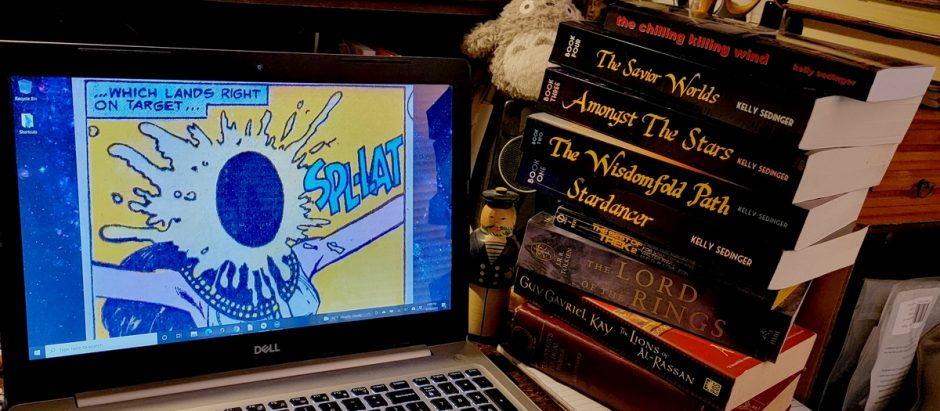
Sometimes it feels like this:

Posted in Uncategorized | Tagged | 2 Comments

I Am No Writer

I posted this image last week to Instagram, and someone asked about it:

An important distinction. #amwriting
 

What do I mean by this? Why would I claim to not be a writer, but rather a storyteller?

What I mean is simply this: I am more focused on the final product than I am the process. Writing is the job; writing is the work. There’s nothing at all wrong with that, because the writing is necessary. But sticking with my metaphor from my post about first drafts, I find it helpful to maintain my focus not on the laying of the pipe or the pouring of the foundation or the running of the wires, but on the final product: the house. Or, in my case, the story.

It’s the story that’s why I’m doing all this. It’s the story whose needs I have to service. It’s the story that I have to do well. It’s the story that readers will hopefully care about, and it’s the story that I hope will bring them back for the next one.

One can write a lot of things without being a storyteller. Writing is a skill with a lot of possible end goals, and the process can lead in a lot of different directions. And I do think about process a lot — in fact, I’ve yet to meet a writer who doesn’t! But in terms of defining who I am, I choose to focus on the goal and not the process.

Mine is storytelling.

What’s yours?


Posted in Writers, Writing | Comments Off on I Am No Writer

Symphony Saturday

UPDATE: Original video replaced, as the video I had used first was removed, for some reason….

Yes, I forgot to post this last week. This whole “two major writing projects in full force at once” thing is working out well for the two projects, but not so much for the poor blog. But anyway!

Here we have Brahms’s fourth, and final, symphony. This one is the most brooding of the four, and I always find that it feels “bigger” than it actually is. There’s an epic scope to this symphony that I think partly outstrips the amazing Symphony No. 1, and a more overall sense of mystery to this work. Brahms plunges us into melody right away, with no introduction whatsoever, and it’s a melody that seems to be always try to catch its breath as it yearns upward and falls back. (We’re in E minor, by the way, which seems to be a favorite key of mine. Lots of folks swear by D minor, and there’s a lot of wonderful music in D minor, but E minor is at the heart of some music that is very near and dear to me.)

The second movement, the slow movement, opens with a “stately brooding” theme, intoned by the horns. In doing a bit of homework for this post I learned that this theme is in what’s called a “hypophrygian” mode, but in all honesty…at this distant remove from my musical education, I honestly can’t say what that means. “Modes” are similar to scales, but they generally pre-date the development of our now-familiar major-minor scale system, so when we hear modal music, it tends to sound somewhat otherworldly in our ears, as if from a far deeper time than music we’re accustomed to.

This symphony’s third movement is one of my favorite things Brahms wrote. It’s the only straight-up scherzo in any of his symphonies (although some of his third movements have scherzo-like sections). Brahms eschews the traditional triple-time for this scherzo, though, choosing instead to use a simple 2/4, and he writes the opening theme so it descends twice onto a portentous chord, which has the effect of stopping whatever momentum we start with. This stop-start feeling that winds through the movement is Brahms at his infrequently-genial best.

Then there’s the fourth movement. Brahms breaks away from the symphonic pack again here, abandoning sonata or rondo forms in favor again of something older: a passacaglia. Now, again, I’m not entirely clear anymore on what a passacaglia is — it involves a series of variations over a repeating pattern in the bass. It’s a demanding movement and not really the easiest of listens, in terms of its form, but it is amazing nonetheless, what with those shimmering opening chords and then the start of the variations, immediately afterward.

Brahms’s symphonies are full of hard moments, but just as many wonderful ones. Years ago, when conductor Semyon Bychkov was finishing his tenure as Music Director of the Buffalo Philharmonic Orchestra, he concluded his final season with all four Brahms symphonies over two programs. I was fortunate to attend both programs, and that deep delving into the symphonic language of Johannes Brahms was one of the more deeply satisfying musical experiences I remember.

Here is Brahms’s Symphony No. 4 in E minor.


Next week: something a little more obscure…and waiting in the wings, a Czech master….

Posted in Uncategorized | Tagged | 1 Comment

Bad Joke Friday

I bought the world’s worst thesaurus yesterday. Not only is it terrible, it’s terrible!

Posted in Uncategorized | Tagged | Comments Off on Bad Joke Friday

Slipped the surly bonds of Earth

Challenger.

Thirty years ago, today.

Posted in Uncategorized | Tagged | Comments Off on Slipped the surly bonds of Earth

Something for Thursday

I have two writing projects going on at once, which somewhat feels like this:

Posted in Uncategorized | Tagged | Comments Off on Something for Thursday