Tonight, whilst walking the dee-oh-gee, the sky was somewhat remarkable.


That is all.
Tonight, whilst walking the dee-oh-gee, the sky was somewhat remarkable.

Some random thoughts on recent Star Wars stuff (or not-so-recent Star Wars stuff that is nevertheless new to me:
As Episode VII draws nearer and nearer, we are seeing more groundwork being laid for the fictional state of affairs in the Star Wars universe, with only the new materials being produced from this point on being considered “canon”, along with the original films and the Clone Wars animated series. I assume that Episode VII will be written so as not to assume knowledge of everything that’s already happening, but the non-film media stuff has been essentially rebooted, with a lot of new stuff scheduled to come out soon (or has come out already, in the case of many comics).
The first big release appears to be a novel by Chuck Wendig, called Aftermath. In this book, we apparently get to see the shifting in Galactic politics after the defeat of the Empire at Endor. Starwars.com has released a sample of the new book, and I did read it. My reactions?
Well, it’s definitely well-written. It moves along briskly and sets up some story stuff that I’m curious about pursuing. However, there are a couple of tonal issues I have. The first is pure taste on my part: Wendig writes the novel in present tense, and quite frankly I have never liked present tense in my fiction. It takes some very good writing indeed to pull me into a story that’s been written in present tense. I don’t know why this is, but it’s just the way I’m wired.
Slightly more troubling to me, though, is the tone of the story. We begin with the celebration on Coruscant and the toppling of the Emperor’s statue, which is shown to us at the very end of Return of the Jedi (the Special Edition, that is). In the movie, we cut from this back to the party on Endor. Wendig, though, reveals that while we’re watching friends hug Ewoks, smile at Force ghosts, and then listening to the music as the end credits roll, the remaining forces of the Empire are cracking down and the people have to arm themselves with chunks of stone from the statue to defend themselves. I suppose that’s a logical thing to assume happening, but…I don’t know. There’s something about the tone of Wendig’s excerpt that makes me worry about the grimdarkification of Star Wars. Gritty fighting in the streets amidst political chaos is a fine trope, but I’m just not sure it’s the kind of trope I look for in Star Wars, which is to me about the mythic and the fantastical.
But we’ll see. It’s entirely possible that I’m wrong. It is just a short sample, after all.
And then there’s the video footage that was screened by the Star Wars people at San Diego Comic Con. It amounts to something of a third official trailer for Episode VII, and here it is:
So why the “Yay! Practical effects!” cheerleading in the video? Well, this is where the conspiracy-theorist in me comes out. I wonder if this isn’t code-speak for Star Wars fans who hated the Prequels. One of the most common complaints about those movies (unfairly, in my mind) is the overreliance on CGI, so I’m wondering if all that talk about practical effects isn’t just the current Star Wars producers’ way of saying to the fans, “It’s OK. We got this. George Lucas isn’t involved. We’re giving you what you want.” I’m getting this faint whiff of this movie, and the Star Wars stuff to come, as being fan service to those who hate pretty much everything since 1980.
Another piece of evidence here? In an interview apparently consisting of yes-no questions, JJ Abrams was asked if there are midichlorians in the new movie. He said “No”. Now, that’s not in itself a bad thing; if there’s no story reason for midichlorians to be mentioned, then they shouldn’t be mentioned. To maintain otherwise would be similar to demanding that every Star Trek story must include Klingons. But many of the articles (case in point) I’ve read on this have taken exactly the tone that bothers me: “It’s OK, we’re going to ignore as much of what George Lucas did as we possibly can.” This might be wishful thinking on the part of the people writing these articles, but JJ Abrams and the rest of the Episode VII crew have not exactly been expending great effort to suggest any admiration for the Prequel Trilogy at all, which reinforces, in my mind, the idea that the goal is to let those films be “out there” but pretty much ignored completely. And that irritates me.
(Besides, people tend to be spectacularly wrong about the damn midichlorians, anyway.)
Let’s see, what else? I watched thirty minutes or so of a documentary called The People vs. George Lucas, which is pretty much what it sounds like: an exercise to air complaints about George Lucas. The first fifteen or twenty minutes are fairly benign, providing something of a background on the degree to which Star Wars has shaped culture the last 38 years. A little of this goes a long way, but there it is. However, about twenty to twenty-five minutes in, we get to the complaints, starting with the Special Editions. After about five minutes of listening to people bitch about Han shooting first, I turned the thing off and didn’t watch the rest. These complaints were just embarrassing to listen to. One guy said something about how it was like George Lucas gave us all the best coloring books as kids but then he showed up and took away our coloring books and…come to think of it, that complaint might well have been when I stopped watching. It was so nonsensically over-the-top, and the tone was so persistently whining, that I just wanted to punch everybody in the movie.
And I agree that Lucas should never have changed that scene.
The degree, though, to which “Han shot first!” has become a shibboleth amongst Star Wars fans is kind of creepy to me, though. Leave me out of it.
So I shut the documentary off, well before it could get to the Prequels.
However, the news is not all bad or troubling! Years ago, when The Phantom Menace first came out, there was a series of articles on Space.com called “The Phantom Heresies”, which delved into that film’s mythic structure (under the assumption that it actually did not suck ). I greatly enjoyed those articles, which shaped a lot of my thinking about the Prequels over the years, including when I wrote the “Fixing the Prequels” series. Well, it turns out that the person who wrote those articles, one Paul Hamilton, has a blog called The Star Wars Heresies. I’ve started dipping into it, and it’s interesting stuff, albeit from a more academic-style viewpoint than I usually take when writing about this stuff. Hamilton also wrote a book on these same types of issues, which I will probably check out at some point. (It’s a bit on the expensive side, even for an ebook, but I’ll get it eventually.) And from his blog I found another, The Star Wars Prequel Appreciation Society, which also seems to be full of interesting stuff. (I’ve not dug much into it yet.)
Let’s see, what else? Not much, really. Just waiting for the new movie and to hear what John Williams does with the music. I hope that the disturbances I’m feeling in The Force come to nothing, but you never know….
Oh, and this is a pretty nifty image (from the international trailer for The Force Awakens):

Some things I’ve seen the last week or so….
:: Bill Altreuter reflects on a visit to Gettysburg:
I believe the United States has as its chief value in the world its aspirational qualities, and I believe that those qualities are best expressed in the Constitution and its supporting documents, particularly the Federalist Papers. The Constitution, a living document, is, like all scripture, flawed. The 3/5ths Rule, for starters was the seed for the horrors of the war I’ve spent the weekend thinking about, but we spent the next century plus– up to and including now, today– addressing the problems created by the country’s economic dependence on chattel slavery in an incomplete and unsatisfactory manner. It’s great that we have the 14th Amendment, but it would be a far better thing if we had more Supreme Court Justices that believed that the 14th Amendment means what it says.
:: Briana Morgan opens up about depression and how it affects her writing career:
I’ve been battling the blues since I was seventeen. As days of sadness turned into weeks and months and even years, I tried to wrap my mind around this new reality. When would I feel better? When would I be cured? Would the existential loneliness ever go away?
(Briana is one of an increasing number of awesome writers I’ve met on Twitter and Instagram. Seriously, she’s really great.)
:: Roger meditates on Hiroshima and Nagasaki:
Regardless, I was never convinced that the United States should be the first country to drop the bomb. The sheer devastation, not just immediately but in the aftermath, troubled me.
(I confess that I’ve always believed the “party line”, that the A-bombs had to be dropped to keep the war from grinding on into an awful, bloody, hellish 1946. I also confess that my belief in such is not informed by the closest reading of history.)
:: Sheila O’Malley on the anniversary of American Bandstand:
Dick Clark was no dummy: he made sure the show was aired in the afternoon, right when kids got home from school. It became Appointment Television for American teenagers. You could watch new music, hear new artists, see your favorites perform, and participate in the frenzy of rock ‘n’ roll, which was still exploding, outward and outward and outward, a Big Bang Theory of culture. Elvis had already moved on, his explosion was so powerful (Martin Sheen made the comment that Elvis reached the sun – what was it like up there? Who else knew but Elvis?), but many many more followed in his wake.
(I don’t remember ever watching Bandstand, but I’ll read Sheila writing about anything.)
:: John Scalzi points out, yet again, that GamerGate consists largely of dummies:
Seriously, though. How these people get through life without poking their eyes out with spoons is entirely beyond me.
(Ayup. I’ve yet to encounter anything from GamerGate that isn’t flecked with frothing stupidity.)
:: SamuraiFrog on the death of Rowdy Roddy Piper:
Man, he’s only a year older than my Dad. That’s hard to think about. I can’t imagine what his family is dealing with right now. He was just a piece of my childhood puzzle, you know? Sad, sad news.
(I have to admit this: I had no idea who Piper was, even as he died. It’s not uncommon for me to be totally unfamiliar with this or that famous person’s work when they die, but Piper took me aback, as I watched people on Facebook — friends of mine I know reasonably well — openly mourn his passing as a part of their childhoods. I had to wonder, increasingly, just how I’d managed back then to be so unplugged from the wrestling world that I literally couldn’t remember ever hearing of this man, who seems to have generated an awful lot of good will in his time here on Earth.)
:: Cal is unimpressed with Donald Trump.
Conclusion – Trump is a maniac that can’t be dealt with like a rational human being. His ego is writing checks that his butt can’t cash at this point.
:: Jennifer is not impressed with what her dog did to her glasses.
This. This is a photo of me with my now fixed glasses.
(I’ve broken two pairs of glasses in my life: one when I stepped on them in second grade, and one in college when I slipped on ice and landed flat on my backpack with the glasses inside.)
:: Lance Mannion is impressed with the rowing team he watched.
The coach finished talking and the crew set to work again. The scull took off and I ran out of room to chase after them anymore. But if I could have, I might have followed them the whole nine miles upriver to Poughkeepsie if that’s how far they were going, it was that thrilling to watch and that pleasant to be be outside and if not on the water then at least by it.
:: Lynn is not impressed with somebody’s rules for eating hot dogs.
I use whole wheat buns. Is that okay, Your High-and-Mightiness? I haven’t seen any sun dried tomato or basil buns but I would try them. Then they tell us the exact order in which the condiments must go on the hot dog. Sorry, I put the onions on first, then the chili. And I’m right; the Hot Dog Council is wrong. Putting the onions on first keeps them from falling off.
(She’s right. Onions on the bottom. I put chili on top, though…and when I have a chili dog, I eat it out of a bowl with a fork because that’s how I roll.)
:: Abby Hathorn is impressed with her new pair of vintage overalls.
On my last trip to Nashville, I stopped by this lovely little vintage shop called The Hip Zipper. There, I picked up bunches of new-old goodies, but the piece I am most excited about is my Liberty overalls!
(Abby Hathorn is another writer I met on Twitter and Instagram. She’s primarily about fashion, and she writes about clothes and fashion with an infectious sense of fun. She really likes color and variety, which is really cool, and she does not think it’s impossible to look good in overalls. Oddly, I do not own any pairs of Liberty overalls. I should probably rectify that at some point…they were the staple brand worn on Hee Haw, which we watched a lot when I was but a wee bairn, and which may well be a big part of my lifelong fascination with overalls. Hmmmm…I honestly don’t remember, but I wonder if there was pie-throwing on that show….)
Blogistan is still a nice place, even if nobody goes there anymore!
I’m sure you’re all just dying to know what my current tools for writing are. Wonder no more! Head over to the Official Site and find out!

What writer doesn’t like talking about process? Let’s talk process! Specifically, the tools I use.
For years, I’ve been a dedicated OpenOffice user. My reasons for this, at the outset, were anything but high-minded devotion to the open-source software model. No, it was purely self-serving: Around 2003 or 2004, I was still using Microsoft Office for Windows 95, which was increasingly out-of-date and lacking in newest features. If I recall correctly, the feature Office for Windows 95 that bugged me the most by its simply not being there was support for a mouse’s scroll wheel, but I may be wrong. In any event, I decided that it was time to update my office software, and at the same time, I learned of the existence of OpenOffice. After reading up on it a bit, and determining that it would suffice for my needs and the price was right, I made the switch, and I’ve used OpenOffice as my main writing software ever since.
Until now.
And not only have I made the switch from OpenOffice, but I have now adopted not one but two primary writing programs.
Why would I do this?
In general, I have never been unhappy with OpenOffice, and I still recommend it to anyone looking for a free office suite. However, there were aspects of its functionality that I discovered weren’t ideal, especially as I started ramping up to the publication of Stardancer. Formatting is very important, and if you’re independently publishing, the task of formatting falls squarely on you. This became a source of a number of headaches – all minor, thankfully, but still not easy to navigate. First, most of the tutorials you find out there on how to format your manuscripts for Kindle Direct Publishing or for CreateSpace assume that you are using Word, and thus they provide instructions for Word only, which means that you then have to do some research to figure out how to get the same effect out of OpenOffice. That brings me to the second problem I discovered: the processes for formatting correctly in OpenOffice are often not nearly as easy as the processes to accomplish the same tasks in Word.
Here’s an example: one standard of formatting manuscripts for submission to publishing markets is that you don’t use “smart” quotation marks (the ones that curl one way at the start of a quote and curl the reverse way at the end of it); you use “dumb” quotes which are just little straight marks that don’t quote at all. This being the case, I’ve been in the habit for years of using dumb quotes in all my writing, and in fact, I didn’t even think about it until I got my proof copy of Stardancer in the mail, opened it up, and recoiled in horror from the dumb quotes in the book. I’m honestly not entirely sure why the standard for submission format is dumb quotes, but the fact is, that in print, dumb quotes look like shit. So I had to change the dumb quotes to smart quotes – every single one of them in the book.
Now, I remember doing this in Microsoft Word, years ago. There, it’s strangely easy. You change the setting to “Use smart quotes” or whatever it is, and then you do a find-and-replace, with a quote in the “Find” field and an identical quote in the “replace with” field. Somehow Word knows to go through and swap all the dumb quotes for smart ones, and it gets them right, putting the left-quotes and right-quotes where they should be. You then do the same thing with a single quote in the find-and-replace box, and Word goes through and swaps out every apostrophe of single quote you have. This is some terrific functionality.
Unfortunately, this functionality doesn’t exist in OpenOffice, so you have to engage a more cumbersome process of using the additional fields in the find-and-replace tool. You have to use “regular expressions” and you have to pretty much do a separate operation for every right-quote and every left-quote. It’s also easy to screw this operation up, which can result in some bad things that you then have to root out.
The quotes thing is one issue, but there were a number of similar issues with OpenOffice that made formatting for self-publishing a right pain in the arse. Now, moving forward, I’ve pretty much stopped using dumb quotes, but that doesn’t help the manuscripts that already exist which still need to see the light of day. But when most instructions for getting things done ignore the platform I’m using, and when a lot of these tasks are more cumbersome than I want them to be, something’s gotta change. I’m planning to release a lot more stuff into the wild over the next few years, and OpenOffice isn’t ideal for my needs.
Further, I’ve learned that OpenOffice will likely not be seeing as much updating and revision in the future, for various licensing reasons that I don’t entirely understand, while a newer open-source suite called LibreOffice, which is originally an offshoot of OpenOffice, will likely see a great deal more innovation moving forward. Here’s an article that explains the situation, and here’s an article that outlines some key differences in functionality between the two suites. I’ve already adopted LibreOffice as my office productivity suite of choice. Here’s what LibreOffice’s word processor looks like:

Now, thus far I haven’t noticed a whole lot of difference, since LibreOffice and OpenOffice share common ancestry. But there are some nice touches that I do like a lot: your word count is always visible in the bottom toolbar, for example, and the find-and-replace tool shows up as a new toolbar in the footer, as opposed to a pop-up window that obscures the work. LibreOffice uses the same file formats as OpenOffice, and to my eye, its Writer program has a much cleaner look. Sadly, LibreOffice’s quotes-fixing works pretty much the same way OpenOffice’s did, which is why I’ve adopted another program for writing and producing books and such.
That program is Scrivener.
[Insert sound of giant weight hitting the earth here.]
If you’re a writer, and if you share the fact that you’re a writer online and interact with other writer-folks on social media, very quickly you will start hearing about a program called Scrivener. Scrivener changes lives. It revolutionizes. It makes everything better. Scrivener is the Disney World of writing programs: it’s the happiest place on Earth, man.

At least, that’s what I’m told. I’ve been using it for nearly a month, which means that I’m about to exhaust my free trial of the program, at which point I’ll have to decide if I want to pony up $40 to buy the program outright. (You get a thirty-day trial with Scrivener. What’s cool is that the thirty days are non-consecutive; if you use it for the first time on Friday and then you don’t use it again until the next Friday, you’ve only lost 2 of your 30 days, not 7.) So, how’s it going?
Well, the first time I used it, I stared at it for five minutes before recoiling in horror and turning it off. Then, figuring that I needed to actually give it a shot, I launched it again and this time played with the tutorial it comes with. This helped, but not terribly much. I still spent the first few days of my Scrivener use staring at it and wondering how on Earth anyone could possibly use this program to do actual work.
I’m generally a start-and-stop kind of writer. I start writing, I write, and then I stop. I work in linear fashion, only retracing my steps when I need to: if the Muse tells me that I’ve made an error previously, either an error of omission or of simply writing the wrong thing. And I don’t outline. I just don’t, except for in certain very specific circumstances, and then in very limited fashion. I like to launch a writing program and start writing.
But here’s Scrivener, with its cork board and its “binder” and its “inspector” and…oh, the features, man! It’s like if you took someone who has only ever driven a 1975 Chevy Nova and then dropped them in the middle of downtown Pittsburgh with the keys to a 2015 Subaru Outback and said, “OK, get yourself home.” Sure, the steering wheel and the pedals and the shifter would look the same, but our marooned driver would almost certainly look around the dash and say, “Huh-whuh?!” That’s kind of how I felt about Scrivener, and even after nearly a month of getting used to it, I still find myself hopelessly confused by some of its features.
Here’s a screenshot of Scrivener, when you’re in its native writing environment:

But that’s not all! Here’s the corkboard:

Like I said, I really haven’t even begun digging into the various things Scrivener does. But I can say this: Scrivener allows a writer to take a more wide-angle view of their story’s structure, if they are so inclined. By use of the corkboard and the binder (that sidebar on the right that shows all the various chapters and whatnot), you can really see how your story is put together, and you can make changes thusly. Again, I’m not sold on all this as being useful to me, but then, I’m still very new to this program.
I do know other writers who are very much committed to outlining and who will produce detailed outlines of their entire novels (or stories or screenplays or whatever), and then they will write a scene at a time, and sometimes they will work on scenes in nonlinear fashion: ”Let’s see, what am I in the mood to work on today? Well, I need to do the scene where Our Hero confronts the villain in the Carbon-Freezing Chamber, without knowing yet that the villain is actually his father…I think I’ll write that today!” Scrivener makes doing that very easy, as you can lay everything out in terms of structure before you start actually producing copy, and then it’s all just bricklaying. This is interesting, but it’s not the way I work, at all.
However, this attention to structure does make it a lot easier to hop around for reference. Many’s the time when I’ll be happily writing along in, say, Chapter 16 of one of the Forgotten Stars books and I’ll realize I need to look something up that happened in Chapter 12. Scrivener puts Chapter 12 a single mouseclick away, which is quite useful.
Scrivener is also highly useful in that it will archive research materials and images and that kind of thing. For the Lighthouse book, I have a number of maps I drew and then digitized (by way of photographing them with my camera – the things we can do these days!), and instead of having to keep an Image Viewer program up and running, I just import those into the Scrivener project for that novel and presto! They’re available at a single mouseclick, too.
What I really like Scrivener for thus far, though, is the formatting. You can cheerfully write along and then have Scrivener automatically format your manuscript into submission style, if you want – or have it compile your manuscript into an EPUB file, which for independent writers like me is pretty dang huge. This is the main reason I got the program in the first place: because of a problem I noticed with the Kindle edition of Stardancer.
Every Kindle book is required to have a Table of Contents, so readers can get back and forth easily. And Stardancer has one. The problem is that its Table is in the book itself. This is because when I published it on Kindle, I used CreateSpace’s automated process whereby they take the files you uploaded for the physical book and base the Kindle MOBI file on them. This worked, for the most part, except for the Table of Contents. In most Kindle books, when you tap the icon in the upper left corner as you read inside a book, the resulting drop-down menu includes a Table of Contents right there, so you can access any chapter as you like. The original version of Stardancer doesn’t have this, and it bothered me. I tried figuring out how to solve the problem using OpenOffice, but this was simply not feasible. Hell, I’m not sure if the problem even can be solved using OpenOffice. Scrivener, however, is designed with the needs of independent writers at least partially in mind, and its compiler made an EPUB file which I was then able to easily convert to MOBI using another program called Calibre. (That’s all I’ve used Calibre for, which is why I’m not much talking about it here. It’s a pretty powerful program, though, and should definitely be in the indie writer’s arsenal.)
Scrivener is a powerful and impressive program. It’s also highly confusing at first, and using it effectively may require some writers to change the way they look at their own work. It’s not perfect for me, by any means. Sure, the corkboard thing looks cool, but I’m generally not one to move scenes around much, so I’m not sure how much mileage I’ll get out of that. The program’s autocorrect lacks one key bit of functionality, too: My most common typo is double-capitalization, like THis. Every other program I’ve ever used automatically fixes those, so I rarely notice that I did it. Scrivener doesn’t fix those, unfortunately; maybe a future revision will. (And maybe I simply haven’t figured out how to make Scrivener do that.)
But Scrivener does have a nifty drop-down menu whereby you can toggle every single dumb quote in your manuscript to a smart quote, and back again if you so desire!
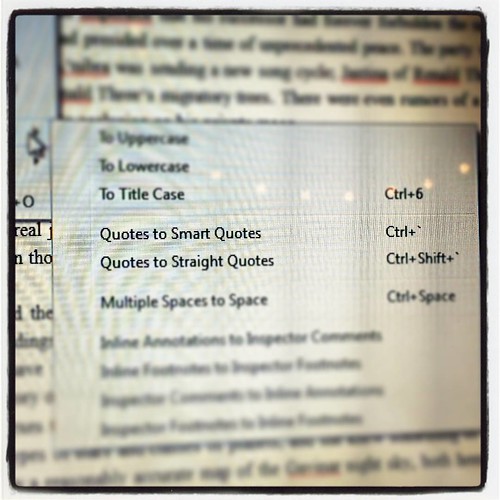
Hey, sometimes it’s the little things. And I really dig the Fullscreen mode, which really puts your current writing front-and-center:

I’m not in love with Scrivener, but hey, who knows. So far I’ve been using it on pre-existing projects and manuscripts, and that’s a pattern that will remain in place for a while. Maybe my views will shift farther in its favor as I learn more about it, use it more, and most importantly, use it to create an entire project from scratch.
But at the very least, they will be getting my forty bucks.

Some stuff:
:: Here’s a nifty video that spells out why so much of the whining about the “overreliance” on computer-generated images, or CGI, in movies today.
:: Eleven amazing clocks. Fascinating stuff here! I’m especially happy to see Pittsburgh’s Duquesne Brewery clock featured; I’ve driven past that clock many a time. It’s kind of disappointing that it is currently used as advertising space for AT&T, but hey, the clock’s still there.
:: The Mole Problem: Why Good Animists Make Good Neighbors. Great post by a Twitter peep of mine on our relationship with the animal world, in the wake of that awful killing of a lion last week.
More next week!
Who doesn’t like Gilbert and Sullivan? Dummies, that’s who. Here is a wonderful suite of melodies from the great operettas of that amazing duo, Pineapple Poll.
Hey there, folks! Just dropping by (in what I hope will be a more frequent thing) to discuss what’s going on in my World of Writing.
1. I’m still preparing for my “relaunch” of Stardancer, which will take place later this month. The book will no longer be a Kindle exclusive, which means that I’ll be able to also publish in on Smashwords, and I may also post several chapters to Wattpad. It’s time to stretch the wings a bit.
1a. When I republish Stardancer, the book will now include a small snippet of The Wisdomfold Path, as a teaser. If you’ve already bought Stardancer, worry not — I’ll be posting the same snippet here at some point soon as well. Also, as I get closer to the Wisdomfold Path launch in November, sample chapters from that book will go up on Wattpad as well.
1b. I will, at some point over the next month or two, set up a mechanism for ordering signed copies of my books directly through this site, if such a thing is desired. It will likely involve Paypal exclusively. I’m kicking around the idea of getting a PO box for correspondence and such, but I want to see what kind of market exists before I go to that much trouble. I have also ordered business cards, and a small number of bookmarks to tease The Wisdomfold Path.
2. I’ve started going through the existing chapters of The Adventures of Lighthouse Boy. I still think this book is likely to take years to come to fruition — remember, my goal here is a long, convoluted, Alexandre Dumas-style adventure — but I’m dipping into it again. I’ve already completely rewritten the first chapter. Wheeeee! This is a fun book that I want to be as rollicking and fun as possible. I may serialize this one on Wattpad in its entirety, when it’s finished. I’m thinking that sometime in the latter half of 2017 might be a logical time for that to happen. (At this point I do not have any inkling as to the actual title of this book. I never let the lack of a title stop me from attacking a story.)
3. I’ve completed the first-round edits for GhostCop (not the actual title), and beta-readers will soon be having a look at that one. My early goal for publishing that one is Summer 2016. (I also don’t have a title for this one yet, and that’s more of a problem since I want to release it in less than a year. I did think up one possible title, but the problem there is that I don’t like that title all that much.)
4. This will get its own post, but I’ve recently switched my writing software. More on that to come.
Onward and upward! Zap! Pow!!


