

The week in photos!
Something for Thursday
In the course of writing Lighthouse Boy (not the actual title), I’ve been listening to more film music lately (more than usual, anyway), with a special ear for classic scores of the Golden Age. Without doubt, my favorite Golden Age film composer is Erich Wolfgang Korngold, whose music formed the backdrop for many a fine Errol Flynn adventure. Here is a suite of his score to The Adventures of Robin Hood, played live at The Proms. (My newest addition to my “Things I Gotta Do Before I Die” list is to attend a concert or two at The Proms.)
Now there’s some swashbuckling music for you!
(And as a onetime trumpet player, I was interested in one particular practice I saw here for the first time ever (it happens at the 7:28 mark, among others): the trumpeter stretches a mask of what looks like felt over the bell of the instrument. I imagine this softens the tone somewhat, muffling the trumpet without changing the instrument’s tone outright, the way a mute does. Korngold knew his way around the orchestra, that’s for sure!)
Share This Post
On Mr. Wilson
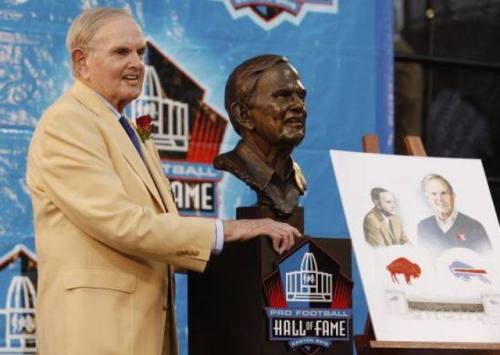
Ralph Wilson, owner of the Buffalo Bills, died yesterday at the age of 95. He was the only owner the team ever had, and, like seemingly everything else around these parts, Buffalo’s relationship with him was…complicated.
Wilson brought football to Buffalo when he decided he wanted to own a football team but the NFL wasn’t playing along, so he joined some other rich guys and launched the AFL. Somehow the new league got off the ground — even with Wilson having to loan some money to another of the owners, a guy named Al Davis, so he could get his franchise, which he dubbed “the Raiders”, off the ground — and eventually flourished to the point that the NFL just merged with the AFL, thus paving the way for the NFL as it exists today.
There would be no football in Buffalo today if not for the efforts of Ralph Wilson, and it’s entirely possible that without him, the NFL itself might not be what it is today. In the annals of football Ralph Wilson’s name might not loom so large as, say, a Paul Brown or a George Halas, but he’s no mere footnote, either.
But Wilson had his troublesome qualities as well, which were often balanced with the good. He could be difficult to work for, as evidenced by his tendency to buck heads with his own underlings. He wasn’t George Steinbrenner in this regard, but Wilson did burn more than a few bridges with good people (most famously former GM Bill Polian, who built the Bills of the early 90s and who then went on to a short stint with the expansion Carolina Panthers and then to the Indianapolis Colts, who Polian then built into one of the best teams of the 2000s). It’s generally been an article of faith that one major factor that’s kept the Bills from ever becoming a championship team was Wilson’s level of discomfort with people he didn’t know well, which kept him from ever really exploring other possibilities as far as people running the team. Thus Wilson rarely went looking outside his organization for bright, motivated people whose trajectories were on the way up.
Wilson also was one to rattle the “relocation” saber every so often, when the team’s stadium lease was coming up. He never outright said, as far as I can recall, that the team would have to move if he didn’t get his way, but the message was always pretty clear that the county-owned (and therefore taxpayer-funded) stadium would need some new stuff done to it every seven or eight years, if the team was to “remain viable in this market”. The whole NFL racket of shaking down municipalities for stadiums or stadium improvements is pretty nauseating, especially in light of the NFL’s non-profit status as it wallows in as much money as anybody has in this world. Ralph Wilson played this game to the hilt, but…he never did move the team, or even come close to doing so, and over the last twenty or thirty years, that hasn’t been the case around the NFL. Al Davis moved his Raiders twice. Georgia Frontiere moved the Rams, Art Modell moved the Browns, and of course, thirty years ago the Irsays brought in moving vans at midnight to haul the Colts away from Baltimore. It happens, but Ralph Wilson resisted the siren call of richer markets.
But on the other hand — and there’s always an “other hand” with Ralph Wilson — he also staunchly refused to publicly consider any kind of ownership succession plan that would guarantee the team’s future in Buffalo after his death. It’s become almost an article-of-faith around here that Wilson must have had some kind of “secret plan” ready to go for after his death, but…well, I guess we’ll find out now, won’t we? If he did, great. But if not…well, as radio play-by-play guy Van Miller used to say, “Fasten your seatbelts!”
Ralph Wilson never moved the team or even came close, but he did extort the county for as much money as he could. Ralph Wilson seemed cheap at times, never being mentioned at all as a guy who would spend top dollar to get the best executives or coaches, but he did shower money on a lot of players in attempts to make the team better. Ralph Wilson was one of the most important figures in the sporting history of this town, but he lived in Detroit. Like I said, it was complicated. Hey, that’s Buffalo. It’s never easy, for us.
Thanks for the football memories, Mr. Wilson. I hope you had one final trick up your sleeve, though.
Share This Post
A Random Wednesday Conversation Starter
What’s an old genre of something that you miss and you know is never coming back? For me, it’s 1970s-era variety shows. The closest we get to that sort of thing is reality competition stuff like America’s Got Talent, and those aren’t that interesting to me anymore.
(I hope this question makes sense…I was trying to figure out how to word it….)
Share This Post
Sentential Links
Linkage!
:: Overalls are everywhere at the moment. I’m loving all the new skinny jean overalls. I seriously considered investing in a pair, but I already had the overalls you see here. And no one needs two pair of overalls. That’s just excessive. (Excessive? Never! Obsessive? Well…um…moving on!)
:: I feel like I can get a glimpse of why someone might become a work-a-holic, especially in this stage of my writing career when I’m really fighting hard for my dream. Not writing seems like wasted time. There is a balance to be found for sure. (Anya Monroe has become one of my favorite writer-peeps. Check her blog out!)
:: So, did I know about Ellen Page?
Sure. Why not?
How did I know?
Same way I know most everything I know.
I read it…
…somewhere. (I didn’t know! But then…I didn’t care, either. But you know, it’s interesting to me on this basis: I tend to just assume people are straight, mainly because that’s the statistical likelihood. And then I find out they’re gay, and I’m briefly surprised, and then I invariably end up thinking, “Why do I need to know this, anyway?” I understand on one level why it’s “news” when someone famous “comes out”, but at the same time…I just don’t care. And I shouldn’t, right? Thoughts?)
:: Is it easier to write paranormal, as opposed to contemporary romance?
:: If a candidate for federal elected office cannot muster the courage or mental fortitude to be interviewed by the singular local paper covering her district, she’s fundamentally unqualified for public office of any kind. (Alan Bedenko is rather unimpressed with the birther lunatic the Republican Party is offering up for Congress in this area. What a disgrace…but then, this is the same NY GOP that begged fellow birther lunatic Donald Trump to run for Governor. Having one of our major parties be so completely insane is so bad for the country.)
More next week. Unless there aren’t.
Share This Post
Bad aim, you shall have.
You know what we haven’t had around here lately? A good old-fashioned geek-gasm! I saw this photo-essay thing on Tumblr last night:


I buy this, for the most part. There are really only two major instances of the Stormtroopers looking like boobs, in the entire Original Trilogy: when our heroes are fleeing the Death Star (and after Tarkin has signed off on Vader’s plot to let them escape so they can be tracked to the Rebel base…which is really kind of shitty news if you’re one of the four TIE Fighter pilots sent to not blow up the Millennium Falcon), and when our same heroes are fleeing Cloud City.
In the latter case, there’s only one egregiously bad instance of “Holy shit, you stormtroopers suck!”, in a very brief shot where the heroes dash across a wide room and one Stormtrooper comes along behind them and, despite his clear line of sight and lack of obstruction, misses with both shots he takes. Chewbacca turns around and with one shot puts this guy down. So yeah, that dude sucked. But for the rest of the time, the Stormtroopers don’t really have good shots on the heroes, and R2 puts up his smokescreen, so there’s that.
As for the Ewoks, this shows a nice pattern to the Imperials’ thought processes which bites them in the arse again. Remember in the first movie, during the briefing, General Dodonna points out that the Death Star’s defenses are designed against a large-scale assault, like a fleet of battleships. The Death Star is designed to go up against a bunch of Star Destroyers, and it never occurs to the Empire that anyone’s going to attack with a bunch of tiny fighters. Likewise, it never occurs to them that the primitive natives of Endor pose any threat at all, and in reality, they probably don’t. It takes Ewok numbers plus some technologically-savvy Rebels (led, in this case, by an improvising smuggler by trade) to manage to get control of things. And also, remember that the Rebel mission on Endor is not complete defeat of the entire Imperial apparatus there; they’re just looking to get in, blow up the shield generator, and get out. If they manage to do that and still leave a thousand Imperial troops alive, then they’ve still got the job done.
It’s always interesting to me how the “Big flaws in Star Wars!” always vanish if you think about them a little bit!
Share This Post
Sunday Burst of Weird and Awesome
Oddities and Awesome abound!
:: Interesting article on the Lost Art of the Unsent Angry Letter:
WHENEVER Abraham Lincoln felt the urge to tell someone off, he would compose what he called a “hot letter.” He’d pile all of his anger into a note, “put it aside until his emotions cooled down,” Doris Kearns Goodwin once explained on NPR, “and then write: ‘Never sent. Never signed.’ ” Which meant that Gen. George G. Meade, for one, would never hear from his commander in chief that Lincoln blamed him for letting Robert E. Lee escape after Gettysburg.
Lincoln was hardly unique. Among public figures who need to think twice about their choice of words, the unsent angry letter has a venerable tradition. Its purpose is twofold. It serves as a type of emotional catharsis, a way to let it all out without the repercussions of true engagement. And it acts as a strategic catharsis, an exercise in saying what you really think, which Mark Twain (himself a notable non-sender of correspondence) believed provided “unallowable frankness & freedom.”
Harry S. Truman once almost informed the treasurer of the United States that “I don’t think that the financial advisor of God Himself would be able to understand what the financial position of the Government of the United States is, by reading your statement.” In 1922, Winston Churchill nearly warned Prime Minister David Lloyd George that when it came to Iraq, “we are paying eight millions a year for the privilege of living on an ungrateful volcano out of which we are in no circumstances to get anything worth having.” Mark Twain all but chastised Russians for being too passive when it came to the czar’s abuses, writing, “Apparently none of them can bear to think of losing the present hell entirely, they merely want the temperature cooled down a little.”
That’s about it for this week. Interesting article, though, with an interesting hypothesis as to why the Internet is so often a cesspool of spittle-flecked rage. It’s not just that it’s easy to post angry missives online, it’s that the very ease of doing so negates the intended catharsis of writing them in the first place.
More next week!
Share This Post
Symphony Saturday
Of all of Berlioz’s literary muses, and there were many, none burned quite so bright in his head and heart than Shakespeare. It was through a performance of Hamlet that Berlioz first saw actress Harriet Smithson, thus inspiring his most famous and enduring work, and it was Shakespeare who inspired Berlioz to write what is, for me, his single greatest symphony and work in general. It’s his third symphony, Romeo et Juliette.
The fact that Shakespeare had such an effect on Berlioz is all the more remarkable given that Berlioz discovered Shakespeare in translation, and given that in Berlioz’s day, translation wasn’t quite so rigorous a pursuit as it is now. The focus was not so much on accuracy, and translators felt little compunction toward changing a work to suit their own ideas. The version Berlioz saw had Juliet awaken in her tomb, so that the lovers could have one last moment together before dying. Translators at that time just didn’t much care about total fidelity to a work, for good or ill. It little mattered, though: Berlioz was thunderstruck.
Nicolo Paganini had commissioned a work from Berlioz, if you’ll remember from last week; while disappointed in the result, Paganini was as good as his word, and paid Berlioz the 20,000 francs he had promised. That influx of cash gave Berlioz the financial freedom he needed to pursue his next work, which is the very symphony we are considering here. And what a work it is. Romeo et Juliette is a symphony mainly because Berlioz says it is. There are almost none of the standard features one might expect from a symphony. Instead of four movements, here we have seven (or even more, depending on how they are counted). Voices feature strongly throughout, culminating in a massive choral finale that depicts the Capulets and Montagues coming together after the deaths of their children. The work is heavily programmatic, going right down the line and basically telling the story of the play in the right order, starting with the fighting in the square and the intervention of the Prince.
With all the symphony’s uses of vocal forces, it might be surprising, then, to note that the most intimate parts of the story are depicted purely orchestrally. Berlioz never allows voices to depict either Romeo or Juliet; instead, when the lovers are called for, the orchestra depicts their moods. This results in the central section of the work, when we “hear” Romeo at the Ball (where he first sees Juliet), the love scene, and then a brilliant and effervescent scherzo depicting Queen Mab (as described in the play by Mercutio). The symphony’s use of voice is pretty much restricted to the people affected most by the two doomed lovers, but the lovers themselves are only shown in the most deeply abstract music of the orchestra itself. That level of music insight is a prime reason why I love Berlioz as much as I do.
Yes, this symphony stretches the very idea of what constitutes a symphony in the first place, but it’s not hard to see the trend continuing through music history later on. In terms of form, this work clearly anticipates Mahler by fifty years; in terms of musical depiction of drama, this work clearly influenced Wagner (who actually sent Berlioz an autographed copy of his score to Tristan and Isolde, noting his admiration for Romeo et Juliette in the inscription). All that, of course, would be of little concern were the music itself not so engaging. Berlioz tended to have an odd time with melody, and this work is no different — but the “Romeo Alone and the Capulets’ Ball” movement is its own little tone poem, and the love music here is, to my ears, utterly rapturous. Even that movement alone amazes in its construction: it begins with Romeo wandering after the ball, struck by love, and we hear the tenors offstage, singing snatches of the main dance music from the ball. But the tenors fade away, and Berlioz’s main melody eventually begins. But somehow it sounds tentative at first, as though Romeo is trying to put what is in his heart into music. Eventually, though, the lovers come together, and the music flowers.
There isn’t a single aspect of Berlioz as a musician that is not in evidence in Romeo et Juliette: his storytelling approach to music, his belief in the power of the orchestra to convey emotion, his skill at writing orchestra textures that still sound fresh to this day. While I have always discounted the notion that music can, by itself, tell a story, this work stands as the finest example I know that that doesn’t mean that story is story and music is music and never the twain shall meet. Here, story informs the music and the music informs the story. If Hector Berlioz really was only known for a single work, and this was that work, he’d be in my personal Pantheon anyway.
The symphony is so large that this performance is in three parts. There are a few complete performances on YouTube, including a very nice live one (with an annoyingly sedate audience). The three parts correspond to the sections of the symphony, which break out like this (courtesy Wikipedia):
Part I
1. Introduction: Combats (Combat) – Tumulte (Tumult) – Intervention du prince (Intervention of the prince) – Prologue – Strophes – Scherzetto
Part II
2. Roméo seul (Romeo alone) – Tristesse (Sadness) – Bruits lointains de concert et de bal (Distant sounds from the concert and the ball) – Grande fête chez Capulet (Great banquet at the Capulets)
3. Scène d’amour (Love scene) – Nuit serène (Serene night) – Le jardin de Capulet silencieux et déserte (The Capulets’ garden silent and deserted) – Les jeunes Capulets sortant de la fête en chantant des réminiscences de la musique du bal (The young Capulets leaving the banquet singing snatches of music from the ball)
4. Scherzo: La reine Mab, reine des songes (Queen Mab, the queen of dreams – the Queen Mab Scherzo)
Part III
5. Convoi funèbre de Juliette (Funeral cortège for the young Juliet): “Jetez des fleurs pour la vierge expirée” (“Throw flowers for the dead virgin”)
6. Roméo au tombeau des Capulets (Romeo at the tomb of the Capulets) – Invocation: Réveil de Juliette (Juliet awakes) – Joie délirante, désespoir (Delirious joy, despair) – Dernières angoisses et mort des deux amants (Last throes and death of the two lovers)
7. Finale:
La foule accourt au cimetière (The crowd rushes to the graveyard) – Des Capulets et des Montagus (Fight between the Capulets and Montagues) – Récitatif et Air du Père Laurence (Friar Lawrence’s recitative and aria) Aria: “Pauvres enfants que je pleure” (“Poor children that I weep for”) – Serment de réconciliation (Oath of reconciliation) Oath: “Jurez donc par l’auguste symbole” (“Swear by the revered symbol”)
Next week: Berlioz’s final symphony, which is, again, rather unique.
Share This Post
Instaweek
A brief writing update
For various reasons, the only writing project to which I can devote any time at all right now is Lighthouse Boy (not the actual title), which got stuck in a particular spot because I just couldn’t figure out where to go with it. I tried one thing, and rejected it; then I tried another, and rejected that; then I tried still a third, and rejected that. And each rejection of a particular plot direction meant deleting at least several days’ work — a few thousand words, each time out. It sucked.
But, I finally got it figured out. The solution involved a bit of retconning and refitting earlier material to give one character a skill he hadn’t had before, and figuring out how to move the tale in a new direction entirely. The book’s backstory involves a fight for the throne — because all good stories have to involve a fight for the throne — but somehow, I got myself into the situation where every way forward involved bringing that war front and center, and that’s not what I want to do. At least, not yet. I want this book to be an adventure tale like Alexandre Dumas, not a wars-of-succession tale like George RR Martin.
But, at least I’m getting the length right, in the fine tradition of Dumas (but hopefully not quite so bad as Martin). Currently the book stands at a little over 100,000 words…and I figure I’m only now nearing the one-third mark. Wow, this is going to be a doorstop!
Onward and upward!