Jean Sibelius wrote The Bard in 1913, when he was entering the late period of his compositional life. The work has little by the way of orchestral fireworks; while there is power, this is no showpiece. It is instead a work of surprising introspective depth in its short running time (about seven minutes, give or take, depending on the conductor). The mood is hushed and meditative, and somehow manages to stay hushed and meditative, even when it does crescendo toward the end.
The inspiration for this work isn’t easy to tease out. Some think it was perhaps a movement from another larger work that Sibelius decided to hold back; some have suggested a particular poem as an inspiration, which apparently the composer himself denied. There does not seem to be any direct literary inspiration to The Bard, nor does the work suggest a pastoral inspiration from the natural landscapes of Sibelius’s beloved Finland.
Perhaps Sibelius meant the work to be mainly abstract, only giving it a name out of habit…or perhaps he meant it to be more of a work of feeling than to have any particularly strong connection to some extramusical source of meaning. I don’t know, but I do know that The Bard is mystically effective in suggesting the kind of wisdom that one would expect from the itinerant poets of old. It may take a few listens to penetrate into the heart of this work: it’s not a piece that leaves a particular tune or melody lingering in the ear, like Finlandia, but its mood is what lingers. And that is almost precisely Sibelius’s point.
But let’s give a listen to something our boy Jean Sibelius wrote in 1908: a tone poem called Night Ride and Sunrise. It’s quite an evocative piece, starting with a brief fanfare figure in the brass before settling into a rhythm that suggest hoofbeats along a dark road, the “Night Ride” of our title. It seems as if we’re going to be in for a long stretch without a melody, until one arises in the upper woodwinds, playing above the rhythmic pulse; this melody yearns and stretches and yet somehow manages to stay almost in the background. Our rhythm gives way to long scalewise passages in the winds, as our texture becomes colder, stormier, more dramatic.
Eventually, though, our sunrise arrives, and it is exactly what one might expect from a Sibelian sunrise: shot through with clarity and nobility, with simple magnificence. Even here, when the chorales in the winds and brass take over, there is still momentum to spare in the continuing pulsing rhythms. I’m coming to see that for Sibelius, a blend of textures is always afoot.
Written when was 30, and thus nearing the halfway mark of his productive career, Sibelius’s The Swan of Tuonela is one movement from his Lemminkainen Suite, a collection of four tone poems that tell the story of one of the heroes of The Kalevala, the national epic of Findland. Lemminkainen undergoes a number of tests and trials, one of which is that he is tasked with killing the Swan of Tuonela. Tuonela is the land of the dead, and the swan is a mystical beast living in Tuonela’s waters. Lemminkainen tries to kill the swan, but is himself shot with a poisoned arrow and dies. He is apparently restored to life later in the story, but this particular movement is primarily concerned with the swan itself.
This work is meditative and almost without bombast of any kind, instead engaging a kind of brooding mysticism that reminds me of Rachmaninov’s Isle of the Dead. A solo English horn portrays our swan, moving with churning placidity through its mournful waters, as the orchestra sings plaintively along with it. It’s a remarkable work.
The land of Karelia is a region in northern Europe that currently comprises sections of Eastern Finland, and Northwestern Russia. Like Alsace-Lorraine between France and Germany, Karelia is a land that has been disputed for centuries, and the scene of many armed conflicts as powers east and west of it struggled to hold it. Today the region of Karelia is split in two.
Sibelius, in his early years of composing, was also fiercely invested in Finnish nationalism and independence, so he was happy to accept a commission from a students’ organization in the Viipuri province, a part of the Karelian region. At first he wrote a tableau of eleven movements, each one with a specific folk-like and rustic character designed to appeal to the nationalistic feelings of the region. Later, Sibelius condensed the larger work down to the Karelia Suite, which is one of his most enduring works.
Unfortunately, the original version of the larger tableau is lost, the score having been burned by Sibelius’s own hand. But most of the orchestral parts survived, allowing a reconstruction in the 1960s, with the missing parts being completed by Finnish musicologists. Luckily the Suite has survived. It comprises two march-like movements, brassy and bold and thrilling, bracketing a Ballade that is evocative and lyrical.
So here’s something new I’ll be trying for a bit, based on my experience in 2020. I wrote a lot last year about Ludwig van Beethoven, which was fitting since 2020 marked his 250th birthday. I don’t plan to focus on a specific composer every year (or every day or every month) for their particular anniversaries, but I did greatly enjoy spending a lot of time in a specific composer’s sound world, so that’s what I’m going to try to do for a while: spending several months focusing on a particular composer. This isn’t to say that I’ll only be listening to the music of a particular composer, but I’ll be focusing that way.
I’m going to start with Jean Sibelius.
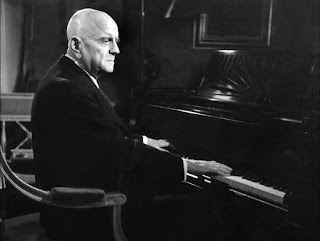
Quite a stern looking fellow, wasn’t he? (Obviously the second photo is Sibelius as a younger man. I screwed up the uploading and decided to leave it.)
Sibelius is known as Finland’s greatest composer, and there’s some good reason for that. From what I’ve read, Sibelius’s reputation has waxed, waned, and waxed again in the almost a hundred years since his main period of active composition came to an end. After the mid 1920s, Sibelius’s output dried up almost completely, and he lived out the remainder of his years–thirty of them, until he died in 1957 at the age of 91–composing little. As David Dubal notes in his book The Essential Canon of Classical Music, “[Sibelius’s] lifespan far exceeded his ability to fathom new artistic developments.”
Sibelius, like Rachmaninov (whose own long lifespan took place within the boundaries of Sibelius’s), straddled the transition from Romanticism to Modernism, and thus the transition from traditional tonality to the various systems that followed it. While Rachmaninov kept composing music that made him seem more and more anachronistic as his life progressed (though it did his reputation no harm), Sibelius’s music is more individualistic, so his reputation has had a harder time. Dubal, again:
Sibelius’s place in music history was once more secure than it is now. Around 1920 in various quarters, he was proclaimed the ideal modern composer and an antidote to the seeming chaos of Schoenberg, Stravinsky, and Bartok. But by the late 1940s, his reputation had begun to decline. The composer Virgil Thompson, listening to the great Seventh Symphony, wrote, “I do not believe for a moment that its gray and dirty-brown orchestral coloring is a depiction of either the Finnish soul or the Finnish landscape…I think Sibelius just orchestrates badly.” Thirty years later Harold Schoenberg called Sibelius “a dated bore” but conceded for him “an honorable place among the minor composers,” while giving to the Danish Carl Nielsen “as much sweep, even more power, and a more universal message.”
I cannot at this point comment on Thompson’s impression of Sibelius’s Symphony No. 7, as I haven’t heard it yet. We’ll see. And I may decide that Schonberg is incorrect; again, we’ll see. I do like Carl Nielsen a great deal, but that’s for another time.
In my college years, I only played two works by Sibelius, on the same program, in my freshman year. The big one was the Violin Concerto, which I disliked quite a bit at the time. It was a hard setting in which to get to know a piece of music, though, and I fully grant that my view at the time was very poorly informed. At that point, the orchestra in college didn’t even have a full complement of players until just before the performances, when our music director (my beloved Dr. Janice Wade) would bring in musicians from surrounding towns to fill out the group. On the one hand, I didn’t know shit, being only 17 (I certainly thought I knew shit, but believe me, I most certainly did not), but on the other hand, that’s also a very difficult scenario under which to form a fair impression of a work.
The other piece was Finlandia, which is by far Sibelius’s most well-known and popular work. It is literally a musical love-letter to Sibelius’s own homeland, and it chock full of orchestral color, some deeply exciting material (the middle section somehow feels march-like without being a march), and then a deeply beautiful hymn-like melody that sounds like a folk anthem (even though all the melodies in the piece are of Sibelius’s own invention). Finlandia has become as beloved in Finland as The Stars and Stripes Forever has to Americans, and it’s as good a place as any to enter Sibelius’s sound world. This particular performance adds a choir to the proceedings, for stirring effect.
In future weeks I’ll look at Sibelius’s tone poems (many inspired by the folk epics of Finnish legend), his symphonies, and, yes, that Violin Concerto that vexed me at seventeen. Stay tuned!