

Kusama: a farewell

For quite a few months now, the Buffalo AKG Art Museum has been maintaining an exhibition of the work of Yayoi Kusama, called One With Eternity. That exhibition has now ended, and I am sad to see it go, even as excited as I am for the next exhibit in that space.

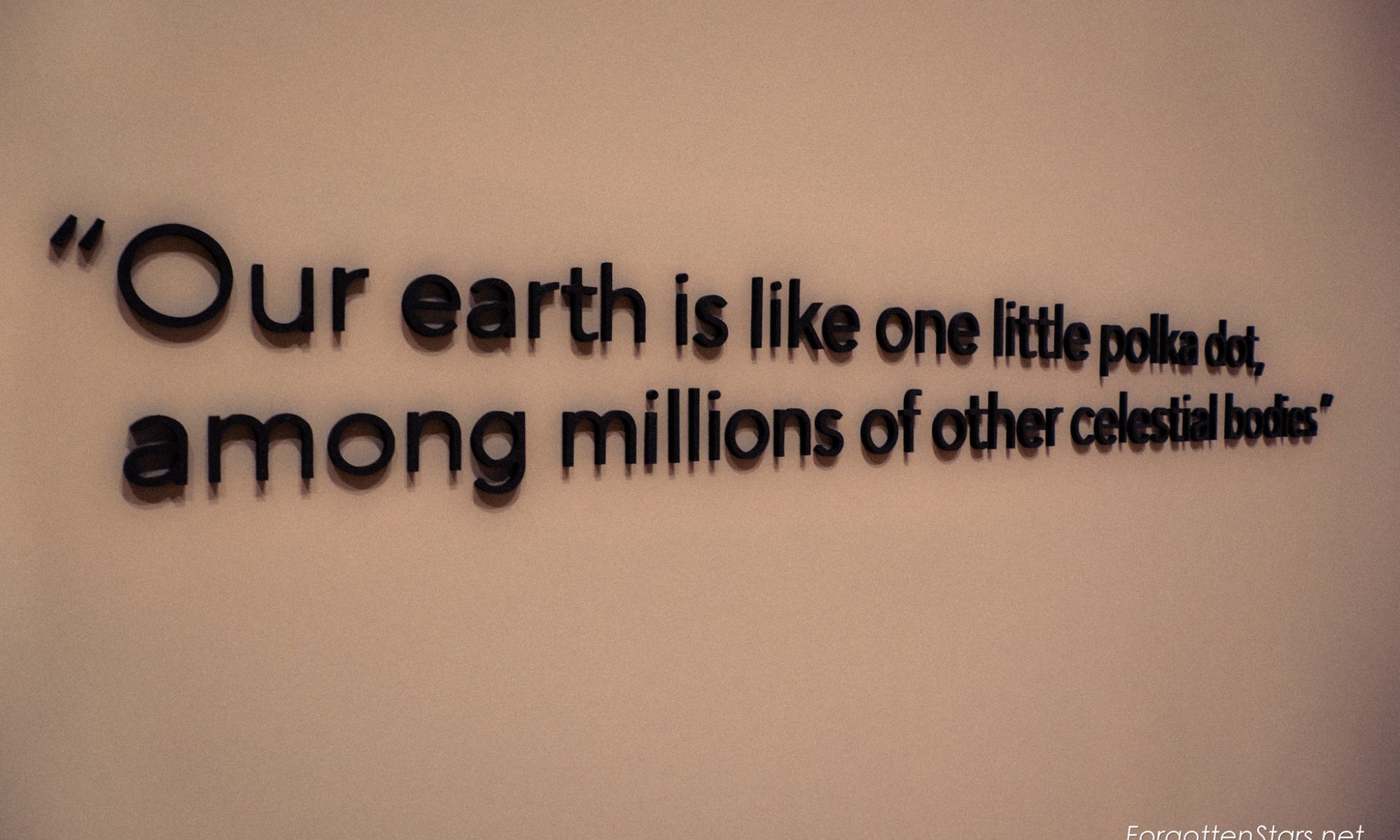
Kusama is, at 97 years old, one of the world’s most successful living artists, and her work has been shown and re-shown all over the world. One of her signatures (she has a number of them) is the “mirrored room”, in which a small room is erected in a larger room with interior surfaces covered with mirrors so that when you enter, you are presented with an infinity. The two mirrored rooms displayed as part of the One With Eternity exhibition also displayed one of Kusama’s other signatures: the polka dot, as well as thoughts on gender as one of those two rooms involved shapes that are distinctly phallic in nature:

One of the best things about the mirrored rooms–beyond the way they provoke your eye into perceiving something approaching infinity–is the way they yielded interesting opportunities for photographing that very infinity. I found this particular room challenging from that standpoint, I must admit, but I got some results that I liked.

Kusama’s use of polka dots is hardly unique to this one mirrored room. In fact, the polka dot recurred in all of the art throughout this installation:

Another recurring motif in Kusama’s work is pumpkins. Yes, pumpkins.

One entire room of the installation space was given to the display of one of Kusama’s pumpkins. Just one. But what a pumpkin it is! If you’ve never thought that the pumpkin could be a thing of grandeur, well, that’s probably because you haven’t seen Yayoi Kusama’s take on a pumpkin. And it wasn’t just set down in the middle of the room, either…or actually, yes, it was, but no easy display this. Look:

It’s hard to describe my emotions from the first time I walked into this room and saw this thing sitting there. First, the size–it’s huge! Second, the sheer absurdity–it’s a pumpkin, writ large upon the floor, almost glowing in its gigantic nature. Third–did I say “absurdity”? Well, that’s not right. This is pure whimsy. And fourth–the sheer assault on the visual sense when you entre this room was almost a force of nature in itself. All that orange, all those dots, the bright lights gleaming off the pumpkin’s burnished surface…it felt like the sensation of looking up at a sky on a cloudless night, well away from the city. The whole thing just takes you in and for as long as you’re there circling this thing, it becomes your world. This pumpkin.

I won’t be looking at pumpkins the same way this fall, this much I can promise.

I would very much like to hear from the people who do the physical work of setting up an installation like this. Are the walls, floor, and ceiling painted like that for the duration? Does Kusama have wallpaper in that pattern that is hung wherever this pumpkin goes? Floor tile? I really want to know!

(And this wasn’t the only giant pumpkin at the AKG as part of the Kusama show. This one was in another hallway entirely, waiting to be discovered. No less the whimsical, though this time feeling more like a piece of art set in a place for viewing.)

The other major part of this Kusama exhibit was another mirrored room, and this one was pure magic. If the first one, the one with the polka-dotted phalluses, was a brilliant and stark infinity, this next one was a purely dark one, dominated by colors that transitioned and shifted as you gazed into the distance. This room is one of the most amazing things I have ever seen.

The photography temptation here was intentional camera movement with a longer shutter speed:

If the first room was a bright and phallic infinity, this one was just pure psychedelic wonder. And in the first one, you couldn’t help seeing yourself as part of that infinity; in the brightness there you were, everywhere, you, repeating into the endless haze beyond the limits of your vision. This room, though, erased you. You might be able to pick yourself out in the reflection, somewhat nearby, but that was all. 

The other day I went to walk the Kusama exhibit one last time, and I saved this room for last. I could have gone back in the line to go through again, but I decided not to. I visited this exhibit five times during its run here, and when my final walk-through of that mirrored room came to an end–how short 45 seconds can feel, when you spend it staring into infinity!–I stopped on my way out. One look back, and then back to reality and the finite world.

But how finite can it be….

For all of my photos from the One With Eternity exhibit, and to see bigger versions, go here.

Share This Post

Yeah, y’all need to step it up.

We’ve all known someone who had one significant accomplishment, and then on the basis of that one achievement they enjoyed notoriety and reputation based on that one achievement, though they never managed to come close to achieving anything on that scale again, right?

Yes, I’m talking about the Ides of March.

The Death of Julius Caesar (1806), by Vincenzo Camuccini (1771-1844)

Share This Post

At the Burchfield Penney

Your Humble Narrator, in front of wallpaper designed by Charles Burchfield, at the Burchfield Penney Art Center

We were at the Burchfield Penney Art Center yesterday. This lovely museum, smaller than the AKG and dedicated to Western New York artists, is always a delight to visit. Art museums have become my favorite places to visit. What an interesting development…I always had a hard time with the visual arts until recently. I have some thoughts on this, but they are forthcoming….

Share This Post

Closer…closer….

And now, a Sequence.

Increasing detail fromĀ Fjall, by Anna Boberg (1864-1935). This painting was recently on display at the Buffalo AKG. I found its depiction fascinating by the way more detail is revealed with each step you take toward it.

Share This Post

“He’ll never amount to a thing”

From the Buffalo AKG, a painting Picasso titled “La Toilette”. Here’s the entire painting:

Larger version here.

Of course, the title of this post comes from the famous (infamous?) exchange from the movieĀ Titanic:

CAL: [scoffing as Rose’s paintings are unpacked] God, not those finger paintings again. They certainly were a waste of money.

ROSE: The difference between Cal’s taste in art and mine is that I have some. They’re fascinating. It’s like being inside a dream or something. There’s truth but no logic.

TRACY (a servant): What’s the artist’s name?

ROSE: Something Picasso.

CAL: [scoffs again]Ā  Something Picasso? He won’t amount to a thing. He won’t, trust me! [to his manservant] At least they were cheap.

Share This Post

“Self portrait”

Last week I shared a work of art titled “Self portrait”, from the Burchfield Penney Gallery.

Here’s a different “Self portrait”, this one by the great Marisol, from the Buffalo AKG:

The information placard for this piece read thusly:

This was the first of many self-portraits by Marisol that are paradoxically both multiplied and fragmentary. Although a “self-portrait”, the sculpture is composed of seven dramatically different heads atop a single wood-block body. They are accompanied by an assortment of other body parts: six carved legs, a single pair of breasts and, at the back, five pairs of variously cast, drawn, or carved buttocks. The multiple heads may allude to the many different sides of every personality and the impossibility of presenting a unified face to the world. Marisol once suggested in an interview that the last head was perhaps like Sunday, yawning with fatigue at week’s end.

I find it interesting to consider new ways of approaching what sounds like an obvious task: creating a self-portrait.

Share This Post

From the Burchfield Penney

“Self Portrait”, Ann Clark. Tufted wool, cotton, and silk.

Across the street from the Buffalo AKG Museum stands the Burchfield Penney Art Center. This is a museum dedicated to the works of Charles Burchfield and the WNY art community in general. We finally visited this lovely museum for the first time several weeks ago.

Share This Post

Something for Thursday

The Buffalo AKG Museum right now has an exhibit dedicated to “Op Art”. The museum describes the exhibit thusly:

In the 1960s, electronic media began reformatting the nature of images and how we see. Unlike static paintings or sculptures, video and digital images are dynamic and interactive, made of abstract patterns of information that are manipulated, stored, and shared as electronic signals or numerical bits of data.

At the very same moment, an emerging movement called ā€œOpā€ (short for ā€œOpticalā€) took art and popular culture by storm. Op artists use abstract patterns to create optical illusions that are dynamic and interactive, much like the electronic images of the time. Could it be more than coincidental that the curves of Op art resemble electronic video signals, or that its grids suggest pixilated digital pictures? In fact, Op art emerged at the same time as video and digital art, and many Op artists would turn to using these technologies, just as many pioneering video and digital artists turned to Op art for inspiration.

I walked through this exhibit the other day, and it was absolutely fascinating, not just for the art itself, but because it is in many ways representative of the popular art that was culturally prominent when I was a kid. A lot of this stuff was like a time capsule. I already plan to return to that exhibit again. (I took a bunch of photos, but I haven’t edited any of them yet.)

One item was a film by John Whitney Sr. calledĀ Matrix III. This was projected on a large screen that was overhanging one of the exhibit rooms. It’s an abstract animation of geometic figures moving around a confined area. Whitney is viewed as one of the pioneers of computer animation, and I have to admit a certain nostalgic feeling for the days of early computer animation, when realism wasn’t even a goal and the whole mechanistic nature of the art was what made it art in the first place.

If you’re local, I strongly recommend this exhibit! It runs until January 27.

Share This Post